The following is from a paper by Romanian scholar Ioana Feodorov, given this year at the 21st International Conference of Historical Sciences in Amsterdam. The full paper, with extensive footnotes is available as a pdf here.
Romanians and Near Eastern Arabs,
Connections through Christian Orthodoxy
Ioana Feodorov, Bucharest
[...]
At a time when Christians all over the Ottoman Empire were brought together by aspirations for freedom of belief, cultural progress and national identity, the Romanians shared with Arab Christians a special responsibility: that of being heirs of the Byzantine legacy, always present in the ritual and spiritual life of the Orthodox'. Near Eastern Churches differ in terms of their cultural features (Greek, Coptic, Syriac, Armenian, and Arab) and their attachment to the resolutions of the Councils of Nikeia (325), Ephesus (431) and Chalcedon (451) as to the nature of Christ. Of all Christian communities of Arabic expression, the Antiochian Orthodox Church, which uses the Byzantine liturgy and dates from apostolic times (alongside the other four that share this glory - Jerusalem, Alexandria, Constantinople and Rome), is the one with which the Romanian Orthodox have had close ties since the 16th century.
Though considered by Muhammad, alike Muslims and Jews, 'People of the Book' (Ahl al-Kitab), Christians were persecuted since the first Islamic century, when the population of Nagran was banished to 'Iraq. After 1516, when the Ottomans conquered the Near East, building churches was repeatedly forbidden, Christians were often forced to live isolated in certain neighbourhoods of the main cities (Damascus, Aleppo, and Mossul) and to take refuge to Mt Lebanon or the Kurdistan, while the tax applied to non-Muslims, gizya, was accompanied by a humiliating status of 'second rank citizens'. Economic difficulties and the repeated vexations from the governors appointed by the High Porte made the Christian Arabs incapable of social and cultural progress, unable to defend their spiritual identity.
In these circumstances the Antiochian patriarchs Makarios III Ibn al-Za'im (1647-1672), Athanasios III Dabbas (1720-1724) and Sylvester of Cyprus (1724-1766) took upon themselves the difficult task of preserving the Christian spirituality in its Arabic expression. The special relationship that certain Eastern Churches had with the Holy See was not encouraging: the authority of the Roman institutions often manifested itself through constraints regarding the attachment to Catholic dogmas. Arabic books printed in Italy required many approvals, lest any "doctrinal error" crept in that would have reflected the creed of a Church other than the Maronite. Biblia arabica had been conceived by Near Eastern scholars based on old local translations, in order to preserve the liturgical traditions proper to Arab Christianity: nevertheless, the Roman theologians ruled for the printing of a new translation of the Vulgata. Liturgical books freely given to the Eastern churches by Catholic missionaries were meant to replace the old Arabic manuscripts that had been used by generations of priests.
The gloomy situation of their communities convinced the hierarchs of the Antiochian Church to look for help in Eastern Europe, where they travelled in search of financial and spiritual help, beginning in the 16th century. The favourable answer that they received from Romanian princes encouraged them to embark on long and perilous journeys. The expectations of these unusual travellers relied on the spiritual solidarity and the benevolence of the Romanian rulers, who had supported the Eastern patriarchates and monasteries since the 14th century." Although kept apart by wide stretches of land and sea, the Romanians and the Antiochian Arabs succeeded in establishing contacts that resulted in important cultural acts. The situation was comparable for the Romanians and the Levantines in many respects, although they were subjected to the Ottoman domination in rather different forms. In the 16th century, acknowledging their Arab identity, Christians of the Antiochian Church (the only Patriarchate were Arabic has been used continuously as official language) aspired to replace the traditional church language-- Greek with the Arabic vernacular". At the same time Romanians were striving to move from the old ritual language Slavonic to their spoken language, Romanian: here too the necessity emerged to spread Liturgical texts through books printed in the people's vernacular.
Moreover, the ties of the Oriental Churches with Eastern Europe helped Christian Arabs assert their role as part of a civilization deeply rooted in spirituality. Unsurprisingly, present-day Lebanon and Syria, lands of many creeds and ethnic groups (with 42% of the population registered as Christian in Lebanon in 1992) were in the front line of the 19th century Arab Renaissance, Al-Nahda, born in Aleppo. Consequently, the French, English and American missionaries found in these provinces the good ground where they set up schools and printing-shops, encouraging the emergence of modern political and cultural movements. The Romanians contributed to these changes readily and fair-mindedly, acting in the spirit of their self-ascribed mission of relief for the Eastern Christian communities.
The first Arab visitor was, presumably, Patriarch Yuwaklrn Ibn Da'wu who crossed the Romanian territory in 1581, heading for Poland, and reported his passage in a poem (unfortunately lost). From 1652 to 1658, Patriarch Makarios III Ibn al-Za'im and his son, Archdeacon Paul ('of Aleppo', Ar. Bulos al-Halabiyy) travelled to the Romanian Principalities, the Cossaks' land and Russia. Athanasius Dabbas, who had temporarily relinquished the Patriarchal see of Antioch to his competitor Cyril Ibn al- Za'rm, visited Wallachia and established durable ties with the local princes and hierarchs. His disciple and successor Sylvester of Cyprus repeatedly sojourned at the princely courts of Bucharest and Iasi, Resuming his forerunners' projects of printing and financial support for the Syrian Christians, he obtained in 1746 from Prince Constantin Mavrocordat the repair and re-consecration of the old church of St. Spyridon in Bucharest, a metochion of the Patriarchate of Antioch.
Following up the research carried out in the 20th century by scholars like Nicolae Iorga, Vasile Radu, Marcu Beza, Dan Simonescu, and Virgil Candea, the considerable crop of literary and historical texts generated by the above-mentioned connections requires further examination. After a long period of neglect, several projects are now promoted by a new generation of Romanian researchers, proficient in Arabic and Greek, aiming to shed more light on the rich information provided by Christian Arabic historical sources.
1. An up-to-date record of the Arabic texts that refer to the Romanians and the Balkan peoples in the 17th-18th centuries.
Considering the eagerness of the Arab hierarchs to bring home spiritually
useful texts, a careful search of Near Eastern libraries and archives (public,
ecclesiastic and private) for surviving copies of journals, letters and literary works will definitely result in interesting finds concerning the circulation of ideas from Europe to the Near East. Catalogues of manuscripts in major libraries of Lebanon have increasingly become available, while recent research focuses on cataloguing and describing documents that reflect the cultural exchanges between Europeans and Levantine Christians. The texts and correspondence that originate in the Arab provinces, dated in the 17th-18th centuries and preserved in Romanian collections, have not been properly investigated yet.
An interesting case is that of Demetrius Cantemir's work The Divan, translated into Arabic by Athanasius Dabbas in 1705, based on the Greek version enclosed in the edition of 1698 (Iasi). Identified in 1969 in Lebanon by the Romanian scholar Virgil Candea as an unknown translation of Cantemir's first printed book, this text has recently been edited and translated into English. Book III of Cantemir's work encloses an entire work written by the Polish Unitarian Andzrej Wiszovaty, Stimuli virtutum, fraena peccatorum, ut et alia eiusdem generis opuscula posthuma (Amsterdam, 1682), a rare example of a Protestant work that reached, via Greek, the Christian Arabic literature.
2. Editions and translations of Arabic works that refer to Romanian history.
During their visits to Eastern Europe Patriarch Makarios III and his son Paul spent nearly four years on Romanian territory. The journal that Paul kept with utmost care and detail survived in several copies of approx. 700 pages each, enclosing unique data on history, politics, society, religious life, personalities, traditions, architecture, etc. This is recognized as an outstanding source of information for the historical research on Romania, as well as Syria, Turkey, Bulgaria, the Ukraine, and Russia. Never edited and translated in its entirety, this text is the object of a research theme conducted at the Institute for South-East European Studies of the Romanian Academy in Bucharest. The end result of this theme will be a complete edition and English translation of the longest and richest manuscript, Ms. Arabe 6016 of BnF-- Paris, in cooperation with Russian researchers (Institutes for Oriental Studies in St. Petersburg and Moscow).
Makarios III also wrote notes and miscellanies that enclose texts on Romanian, Bulgarian, Georgian and Russian historical topics (Magmu' Latif, Magmu' mubarak, a.o.). Two chapters regarding the Romanians were edited and translated by this author, La Chronique de Valachie (J292-1664) and The Arabic Version of the Life of Saint Paraskevi the New. 16 The same collections enclose texts that were adapted from famous works by Paisios Ligarides, Dorotheos of Monembasia, Agapios Landos, Damaskinos Studites, etc., acquired or copied by Patriarch Makarios III durning hiS Journeys.
3. Catalogues of the Oriental manuscripts preserved in Romanian libraries.
After a first step towards a catalogue of the Oriental manuscripts was taken in 1946, the Iranian researcher Mohammad Ali Sowti recorded thirty years later in a catalogue (never published) 721 Oriental manuscripts, including Arabic, preserved in the largest collections in Bucharest and Cluj. The author's hope was that his efforts would be continued: "I have tried to help future research into Turkish and Arabic manuscripts, to the extent that the data I present herewith encloses previously unpublished clarifications and information. In the absence of specialists in Oriental codicology and cataloguing, the record was not brought to completion". The Library of the Romanian Academy is preparing a project concerning the description and online catalogue of its Oriental collections. This requires the cooperation of foreign specialists in codicology, cataloguing and specialized software, alongside support for European funds dedicated to increasing the accessibility of Oriental collections. Completing this record will help both the Romanian research community and the progress of world surveys of Islamic and Christian Arabic manuscripts, which have been under special focus in the last decades.
4. Defining the Romanians' contribution to the beginnings of printing in the Near East.
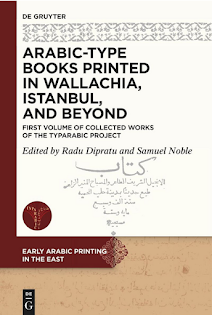
Around 1700, Athanasios Dabbas travelled to Wallachia several times and was hosted by Prince Constantin Brancoveanu (1688-1714). The Romanian ruler helped him print the first church-books in Arabic script, asking the scholar and master engraver Antim Ivireanul ('the Iberian') to carve a set of Arabic types. Two books were printed in Wallachia in Greek and Arabic: a Liturgikon (Al-Qondaq al-falahi, 252 pp.) in 1701 (Snagov), and a Book of Hours Kitab al-Sa 'at, 711 p.) in 1702 (Bucharest). When leaving the Wallachian capital in 1705, Dabbas received from Brancoveanu the Arabic types and printing implements, installing them at the Metropolitan residence of Aleppo. Eleven books were printed there between 1706 and 1711: the first was the Psalter (Kitiib al-Zabiir al-sarifi, showing on the first page Brancoveanu's coat of arms. Then followed the Gospels (Kitab al-Ingil al-Sarif alTahir wa-l-misbdh al-munir al-lahiry, the Book of the Chosen Pearls (Kitab al-durr al-muntahab) enclosing 34 homilies by St. John the Golden Mouth, and in 1708 a second edition of the Gospels, the Book ofProphecies, the Apostle, a.s.o. These books were later edited again and again in the printing-shops of Lebanese Christians.
In 1745-1747 Patriarch Silvester of Antioch addressed the Prince of Moldavia Ioan Mavrocordat for help in printing books for the Christian Arabs: the Liturgikon, the Aleppo Psalter and several polemical works (among them, The Proof of Truth and Transmission of Justice by Patriarch Nectarios of Jerusalem that Sylvester had translated in 1733 as Qadii al-haqq wa-naql al-sidq). In a recent book devoted to the life and works of Patriarch Athanasios III Dabbas, A. C. Dabbas stated that Patriarch Sylvester re-installed in 1747 at the Metropolitan residence of Aleppo the old press brought by his ancestor. A fourth episode, less documented, is the establishment by the Christian Arabs of the first press in Beirut after 1750, transferring the old one from Aleppo. A symposium held in Bucharest last year addressed the issue of the Romanians' contribution to printing in the Balkans and the Near East, including a paper, by this author, about the Arabic books printed in Wallachia and Syria before the middle of the 18th century. Whatever the particulars of these events (still under scrutiny), they resulted in a transfer of printing technology and know-how from Wallachia and Moldavia to Aleppo and neighbouring areas. Thus, European culture, in its Romanian forms, was "imported" in the Near East in order to fulfill the Christian Arabs' needs, similar to those of all the Sultan's subjects.
At the present time, the model of living together that Christian Arabs and Muslims of the Near East have provided for centuries is becoming increasingly interesting. Long before it was promoted by missionaries sent from Rome, the dialogue between Christianity and Islam was lived effectively, on a daily basis, by the multi-confessional Arab communities of the Eastern Mediterranean lands. Nowadays when attitudes towards Near Eastern peoples are constantly reappraised, the progress of this research is encouraged by an increased interest of the scholarly circles for the Christian Arabs, a diverse but neglected community, spread all over the world. By completing the projects that I have mentioned, Romanian researchers have the opportunity to participate in a truthful and more detailed definition of the Christian Arab civilization in its relationship with South-East Europe.
Tuesday, August 31, 2010

Tuesday, August 24, 2010
Our Lady of the Wind

The Arabic original, by Jirji Sassine can be found here.
Our Lady of the Wind
Patron of the Church of Our Lady of the Wind, Enfeh al-Koura
The nuns of Our Lady of Kaftoun painted this icon in December 2001, at the request of the parish of Enfeh, and after having shown preliminary designs to fathers and theologians who gave their blessing. It is an offering from Michel Faiz Touma, for his parents the reposed Faiz and Nejmeh. It measures 90cm by 60cm and it was consecrated by Fr. Zakhour Nimeh, the parish priest of blessed memory. The feast of Our Lady of the Wind is the Feast of the Annunciation, where it takes the place of the icon of the Annunciation, and below it most of the image is the sea and fish (the Feast of the Annunciation is connected to permission to eat fish despite the fast).
An explanation of the icon “O Virgin, calm the tumult of our passions and quiet the storm of our sins…” (from the Paraklisis to the Theotokos).
This is the message of the icon of the Theotokos, Our Lady of the Wind and what is written underneath it. She is lifting up the prayers of the faithful who are drowning in the sea of sorrows and the tempest of temptations to the Lord Jesus who is always present and watching from heaven, which is represented by the sky-blue circles amidst the golden background. He blesses with both His hands in response to the intercession of His mother the sailors who struggle amidst the waves that toss about the fishing boat (and the boat is a symbol of the Church). He leads them to the shore, the place “below the wind” north of Ras Qal’at Enfeh where the church of Our Lady stands. They seek refuge under her serene protection, far from the storms and whirlwinds coming from the sea (a symbol of death and the world of darkness where the dragon plays (the psalm of vespers). The whirlpool which appears along our coasts in the winter is still called “the dragon” by local fishermen and this is reflected in the icon by depicting the storm in this form), from the southwest across from the cliff, but the Theotokos Our Lady of the Wind is standing next to her church, lifting up her left hand in supplication to her divine Son to preserve her children, while with her right hand she repels from them the storm coming from afar.
The icon goes from nature to the site of the church of Our Lady where the bay “below the wind”, which during most of the days of the year is protected from the southwesterly winds which cause storms and batter the cliff. The icon goes from the calm bay which forms a natural harbor for fishermen to the spiritual reality where Our Lady takes those who seek her intercession under her protection.
In the details, the waves appear as a spiral of the colors of the sea and the sky, and this is in imitation of the style of the extant mural icons in the church of Our Lady of the Wind, which probably go back to the twelfth century. They reflect the ambiance of the local sea and among them are fish, so often mentioned in the tradition of the Church.
Likewise palm trees, which decorate the coastline since Phoenician times, are mystically connected to the Virgin (in the Song of Songs and the Akathist) surround the church.
She is the Virgin Lady, the Theotokos who is honored by the faithful in the village and the surrounding region. And here are the ancient churches forming a ring around her church: from the right St. Simeon, St. Michael, and St. Katrina and from the left St. George and the Monastery of St. John the Baptist. Likewise she is surrounded by her monasteries: Deir al-Nouriyyeh drawn at the top of the cliff in the background along with the site of the ancient monastery in the middle of the mountain where Abd al-Masih al-Enfawi practiced asceticism and from which the light of the Virgin shined forth, according to the tradition of the monastery’s name. At the end of the peak is the church of St. Simeon the Stylite. As for the monasteries and shrines to Our Lady in the region for which there was not room to draw in the icon, they are present in a hidden way, and to complete the list they are: Our Lady of the Seas in Batroun, the Horshiyyeh Cave in Hamat, the shrine of al-Rihaniyyeh in Hari, al-Za’tariyyeh in Shaka, al-Zurou’ in Kfarhazim, Sayyidat Fi’, Our Lady of the Spring (al-Na’oura), Sayyidat al-Bazizat (the Nursing), Sayyidat al-Qutrubiyyeh in Enfeh, Sayyidat al-Khazaib in al-Harisha, the Monastery of Our Lady of Balamand, and Deir Sayyidat Natour, where the perspective of one looking at the icon stands.
She is the Virgin who herself saves through her intercessions all those sailing through the storms and waves on the sea of life.
She is the Lady of all places—land, sea, and air and is constantly present and protecting all who honor her. Through her intercessions, O Lord, have mercy on us and save us, amen.
Monday, August 23, 2010
Final Report from the Holy Synod

The Arabic original can be found here. As always, this translation is my own and is not official. An unofficial French translation has also been released here.
Final report of the 46th Regular Session of the Holy Synod of Antioch, taking place in the Monastery of St. Christopher, between the 17th and the 20th of August 2010 under the leadership of His Beatitude Ignatius IV.
On Tuesday August 17, 2010 the regular session of the Holy Synod of Antioch was held, lasting until Friday August 20, 2010, under the leadership of His Beatitude Ignatius IV (Hazim) and in the presence of the Fathers of the Synod of Antioch, the metropolitans of the nation and the emmigration. They studied an agenda related to pastoral and ecclesial matters and adopted appropriate decisions related to them.
First, the Synod listened to a detailed presentation by Dr. Elie Salem, president of Balamand University. During it, he explained how the university is developing on the academic and administrative levels. At the end of the presentation, the Fathers thanked Dr. Salem for what he undertakes with the working team at the university and they affirmed the necessity that the university continue fulfilling its role showing the Church's mission of service to all the children of the nation.
This was followed by a presentation by Dr. Georges Nahas, dean of the St. John of Damascus Theological Institute, which covered academic, spiritual, and administrative aspects, especially the new education program and modern and accepted methodologies. He likewise indicated the development of the master's program and the bachelor's in religious studies, and the fathers affirmed the necessity of connecting theological knowledge with pastoral experience so that the priest can bear the image of Christ the Good Shepherd into the world. They also formed a synodal committee to assist the patriarch in overseeing the affairs of the institute.
Pastoral care was a significant concern at this session, and on the second day the Fathers approved of a text prepared by Metropolitan Georges (Khodr) for a pastoral guide for priests to rely on in carrying out their pastoral, apostolic, and sacramental service. The guide contains texts reflecting the pastoral reality that priests live today. This guide, which covers a variety of topics in a simple style, treats in detail situations every priest faces. The guide pays close attention to the steadfastness of Antiochian tradition and reflects modernity. It calls for reliance on the principles of performing the sacraments in the Church while it pays close attention to the circumstances of pastoral practice in all other matters.
After that, the Fathers considered the status of youth work in the See of Antioch, and agreed to clarify the role of the clergy and laity in receiving all the gifts of the Holy Spirit for the sake of unity and peace in the Church. This relationship is based on the fatherhood of the bishop and his assistants and on the sonship of the faithful within the one Church.
With this goal in mind, His Beatitude commissioned the Holy Synod to form a committee under his leadership for the organization of pastoral and educational work on the level of the entire patriarchate.
The Holy Synod hopes that God will inspire all with the purposes of the Lord in the cooperation of all His children, so that love and respect will prevail in the establishment of normal relations between all the members of the Holy Church. The Synod is confident of a renewal of spiritual life for all and it remains clear that the responsibility of Christian education for everyone is the responsibility of the bishop and his leadership, along with the participation of those who have competencies for helping him in this.
The Fathers then listened to a report by Metropolitan Philip (Saliba), Metropolitan of the Archdiocese of North America about the status of the Archdiocese and aspects of apostolic and pastoral work there, indicating the development of the Archdiocese in all fields.
On the third day, in light of a study prepared by Metropolitan Basil (Mansour) about the historical status of the bishop in the Orthodox Church, and after long and detailed discussions, the Fathers affirmed that the bishops of the Archdiocese of North America are auxiliary bishops (asaqifa musa3idun) assigned to dioceses and entrusted by the Metropolitan of the Archdiocese to dioceses. They are subordinate to their spiritual point of reference, the metropolitan of the Archdiocese, who has general authority over the whole Archdiocese.
The Holy Synod then listened to reports about pastoral work in the Archdioceses of Central and Western Europe, Mexico, and Argentina. They praised the work being undertaken there and asked the bishops of these archdioceses to continue their work for the Good of the Church and her development. On the basis of the widening of the work of the Archdiocese of Central and Western Europe into the countries of Scandinavia, the decided to change the name of the archdiocese to "the Archdiocese of Europe".
On the fourth day, the Fathers listened to reports about the preparatory meeting for the general Orthodox council which took place in Chambesy- Geneva and also to reports about the meetings of the Orthodox Churches which took place in the countries of the diaspora and especially in North, Central, and South America. They raised up prayers that the mutual Orthodox work might bear fruits to the glory of Jesus Christ and the good of the Church.
After that, they went on to study the topic of Orthodox-Catholic dialogue and the stages it has reached. They affirmed the desire and effort of the Church of Antioch for the realization of the greatest possible closeness between the two churches, especially on the levels of daily witness and service to the weak. They formed a new Antiochian committee to pursue this dialogue.
Finally, they listened to a report from His Eminence Boulos (Yaziji) about the status of plans for Orthodox media and they asked His Eminence to continue work on the next stage.
The session did not end without the Fathers affirming that the the pastors of the Church are from beginning to end shepherds of the People of God, who suffers the difficulties of life and hard circumstances, and that they continue to be watchful in bearing these children of who thirst for the Word of God in the first of their paternal priorities, supplicating God to bless this good flock and its worship, and to increase upon it grace and blessings.
After the end of the meeting, His Beatitude sent a letter to the President of the Republic, Dr. Bashar al-Asad, the text of which follows:
Honorable Dr. Bashar Hafez al-Asad, President of the Syrian Arab Republic
After the best prayers for your preservation,
We lift up greetings and prayers for your honorable position on the occasion of the session of the Holy Synod of Antioch in Seidnayya. Their Eminences, the members of the Synod join me in doing this.
I express my great gratitude to you for this meeting which expresses your love for our Church and your regard for it as the national church par excellence. This makes us even more confident of our deeply-rooted existence in this country so dear to our hearts, Syria.
We repeat our prayer to God, may He be exalted, for your continual health and success.
Ignatius IV, Patriarch of Antioch and all the East
Sunday, August 22, 2010
More from Damascus
I apologize for not having the time today to translate the entire thing, but the Holy Synod has released its final report for its meeting this past week. While the website of the Patriarchate has been down all day, it is available in Arabic in today's an-Nahar here. I hope to have the whole thing posted by tomorrow evening, but here is the part about North America:
[On the second day], the Fathers listened to a report by Metropolitan Philip (Saliba), Metropolitan of the Archdiocese of North America about the status of the Archdiocese and aspects of apostolic and pastoral work there, indicating the developement of the Archdiocese in all fields.
On the third day, in light of a study prepared by Metropolitan Basil (Mansour) about the historical status of the bishop in the Orthodox Church, and after long and detailed discussions, the Fathers affirmed that the bishops of the Archdiocese of North America are auxiliary bishops (asaqifa musa3idun) assigned to dioceses and entrusted by the Metropolitan of the Archdiocese to dioceses. They are subordinate to their spiritual point of reference, the metropolitan of the Archdiocese, who has general authority over the whole Archdiocese.
[On the second day], the Fathers listened to a report by Metropolitan Philip (Saliba), Metropolitan of the Archdiocese of North America about the status of the Archdiocese and aspects of apostolic and pastoral work there, indicating the developement of the Archdiocese in all fields.
On the third day, in light of a study prepared by Metropolitan Basil (Mansour) about the historical status of the bishop in the Orthodox Church, and after long and detailed discussions, the Fathers affirmed that the bishops of the Archdiocese of North America are auxiliary bishops (asaqifa musa3idun) assigned to dioceses and entrusted by the Metropolitan of the Archdiocese to dioceses. They are subordinate to their spiritual point of reference, the metropolitan of the Archdiocese, who has general authority over the whole Archdiocese.
Thursday, August 19, 2010
Day Two of the Holy Synod's Meeting
The Arabic original can be found here. This translation is of course not in any way official, but it's worth noting that with regard to the discussion of North American bishops, the word 'auxiliaries' was given in English and Arabic.
[Update: This report is no longer posted on the Patriarchate's website. However, it can still be found on the website of the Archdiocese of Tripoli here.]
[Update: This report is no longer posted on the Patriarchate's website. However, it can still be found on the website of the Archdiocese of Tripoli here.]
The Holy Synod continued its work schedule, and approved a text which it will publish to be a pastoral guide for priests, to help them to carry out their apostolic, pastoral, and sacramental service.
The guide includes texts includes texts discussing the pastoral reality that priests live today in addition to various other subjects. It is in a simple style and treats in depth situations that every priest faces.
The guide pays close attention to the steadfastness of the Antiochian tradition and reflects modernity. It calls for reliance on the principles of performing the sacraments in the Church but also proposes reliance on economy in dealing with all pastoral concerns.
The Fathers also studied the state of youth work in the See of Antioch and the integration of the various gifts of the Holy Spirit in the Church, which strengthens the harmony between the fatherhood of the bishop and the sonship of the faithful within the one Church.
With this in mind, the Fathers decided, with the commission of His Beatitude Patriarch Ignatius, to form a committee concerned with the organization of pastoral and educational work on the level of the whole Patriarchate.
They then listened to a report from His Eminence Metropolitan Phillip (Saliba), metropolitan of the Archdiocese of North America, about the state of the archdiocese and aspects of the apostolic and pastoral work there, where His Eminence explained the development of the archdiocese in all fields.
The Fathers affirmed, after careful and lengthy deliberation, that the bishops of the Archdiocese of North America are auxiliary bishops, raised up by God and dependent upon the metropolitan who has complete authority over the entire archdiocese. This is on the basis of the study prepared by His Eminence Basil (Mansour) about the position of the bishop historically in the Orthodox Church.
Wednesday, August 18, 2010
Day One of the Holy Synod's Meeting: Education

So, this is up on the website of the Patriarchate in Arabic, but not in English. So, I figured it was worth translating. The original can be found here.
During the morning session of the Holy Synod of Antioch taking place in the Patriarchal Monastery of St. Christopher, the Synod listened to a presentation by Dr. Elie Salem, president of Balamand University. During this presentation, Dr. Salem explained how the university is developing, with regard to academics and the number of faculties, as well human resources, the number of students and buildings, and the number of university publications. He likewise presented the future plans and budget for the academic year 2010-2011, assuring the Synod that the university is financially sound, which assures stable development.
Dr. Salem put forward a number of suggestions for strengthening the relationship between the university, the archdioceses, and the Orthodox schools.
At the end of his presentation, the bishops thanked Dr. Salem for his work, and especially for the fact that during the past two decades the university has become the equal of the most well-established Lebanese universities in various ways.
The Fathers likewise emphasized the necessity of the university’s role in making the Orthodoxy prominent and the necessity of carrying out this role by promoting Middle Eastern Antiochian Orthodox thought and history, with the knowledge that the university must remain open to all the spiritual families of Lebanon.
During the second session, Dr. Georges Nahas, dean of the St. John of Damascus Institute of Theology gave a presentation covering all academic, spiritual, and administrative aspects. With respect to academics, Dr. Nahas presented the new program in education and modern, accepted methodologies. He likewise indicated the development of the master’s program and the bachelor’s in religious studies for those who are not interested in theological studies.
With regard to student life at the institute, Dr. Nahas indicated the close attention to the daily liturgical life of the students as well as requests to some spiritual fathers to give the students attention. So there is personal attention to each student so that we may be on a level appropriate for clergy. He also pointed out that students are divided into small working groups in their studies, and the launching of a group for recreational and cultural activities during free time.
He then discussed the difficulties that the work of the institute faces, and how they should be addressed administratively, asking the Fathers’ help in applying the institute’s efforts at solving these problems.
He then talked about the presence of the institute in the university as a whole and mentioned that the professors at the institute desire a more effective presence at the university within the fields to which they can contribute. He talked about the presence of the institute on the level of Antioch and in general, through the various activities which it organizes. Dr. Nahas also talked about the development of relationships with Orthodox theological institutions in the world, and the establishment of an important network of external relationships which enable the exchange of academic expertise.
He then presented on the institute’s administrative and organizational affairs and the plans for the future set forward in the ten-year working plan which insures the role of the institute in bringing up students and in revealing the Orthodox identity, and as a center for pastoral care and also for the publication of religious instruction in the Arabic language.
During the discussion that followed, the Fathers emphasized the necessity of connecting theological knowledge with pastoral experience so that the priest is able to bear into the world the image of Christ the Good Shepherd and not fall into theological excess and ignore the pastoral aspect of the priestly vocation.
The accompanying Patriarchal media delegation:
Archimandrite Ibrahim Dawud
Fr. Daniel Nimeh
Dn. Demitrios Mansour
Tuesday, August 17, 2010
Carol Saba on the Holy Synod of Antioch
For the full essay in the original Arabic, published in an-Nahar, go here. I don't have time this morning to translate the whole thing... The two paragraphs I left out are a summary of events in the Orthodox world that are well-covered in other English-langauge sources. The pivotal decisions being alluded to here have to do with the two most significant matters that are presumably under discussion today: how to resolve the conflict between the Orthodox Youth Movement and Met. Paul of Aleppo and what to do about the Archdiocese in North America....
The Holy Synod of Antioch meets on the seventeenth of this month at the Patriarchal Monastery of Saydnayya. Active since 547 AD, the monastery is on a hill 25km from Damascus. Many papers seem to be on the table at this ‘pivotal synod’. Issues, concerns and challenges must be met with courage and vision by Church that have always been the basic centers of Antiochian Orthodox witness in the East and in the world.
[He then discusses various developments in the Orthodox world relating to increased cooperation and communication between the local churches, as well as the prospects of increased cooperation with the Catholic Church in Europe.]
As for Antioch, all eyes look with hope to the fathers of the Orthodox Holy Synod of Antioch in which will participate bishops from the diaspora and the Mother Church. The synod looks to me to be pivotal on a number of levels. Serious challenges face the Church, internally and externally. Effort must be made at awareness and discernment so that the Church does not deviate and become “one of the sects”, subject to various squabbles. These challenges are pivotal to our ecclesial life in the East and to our witness to the Nazarene risen from the dead. It is necessary to develop “ecclesiologies of cooperation” in the management of the Church on all levels, canonically and in practice, through constructive cooperation between the priesthood of service and the royal priesthood in order to take the Church from a state of preserving existence to a state of bold witness and in order to develop new frameworks for pastoral care, diakonia, and various gifts in order to address the world boldly and with discernment, whether in politics, media, and economics, or culture and social affairs, etc… This is not according to a principle of being colored by the world, but according to the principle of “you are the light of the world and the salt of the earth.” The Antiochian Orthodox Church bears a great heritage, a diverse patrimony, a living apostolic tradition and theological thought. The Church’s rich gifts make the Antiochian witness a witness of linkage, of connection, of continuity. These are her pivotal gifts in the Church, for the sake of the transfiguration of the whole world. There remains the serious question of how to deal with the current squabbles that rise up from here and there and how to tie together this great diversity and valuable capabilities and many rich gifts that the Church of Antioch possesses to push them forward together. Here is the central role of the Synod, to inspire and to take initiative, to set forth extensive and programmatic frameworks for cooperation between clergy and laity, to gather the gifts and capacities of both, to study different challenges and to face them in an Orthodox manner, to endorse a roadmap for an active and effective Orthodox witness in today’s world. The Church of Antioch will either be a church giving true witness to Jesus Christ or she will not exist. Her witness must either be based on the Middle Eastern, Antiochian tradition, distinguished by its firmness of faith and constant defense of right belief in the face of change, or she will not exist. The gift of Antioch within the universal Church is that it is founded upon Christians’ awareness of their identity in Christ, “they were called there Christians”, that is their awareness that they are Christ’s and His alone. Thus Antioch must be Orthodox, and must say and do no more and no less!
Subscribe to:
Posts (Atom)


 Posts
Posts

