Tuesday, October 17, 2023

Patriarch John X on the History of the Melkite Schism

From here in English and here in Arabic. The speech is quite important, among other reasons, for its clear statement of Antiochian Orthodox ecclesiology.


Opening Speech of
Patriarch John X
In the International Scientific Conference entitled:
“The Orthodox Church of Antioch from the Fifteenth to the Eighteenth Century:
Towards a Proper Understanding of History”
Balamand 16/10/2023
 
On this blessed evening, I am pleased to be among you and to inaugurate with you, from this blessed Hill of Balamand, the International Scientific Conference entitled, "The Orthodox Church of Antioch from the Fifteenth to the Eighteenth Century: Towards a Proper Understanding of History."
 
As I welcome each and every one of you, beloved brothers and siters, I pray for God's blessings to shower you, and I entreat Our Lady, the Ever-Virgin Mary, patron saint of this place, to embrace you with her tenderness and intercede to her Son for all of us, so that we may live faithfully according to her commandment: "Whatever He says to you, do it."
 
A proper understanding of history, as mentioned in the conference title, requires adherence to scientific principles. The account of history is not a personal point of view, but a set of facts and events that we ought to study in order to understand what actually happened, and to draw conclusions. Since our topic deals specifically with ecclesiastical history, it is our quest to redeem it, to correct the course anew, to heal wounds, and to reconcile every rift. 
 
However, what is evil is the changing of the reading of history according to immediate self-interests, so that things are turned upside down, and facts are taken as personal views! Yes, we deeply regret that some are comfortable with the "post-truth era" and consider this as a basis. For some, truth has become synonymous with what the masses believe, i.e., the product of sophistry and populism, while historical facts are left to oblivion. In this post-truth era and the blurriness associated with it, we need, now more than ever, for scientific research to reveal facts. Therefore, we want this scientific conference today to deal with a difficult period in the history of the Church of Antioch, the first church founded by the Apostle Peter, in which "the disciples were first called Christians" (Acts 11: 26). From this Church came Ignatius, the God-bearer (+107 AD), who, on his way to be grinded by the teeth of the lions in Rome, addressed the whole Church with his letters, which are still a universal ecclesiastical reference. Saint John Chrysostom, the teacher of the universe, who was led as a lamb and taken to exile. He yielded up his spirit on the way, as a result of the decisions of the Synod according to the emperor's policies at that time, that is, outside the nave of the church, in which Chrysostom refused to yield up his spirit to his Lord. Saint John of Damascus was the defender of the faith, and whose hand was restored by the Virgin after being cut off for speaking the truth of faith. Let us not forget Patriarch Peter III who sought with all wisdom and strength to prevent the schism between Constantinople and Rome and to keep the dispute between them within the confines of the Church. He wanted differences, especially small ones, not to turn into a reason for distance, division, fragmentation, hostility, and for an absence of love.
 
In the context of preserving the spirit of Peter III, who saw himself as "a bone of Antioch’s bones and blood of its blood", and in the footsteps of the Apostle Peter, who bore his name and who also succeeded him in the care of the sheep of Christ in the Mother City, the Church of Antioch, the Apostolic Patriarchate and the first See of Peter continues to be the Church of communion, consultation, openness, and peace. She remains a Church with her place and authority among the Churches. It pains and saddens her with every division between other churches. Equally, She is pained by the dismemberment of a segment of her children who violated her authority as a church being the fullness of ecclesiastical entity, and as a church equal in dignity to the second church established by the head of the Apostles. She is a church that is aware that her role as an authority is no different from that of other ancient apostolic patriarchates. She is a church whose Patriarch, Peter III, realized that it was his responsibility to work on avoiding a schism between the two sister churches.
 
From our predecessor, Patriarch Peter III, we understand the faith of our Church is that true communion can only be achieved through consultation and mutual respect between Churches, through the community's complete obedience to its Lord, God, and Savior Jesus Christ, along with being in harmony and peace that descends from the Holy Spirit, and away from any worldly logic of domination, control, and subjugation of others. Is there anything more beautiful and truer than Patriarch Peter III's analogy of the five patriarchates to the five equal senses, working together in harmony within the body of the Church, whose only head is Jesus Christ, Who promised to be with us forever until the end of the age?
Just as the Antiochian Patriarch Peter III was bold in this ecclesiastical theology, which was contained in his correspondence with Rome and the Latin world, he was equally bold and faithful to the authentic Orthodox ecclesiastical theology in his interaction with the Ecumenical Patriarch Michael Cerularius, when he reminded him that "the Apostolic See of Antioch is not under the See of Constantinople." 
 
It would have been desirable for the contemporaries of the Patriarch of Antioch to hear his voice and realize that there is no place for lust, power, and domination in the Body of Christ! It would be desirable for our brothers today, who refuse to resort to conciliarity and claim primacy of Sees and their infallibility, hear the words of this Patriarch. Suppressing the conciliar sense is a sin. Conciliarity is the starting point for anyone who wants to maintain unity, and who does not want to isolate and marginalize others.
However, history, even church history, is not always written by the wise and saints, and therefore the wisdom of the Patriarch of Antioch did not resonate with the disputants, and the schism between East and West was perpetuated and deepened with the passage of time, and tragedies succeeded. Antioch was not spared the repercussions of the great schism and the struggle for power, and this part of the Church turned into a land of conquest and capture.
 
The schism deepened and took on existence and reality with the so-called Crusades that uprooted the Orthodox Antiochian patriarchs from their See and replaced them with Latin patriarchs.
 
Despite the severe hardships and persecutions that befell us in the Mamluk era and other eras, the leaders of the Church of Antioch never lost sight of the fact that the only response to attempts at unity, through coercion and material/worldly temptations, was total and complete devotion to the spirit of Orthodox conciliarity. Hence Antioch's rejection of the Council of Ferrara Florence in 1439, which was held on the verge of the fall of the Roman Empire. 
 
The years continued with their cruelty to Christians living in this tormented region of Antioch. With the advent of the Ottomans and the first attempts at Western colonization in the East, Rome sent missionaries to us, not to help persecuted Christians, but to entice them to join it, accompanied by promises of commercial and economic opportunities and political protections by the European powers, so those who became weak under such pressure joined it.
 
This situation was not because of the accusations that some attach against the Antiochian clergy about the alleged neglect of the parish and the so-called lack of spiritual care for the faithful. The patriarchs of Antioch since the seventeenth century, such as Meletius Karma (1634-1635), Makarios III Ibn Zaim (1648-1672), and Athanasius III Dabbas (1686-1724), spared no effort to educate the parish, secure its needs and preserve the Orthodox faith. Their efforts yielded a pastoral renaissance and cultural and spiritual renewal in the Patriarchate of Antioch. 
 
The themes of this conference will allow you to appreciate the renaissance vision that the Church of Antioch worked to achieve despite the harsh social situation and the challenges of the living conditions in the Middle East at that time. No matter how much some try to obscure or distort the facts, they are not able to hide what has been achieved in many areas, including: reviewing books, scientific and critical editing of texts, printing them in Arabic in printing presses, criteria for priest selection and for the election of bishops, educating priests in seminaries and theological schools, restoring many church buildings and icons, providing relief funds to needy families, opening schools for children's education, organizing spiritual courts and supervising their work, regulating marriage and personal status laws, and revitalizing monastic life in monasteries. Their labors were mixed with the sweat of perseverance, the tears of prayers, and the blood of martyrdom. They had a clear and correct vision of the ecclesiastical renaissance, and of how to establish the flock in the authentic Orthodox faith, despite the enormous pressure from inside and outside to destabilize Church life and the confidence of the faithful in the Church.
 
You will have the opportunity to see this renaissance movement carried out by the Antiochian patriarchs and bishops despite all the challenges and attempts to break in and sow dissension, and to carefully research all these subjects and events during the next two days, in order to draw lessons and prevent the recurrence of the same tragedies, especially in these difficult days in our countries, in which many at home seek alleged protections, and many abroad seek to buy consciences and loyalties and win over the needy people or weak souls.
 
Fraternally, I leave it to those who departed from us and joined the West, in accordance with an agreement that allowed them to preserve their rituals and maintain their patriarchal system, to evaluate the results of their choice, especially since this Balamand hill witnessed, not long ago, an Orthodox-Catholic dialogue and church meeting (1993), which examined the feasibility of this Uniatism as a way to achieve the desired unity between churches and dropped it from consideration as a feasible way in the efforts for unity. Pope John Paul II, with his usual boldness, apologized in 2000 to the Eastern Orthodox Church for the mistakes made by the Church of Rome, in the Middle Ages, towards the Christians of the East that led to Christian fragmentation.
 
From a paternal outlook, I say that our Antiochian See suffered because of the absence of fraternity and fell under a tutelage that had its own implications, but it was able at the beginning of the twentieth century to enter a new phase inaugurated by the election of Patriarch Meletius Al-Doumani.
 
In addition, I must thank God, because He has given us, Christians, the ability to be present in this Antiochian scope, to overcome difficulties, despite the twists and ruggedness of history, to bring us closer together, to remove the effects of division from our souls, to make us feel that we are one family of the Father. Our common life in this regard has increased our sense of the importance of our unity. It has made our relationships based on the encounter in Christ Jesus and not on formal courtesies. That is why we will continue to work together, to strengthen the bonds of fraternity and love among our Churches, and for achieving the united witness of Christ Jesus.
 
In this atmosphere of love, we must, at the Antiochian level, break through the barriers of history, tear down the remaining walls of enmity, abandon emotional courtesies and superficial closeness, translate our love for one another into a sincere revelation, activate local theological dialogue and deepen common historical research, so that we can strengthen our true Antiochian identity through joint scientific works that contribute to the healing of our historical memory. This healing process, as noted above, began on this Balamand hill thirty years ago, when Uniatism as a method to unite with Rome was rejected. Therefore, we hope that this conference, in which we desire to have a proper understanding of our history, be the first pillar, which establishes joint action with our brothers that will allow the history of that era to be read accurately and to dispel all ambiguities that marred it on the way to be fully healed from wounds and be in the service of the desired unity.
 
We have made great strides in our joint pastoral work, through the agreement between us and the Syriac Orthodox, and we were close to achieving a project of unity between us and the Rum Catholics, but the difference in the understanding of partnership, conciliarity and the relationship with the churches outside the Antiochian scope prevented the realization of this project. Should we give up and abandon the dream of Antiochian unity? Would it not be better for us to have the courage to insist on continuing to work in order to get as close as possible to this unity? Is not the vivid feeling of our children regarding unity of destiny and unity in witness and holiness an incentive to strive for the unity to which we all aspire and whom the glorious Lord Jesus has commanded us to follow? 
 
As I speak to you about Antioch, I remember the last Feast of Pascha that I held above the rubbles of the Antiochian historic cathedral recently destroyed by the earthquake, inflicting indescribable suffering on the people. Here, I take it as an opportunity to send my peace, love and blessing to our children in this city, and in Alexandretta and Mersin, and with them and through them I assure the world that we are children of hope, that we will rebuild what was destroyed, and we will remain witnesses in this land on which the Apostles walked. This land was sanctified by the blood of the martyrs, including the two hieromartyrs, Nicolas Khashe and his son Habib. Those two were martyred in the last century and their glorification will be studied by the Holy Synod in its upcoming meeting, and whose intercession we already ask for all of us and for this See which is preserved by the holiness of its believers throughout generations.
From this blessed Balamand hill, which is one of the places that has a vibrant presence for our Orthodox Church in our beloved Lebanon, I address all our fellow citizens to work together to formulate a vision that respects the pluralism that abounds in this country and its distinct communities, and to preserve the unity of Lebanon, a unity that highlights our values, and does not turn sectarianism into a tool for corruption and vitiation, to disrupt governance, to hinder the work of the state, and to oppress citizens. Hence, I address the consciences of all officials in this country, and in particular to the members of parliament, calling for the election of a President of the Lebanese Republic who will ensure the regularity of the work of institutions. I ask for divine mercy for the souls of those who died in the Beirut Port explosion, stressing that justice that ought not to be hindered by self-interests finds its way and prevail.
To the civilized world, to people of conscience wherever they are, I ask: Why making the Syrian people starve? What is the guilt of these people which makes you punish them by blocking food and medicine? Is it humane to deprive a human being of electricity, water, heating, and medicine? Is it humane for fathers to be unable to feed their children and mothers to live anxiously in order to secure a morsel of bread? Has politics become so criminal that it watches people die of hunger and oppression and remain indifferent? Isn't it time to lift the blockade on the Syrian people and lift the sanctions on them?
 
How can I not express the pain in our hearts over the case of the Archbishops of Aleppo, Youhanna Ibrahim and Boulos Yazigi, who have been kidnapped since April 2013? This bleeding wound in the body of the Antiochian Church will not heal until their fate is known, and their kidnapping will remain in our history as a painful picture of the oppression suffered by human beings living in this East.
 
As we stand here in the vicinity of the eternal Cedars, we must say a word of truth about what is happening in occupied Palestine. Palestine is crucified because of the self-interests of nations. Palestine is bleeding with the Nazarene on the calvary of tyranny. We support the Palestinian right to its land and to the effective establishment of its state. We stand by the side of these displaced people who are suffering from bitterness and siege, imprisonment, murder, and displacement. Peace cannot be formed on the bodies of children and slaughtered men, nor is it imported by shedding innocent blood. What is happening in Palestine is the result of the violation of human dignity, the contempt towards international law and all resolutions, racial discrimination policy, and the persistent imposition of the logic of oppression. Hence, our call is for the immediate cessation of the war on Gaza. The people of Gaza are paying the price of the suffocating siege with much blood. Our call also for us, Muslims and Christians, to see in Jerusalem a way up to the mercies of the Father of Lights. We ask the Holy Lord to send down His divine justice and mercy, and His peace which surpasses all human peace, a peace that cannot be established by blood and fire.
 
Beloved,
History has been harsh on us in this region, and it continues to be harsh, but we are loyal to this land, because it has been mixed with the soil of our fathers and with the blood of our saints. We are committed to bear love for all the inhabitants of this area with whom we were, and still are, partners in life and death and mistreated like them by external forces. We are the children of this land, and we do not seek foreign protections in it, but we seek to translate the teachings of the Gospel in this land. Let us convey the kindness and peace of Christ wherever we go. We are here to build this country on the values of love and decent morals with all good and sincere people. We are a loving bloc, not a sectarian bloc. We only aspire for the earth to be heaven and for history to be a history of God's lovingkindness, compassion, and love for mankind, not the history of sin.
 
In conclusion, three hundred years have passed, my dearly beloved, since the unfortunate schism of 1724 AD, which led to a rift in our Antiochian Orthodox Church, resulting in unfortunate and sad social, economic, and political repercussions, which reflected negatively on our parishes. It is our hope that this conference will add to the foundations we have put in place in order to restore unity and harmony between our church and the Rum Catholic church, and that it will also promote the strengthening of fraternal ties between the five patriarchates (which bear the name of Antioch), and stir the spirit of kinship among them so that our witness to the Lord of glory may be one.
 
May the Lord God bless you and bless this conference for the God’s glory, and for the good estate of the Church and Her unity, and for the prosperity of the country and the people.

Tuesday, September 26, 2023

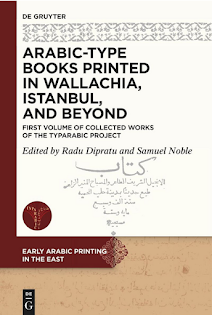
Ioana Feodorov: Arabic Printing for the Christians in Ottoman Lands (Open-access Book)

Arabic Printing for the Christians in Ottoman Lands:

The East-European Connection

Arabic printing began in Eastern Europe and the Ottoman Levant through the association of the scholar and printer Antim the Iberian, later a metropolitan of Wallachia, and Athanasios III Dabbās, twice patriarch of Antioch, when the latter, as metropolitan of Aleppo, was sojourning in Bucharest. This partnership resulted in the first Greek and Arabic editions of the Book of the Divine Liturgies (Snagov, 1701) and the Horologion (Bucharest, 1702). With the tools and expertise that he acquired in Wallachia, Dabbās established in Aleppo in 1705 the first Arabic-type press in the Ottoman Empire. After the Church of Antioch divided into separate Greek Orthodox and Greek Catholic Patriarchates in 1724, a new press was opened for Arabic-speaking Greek Catholics by ʻAbdallāh Zāḫir in Ḫinšāra (Ḍūr al-Šuwayr), Lebanon. Likewise, in 1752-1753, a press active at the Church of Saint George in Beirut printed Orthodox books that preserved elements of the Aleppo editions and were reprinted for decades. This book tells the story of the first Arabic-type presses in the Ottoman Empire which provided church books to the Arabic-speaking Christians, irrespective of their confession, through the efforts of ecclesiastical leaders such as the patriarchs Silvester of Antioch and Sofronios II of Constantinople and financial support from East European rulers like prince Constantin Brâncoveanu and hetman Ivan Mazepa.

Download the entire book here. 

Sunday, September 17, 2023

Met Ephrem (Kyriakos) on the Jesus Prayer

Arabic original here.

The Jesus Prayer

"Most assuredly, I say to you, whatever you ask the Father in My name He will give you. Until now you have asked nothing in My name. Ask, and you will receive, that your joy may be full" (John 16:23-24).

In the Bible, the name is seen and experienced as the presence of God Himself. The name holds a twofold power: on the one hand, feeling the living God , and on the other, knowing Him.

Jesus' name indicates the incarnation:

Before all else, the name 'Jesus' indicates the reason for God's coming in the flesh for our salvation. By taking on our nature, God shows that it is possible for us to also become sons of God. The name 'Jesus' means 'God is the Savior'.

God said to Moses that His name is 'I Am': great is the name of the Holy Trinity.

Jesus is the God-Man. He brings both together in His person and through Him it became possible for us to reach the Father.

Can man ask for anything more than that?

When the personal God, I Am, is revealed to us, the fundamental difference between Him and various deviations like yoga, Buddhism and even Transcendental Meditation, is revealed.

Of course, when our minds are turned away from every image, it is possible for meditation to grant us a sense of rest, peace and liberation from time and place.

But there is no sense of standing before a personal god.

This can lead to a state where the person who practices meditation comes to be content with the psychological results of such experiences.

In this way it turns one away from the living God in order to focus on that "nothingness".

The hesychastic technical method:

The one praying tries, by repeating Jesus' name, to connect the intellect to the heart.

This is after he has already focused on conforming his daily life to Christ's commandments.

The one praying takes an appropriate bodily posture, reciting the prayer while his head is bent towards his chest, taking a breath at the words "Lord Jesus Christ, Son of God," and exhaling at the words "have mercy on me a sinner."

In this way, he can keep his focus from wandering.

This method makes it possible for the one praying to keep his attention focused on the heart without resorting to psychosomatic methods.

Nevertheless, it is not possible to acquire true prayer through this technique because this only comes through faith and repentance.

The important thing is that we focus our attention on the name of Jesus Christ and on the words of the prayer.

When you feel the pain of sin crying out, the intellect naturally turns to the heart.

The full form of the Jesus Prayer is, "Lord Jesus Christ, Son of God, have mercy on me a sinner."

Finally, when prayer becomes an automatic movement, it becomes fixed in the heart without any effort.

After the mind has become focused and at rest, prayer brings blessings. It comes like a delicate flame within us, like inspiration from the Most High, like joy in the heart with a feeling of divine love, delighting the intellect with spiritual contemplation.

+Ephrem

Metropolitan of Tripoli, al-Koura and their Dependencies

Friday, September 15, 2023

Maria Mavroudi: Byzantine Translations from Arabic into Greek (Open Access)

Maria Mavroudi, "Byzantine Translations from Arabic into Greek: Old and New Historiography in Confluence and in Conflict," Journal of Late Antique, Islamic and Byzantine Studies 2.1-2 (2023): 215-288.

 Abstract: 

Scholarly demand to re-evaluate underappreciated cultures has grown since the 1980s. This generated a call to re-write the nineteenth-century narrative on the transmission of knowledge from the ancient Near East to the Graeco-Roman, Islamic, Western medieval, and early modern European world. The paper surveys the modern study of Byzantine translations from Arabic into Greek in order to propose a new narrative frame, no longer linear but attentive to continuous and bi-directional contact between medieval civilisations. The paper offers the contact between Byzantium and various parts of the Islamic world as an example. It discusses the presumed insularity of Byzantine literary culture and its relationship with ancient Greek literary heritage. Problems of dating, localising, and socially contextualising the translations (through information on their authors and patrons) are also examined.


The entire article can be read and downloaded in open access here.

Wednesday, September 13, 2023

Jad Ganem: Two New Saints

 Arabic original here.

Two New Saints

During the divine liturgy that he celebrated for the Feast of the Nativity of the Mother of God at the Monastery of Saydnaya, His Beatitude Patriarch John X announced that the Holy Synod of Antioch will discuss at its next regular session declaring the sainthood of the hieromartyr Fr Nicholas Khashsha and his son, the hieromartyr Habib Khashsha, two Damascene priests who were martyred for the faith in the last century.

As a layman, Fr Nicholas was an activist for returning the Patriarchate of Antioch, which had been under Greek domination since the Melkite Catholic schism, to Arab control and was active in establishing and developing schools for the community. He was then ordained to the priesthood, where he served the Archdiocese of Damascus. Patriarch Meletios (al-Doumani) then delegated him as his vicar for the Diocese of Mersin, whose bishop, Alexander (Tahhan) had abandoned it because of its poverty and the disturbances it was experiencing. In Mersin, Fr Nicholas succeeded in reuniting its dispersed flock and caring for and strengthening the faithful, who were subjected to various forms of persecution and ethnic cleansing. The Turkish authorities grew frustrated with Fr Nicholas and arrested him on the basis of slander against him, then tortured him until he was martyred.

Habib, the eldest son of Fr Nicholas, followed in his father's footsteps. Despite his success in business, he decided to be ordained to the priesthood and served as a priest in Damascus and Cairo. His service was distinguished by a life of prayer, devotion to shepherding the faithful with love and self-sacrifice, and his closeness to the poor, who he cared for like he cared for his own family, feeding them with their food and the money that his brothers sent to help them because of his poverty. His life was crowned with a martyric death on Mount Hermon, where smugglers beat him to death because he was a Christian priest, fulfilling his desire to imitate his father.

The faithful have passed down the stories of these two priests and they remain alive in the memory of Antioch because "their blood has attested that the Holy Spirit is in them and because though love they have transcended the barrier of the earthly body and become figures of light." Today, if the Holy Synod decides to declare their sainthood, it is "in obedience to the One of whom they have become worthy."

By declaring their sainthood, the Holy Synod places before the flock and the faithful, at this difficult time, the image of a married priest to whom the Church entrusted the task of shepherding a diocese whose bishop had refused to shepherd it and fled it when its resources became scarce and it started to face difficulties. He shepherded it as though it were his little family. He and his sons lived in it and among its people and he died for it. The Holy Synod also puts forward the image of the son who abandoned worldly success in order to imitate his father and become a shepherd of souls, serving the poor as though they were a little family and dividing his sustenance and that of his family with them. He served them as though they were his masters, not caring about money or worrying about the future, but relying on the mercy and generosity of God, who crowned his life with the crown of martyrdom.

Perhaps, by its effort to declare the sainthood of the hieromartyrs Fathers Nicholas and Habib, following the declaration of the sainthood of the hieromartyr Joseph of Damascus, the Holy Synod desires to emphasize that sanctity is not limited to monks, but rather also exists outside of monasteries, and that the family which is sincerely committed to Christ is also just as much a locus of sancity as anywhere else.

Monday, September 11, 2023

Asad Rustom on the Era of Patriarch Cyril al-Za'im (III): Euthymius al-Sayfi

Translated from: Asad Rustum, Kanisat Madinat Allah Antakya al-'Uzma [The Church of the Great City of God Antioch], Jounieh: Editions St. Paul (1988), vol. 3, pp. 111-119.

Part I here.

Part II here.

Rome completes its mission: Athanasius kept to the truce and was unable to return to the patriarchal see, so Rome undertook to complete its plan and in 1697 the attention of the Jesuit priest Verseau was drawn to Balamand Monastery because he was familiar with the monks and "the schism has a great affair there because they all belong to the Rum millet." Fr Verseau repeatedly attempted to enter Balamand in order to expound on the Catholic faith, but he failed. Then two disciples of the Jesuit fathers felt the monastic calling and chose Balamand as their place to serve God, "and Fr Verseau started to visit them and guide them, warning about the danger in that monastery." It was then confirmed that they were firm in their Catholicism and so he took them on as a tool for Roman propaganda among the monks. He increased his visits to the monastery and became acquainted with all the monks, taking part in the monastery's gatherings without any impediment. "In order to please them all," he praised Saint Basil the Great and read accounts of him to them. He then put into the hands of his two friends books by Fr Clisson and Fr Nau. In 1704, five of the monks of Balamand sent a petition to the Congregation de Propaganda Fide that included the following:

"We present to Your Resplendent Majesty that we are your servants, numbering five people from the millet of the Arab Rum, monks of the path of Saint Basil the Great, who were reared from our childhood in the Catholic religion, always submitting to the Supreme Pontiff, His All-Holiness. Nevertheless, in these lands we have not found the freedom to perfect the way of life for salvation of the soul as is necessary in monasticism due to the country's lack of stability and the rule of the nations over it and the disorder of the monasteries and monks. We have presented our situation to Your Resplendent Majesty so that if you decree and command us, we will come before you about this matter. We ask that you grant us, out of the charity of the Holy Church, a humble place where we may take refuge alone, either in Rome or outside it and for you to grant us there the necessary food and ascetic drink sufficient for the body and nothing else, so that we may serve God in our place as much as possible and pray for Your Resplendent Majesty.

Balamand, in the region of Tripoli of Syria on November 1, 1704. Your servant, the hieromonk Macarius. Your servant, the hieromonk Gerasimus. Your pitiful servant, the hieromonk Hanania. Your pitiful servant the hieromonk Nasrallah. Your servant the hierodeacon George."

The Monastery of Saint John, Choueir: At this very moment, two young men from Aleppo arrived at Balamand, desiring to practice chastity and asceticism. Father Nasrallah from Aleppo advised them "to go to Mount Lebanon and search for an empty place. Afterwards, we will come to you and make a canonical monastic order, because in this monastery one cannot live in freedom of faith because in it there are recalcitrant people and associating with them is not beneficial." They heeded his advice and went and found a monastery called Mar Yuhanna al-Choueir, and sent them news about it.

This monastery was humble in the beginning, only containing a small church named after John the Baptist and a humble room that was home to an ascetic from the Sawaya family of Choueir. Choueir was suffering from a feud between its two big families, the Maja'is and the Sawaya. When the dispute arose between the two patriarchs, Athanasius and Cyril, one group sided with the former and the other with the latter. The Maja'is supported Cyril, so the Sawaya decided to support Athanasius. The Maja'is won over the majority of the families of Choueir and the Sawaya were prevented from praying in the Church of Our Lady, the village church, so they began to pray in the Church of Saint John mentioned above. In this way, the Monastery of Saint John is not named merely after its being found in the area of Choueir, but also after the Choueirite ascetic who founded it and his Choueirite family members who made its church their place of worship, defending those monks claiming obedience to Rome who took refuge there.

Rome's Only Man: One of the individuals in obedience to Rome, submitting to its bishop, was Euthymius al-Sayfi, metropolitan of Tyre and Sidon (1682-1723). He was born in Damascus around the year 1643 with the name Mikhail ibn Musa al-Sayfi, growing up there. He studied in the community's school at the patriarchal residence and received special attention from the priest Jirjis Bariq, imbibing Catholicism from his youth. This priest Jirjis had traveled to Rome and adopted Catholicism there. When Mikhail was young, he frequented the monastery of the Jesuit and Capuchin fathers and they attracted him to themselves, increasing his obedience and submission. He became close with the patriarchal vicar Neophytus al-Saqizi, learning Greek and the art of Byzantine chant from him. Perhaps Neophytus himself ordained Mikhail as a deacon and then priest in 1666.

Jeremiah, the metropolitan of Tyre and Sidon died around 1680 and the Latin missionaries encouraged the Rum notables in Sidon to elect the priest Mikhail al-Sayfi. Patriarch Cyril III agreed and consecrated him as metropolitan of Tyre and Sidon in 1682, giving him the name Euthymius. The first activity that this new bishop undertook was that he hurried to send a copy of his confession of the Catholic faith to Pope Innocent XII, with the Capucin father Accursio. This father Accursio was the teacher of the new bishop's confession in Damascus. Part of what is contained in the confession is as follows:

"I have rejected the error and schism of the Rum for some time and I have confessed the Catholic faith at the hands of the missionary monks in Syria. Now, by the grace of God, I have become bishop over the See of Tyre and Sidon and I must offer the necessary obedience to you and reference to your holy see, imitating the holy fathers Athanasius the Great, John Chrystostom and all the holy fathers whom the Roman Church has received in the time of their struggle and persecution. I do not need to mention the rejection, imprisonment, humiliation, loss of money I have endured and the enmity from the Muslims, along with some of the Rum and their clergy, especially their patriarch called Cyril, on account of my confession of the Catholic faith."

The archdiocese of Tyre and Sidon was large but not very populated, so the new bishop worked to populate it by encouraging migration there. He agreed in May of 1686 with the Rum notables in Sidon to write to those Christians who were willing, to invite them to reside in Sidon. The qadi of Sidon issued a deed for this that still exists to this day. He then rebuilt the Church in Sidon with his own money and formally issued a deed for this on April 11, 1690. It is no surprise that such a deed was necessary because Islamic law forbids the construction of churches and monks' cells but permits the renovation and preservation of old ones.

The most important thing that Euthymius undertook during this initial period of his episcopacy was that he established the Salvatorian monastic order to spread the principles of union with Rome and submission to its bishop. This work started in Sidon where, before 1700, he gathered together a number of monks to live a common, canonically-ordered life with him at the Machmoucha farm near Joun. The Salvatorian priest Constantine Bacha believes that the metropolitan's disciples numbered, at the end of the 17th century, no less than ten and that they were unable to live in Sidon and its surroundings without being subject to every accusation and every hardship from the army and others, so they rented the Machmoucha farm from its owner, the qadi Sheikh Qablan, to live and work there. They did not do this for long before, by the care of the Savior, their monastery in His name was established in 1711. Euthymius composed a special rule for its monks, news of which spread among people until it reached Aleppo. His letter to a friend in Aleppo preserves some of what the Salvatorian monks practiced in the beginning and some of the principles that Euthymius had in mind. His friend, a bishop, wrote in objection to Euthymius' permitting his monks to eat oil and fish during fasts. The latter responded:

"It does not escape your knowledge, if you ponder and see the weakness and decline of the millet and its lack of the necessary knowledge and spiritual sciences. We have seen many with weak temperaments and good zeal, who had a little knowledge and wanted to have a pure life, ordered by keeping the three vows that are the foundation of all monastic orders, so that they might benefit their millet by their activity and knowledge. But they forsook entering monasticism on account of its harshness of living now among us and so fell short of completing their good intention. When I realized that this particular reason was preventing the universal good, I used the authority of binding and loosening given to me by God and His Church to issue an order, indeed to issue a compulsion, known to all on account of its being issued and entering into force. This was so that worship in this manner would be something by choice rather than compulsion. It is not as it is now, practiced by others openly and rejected by the majority in secret. Moreover, so that we would not imitate the harshness of some previous shepherds who used their authority to bind and not to loosen, nor even less should I curse rather than bless those in whom God's words through the Prophet Micah are fulfilled: 'Eat the meat of my people and break their bones.' For this reason, we see their state as they have caused great losses for this pure path and for the excellent Christian faith. My intention as well, if it so happens, is for such as these to be separated from the other monks only in their abode and means of living, and to agree with them in keeping the three vows and the rest of the other rules, since they are under the obedience of one leader. If our intention is not achieved with them, then God has proof against the stubborn."

Euthymius, Bishop of those Submitting to Rome (1702): Some of the bishops rejected the harm that had come to the Church on account of the schism and arrogance stormed in their minds, so they wrote to Euthymius around 1694 so that he would be their leader and the flock would have one shepherd. Then an understanding was reached between Athanasius and Cyril and Cyril became the sole patriarch. His heart was set on hindering the activities of the missionaries and not facilitating their interests. He refrained from sending to the sultan recognition of the priests who befriended the missionaries and worked under their guidance. Athanasius went back on what he had promised Rome at the beginning of the affair. In 1700, Clement XI (1700-1720) took charge of the See of Rome. Euthymius wrote to congratulate the new pope and renew his submission. On February 24, 1701 he composed a new letter in which he explained the situation in the Patriarchate of Antioch and requested to be the "vicar of the pope in the East" in order to give him the authority to recognize Catholic bishops outside his diocese. He mentioned the desire of the metropolitans to install him as patriarch of Antioch and he attached the document that they had signed, but he said that he had little reach and could not accept their request because he was subject to "the authority of the Muslims." Therefore he only sought "the authority of the dhimmis."

The Propaganda Fide studied Euthymius' request in a session held for this purpose on December 6, 1701 and accepted the metropolitan of Tyre and Sidon's request for a period of seven years by a decision brought before the pope. Clement XI accepted the congregation's decision and ordered that it be acted upon and the following message was sent to Euthymius:

"To sayyid Euthymius, metropolitan of Sidon and the Rum in all the Patriarchate of Antioch where there are no Catholic bishops: On Wednesday, July 19, 1702 in the regular audience of the revered father assistant, the Most Holy Father granted, according to what was presented to him, to the aforementioned petitioner these rights for a period of seven years, such that he may in no way exercise them outside the boundaries of the aforementioned patriarchate or in dioceses in which there are Catholic bishops."

The Book al-Dalala al-Lami'a (The Shining Proof, 1710): The Jesuit father Michel Nau resorted to writing in order to convince the Rum to obey and submit to Rome and during the time of the Patriarch Macarius he composed a book entitled The Argument of the Holy Roman Church for its Orthodoxy and Right Worship. The Orthodox fathers were not convinced by this, particularly the monks of the Holy Sepulcher. At the beginning of the 18th century, they translated into Arabic a letter by Zacharias, bishop of Adana, in defense of the holy traditions, explaining Rome's program and revealing the secret falsehoods of its manner of action. They then distributed it in the territory of Antioch and it was on everyone's tongues and was circulated about. On June 10, 1704, Euthymius wrote to the Propaganda Fide saying, "The schismatic members of the eparchy of Jerusalem have prepared the book of Zacharias, the bishop of Adana, which is filled with blasphemies against the opinion of the Church of Rome. They have translated it into Arabic and published it in our country, in the jurisdiction of the See of Antioch, to spread the poison that is found within it." Euthymius adds that he undertook to write a book that "elevates the honor of the Holy Roman Church and puts her opponents to shame." He asked to be supplied with the writings of John Cariafili [?] refuting Zacharias, the refutation of Neilos [Kabasilas] of Thessaloniki, books by (Cardinal) Bessarion, the metropolitan of Nicaea, the books of Demetrius Kydones, and the book of Pierre Courfois [?] about the service of the mysteries and purgatory because they were necessary for him. Euthymius sent his manuscript to Rome and it was approved by Cardinal Barberini and so "The Shining Proof between the two poles of the Universal Church, containing the agreement of the Eastern Rum Orthodox Church with the Universal, Western Church of Rome and their unity in one opinion and one Christian faith" appeared in Rome in 1710 with a subvention from the Propaganda Fide.

It was distributed and so in 1712 the oikonomos of the Church of Aleppo refuted it in a letter which, as it appears, remains in manuscript. This oikonomos was known to Euthymius as "someone with knowledge, keeping the rites of the Rum perfectly, supporting and defending them." The book al-Dalala al-Lami'a attracted the attention of the Orthodox patriarchs and metropolitans and they mention it in the excommunication that was issued in 1718 against Euthymius and those who strayed with him, because he "composed books on his own and drew on testimonies as he saw fit and attributed them to the Holy Eastern Church."

Euthymius Gets Ready: Euthymius issued commands according to whim and in September 1713 observed that "the eparchy of Antioch is good soil in need of workers" and that its patriarch, Cyril, was "a man lacking knowledge who hates the Roman Church" but he did he did not dare to offer offer obedience before the patriarchs of Constantinople and Alexandria. He believed that the bishop of Saydnaya, Gerasimus al-Shami, was "a man at God's gate, his holiness is a measure of wine and the wine remains in his cell, Christ be pleased with him;" that the bishop of Maaloula and Qara was "a recalcitrant, heretical Cypriot;" that the bishop of of Baalbek was "a Cypriot with good intentions, if God blesses him with a teacher he might agree with everything we want;" that the bishop of Homs was "hapless in religion and this world;" that the bishop of Hamat was "a Cypriot strong in unbelief and in insulting the religion of the Church and of us. For two years, he has been present with us in activities of his. We honored him and gave him abundant charity and advised him as much as possible. From that day, he ceased the insults but he remains in his unbelief;" that the metropolitan of Beirut "previously believed in the Church and honored and glorified the Church of Rome. For this reason, we conferred upon him some charitable support and invited him to Sidon. We explained to him the shortcomings and the error that has befallen the Church of the Rum after the schism;" that regarding the bishop of Tripoli "some of the missionary monks have testified that he is Catholic, but I have not discerned any signs of Catholicism in him. Perhaps he had confessed the truth under the influence of a certain hope and when the hope was lost, he returned like a dog to his vomit;" that the metropolitan of Lattakia was a "heretical Chiot, ignorant of religion. He barks and snaps with heresy without being aware of it;" that regarding the Patriarch of Aleppo [i.e., Athanasius Dabbas] "he is known in Rome as a Catholic and is known to me as a climber [? مساقل ];" that the metropolitan of Adana was "an insolent Cypriot, an enemy of God and His Church;" that the metropolitan of Diyarbakir was likewise a Cypriot, that the metropolitan of Erzerum was from its eyalet and the metropolitan of Cyprus was from the eyalet of Erzerum. It is well-known that this traffic was widespread at that time and existed on both sides.

In this way, Euthymius, Rome's only bishop in the dioceses of Antioch, attempted to attract bishops to Catholicism with methods that might not all be legitimate. As for the Jacobites, attracting them was far-off in his view "and would be more attainable through force." Here it should be remarked that true unity is not achieved through money and force, but through the Holy Spirit and love, which does not seek for itself and does not think ill, but takes its time, accompanies, trusts and is patient.

Bp Constantine Kayyal: The Rich Young Man

Arabic original here.

The Rich Young Man

"What should I do to inherit eternal life?" This is the question that every person who aspires to a good life asks, in order to attain the crown of holiness.

The young man in today's Gospel reading is no different from other young men who wish to live a good life, and this desire and longing for a good life is planted in us because we were created in the image and likeness of God.

This is because Jesus waits for all of us. No matter what questions, cares and worries we bear, He wants to hear them with love. He is neither a psychiatrist nor an ethics professor, but rather Lord and Savior, because He is all love and only gives love.

Since doing good deeds and works of mercy does not in itself mean avoiding sin, you must go beyond all these things and follow Jesus, who waits for you. You must become free of your concern for yourself, of your selfishness, of every earthly thing, follow your Teacher and be a living bridge that connects God and people.

Here Jesus focuses on the commandments that order our relationship to our neighbor, among them worship, which requires two things: the first is with regard to God and the second with regard to the neighbor.

In order to proceed towards the kingdom, you must be free of fornication and preserve your life and the life of your neighbor. Otherwise, you are infringing on another's possession. You must be committed to the orphan and honor your parents and support them. The young man responded:

"I have done all this since my childhood. What do I still lack?"

So Jesus said to him, "Sell everything you have and come follow me."

That means, get rid of everything and follow the Lord. Join Him and commit to the path of perfection. But on account of his heart's attachment to what his hands possessed, the young man went away sad.

Therefore, live a life of giving, so that you may feel true happiness. Do not be like this young man who was attached to his wealth. Trust that everything is possible with God and He alone is able to help you, support you and lift you up to Himself.

Yes! The young man went away sad like any person living on earth, while the Christian is a person created for heaven. It is true that the Christian lives on earth, but he is not of the people of the earth. He is a heavenly person born from above, born in water and the Spirit. His concern is heaven and his mind is on heaven.

His faith is translated into good deeds that benefit others so that he may inherit eternal life. But here we must be aware that we do not inherit eternal life while we are sitting in our places, but rather when we are active and act in love, because the kingdom of heaven does not come to us ready-made. The kingdom is taken by force and we must rightly deserve it.

This is eternal life. It is not in obeying the laws and rules and keeping the divine commandments, for the Ten Commandments have no value if word is not attached to deed and if man is not the purpose for which these commandments exit.

Dear reader, always remember the Lord's words in his famous Sermon on the Mount, "Lay up for yourselves treasures in heaven, where neither moth nor rust destroys and where thieves do not break in and steal. For where your treasure is, there your heart will be also."

Our only treasure is not in banks, in income or in possessions, but rather in heaven. This treasure is good works, mercy and love for one's neighbor. It is faith in God and acting according to His will so that we may inherit the desired kingdom.

Bishop Constantine Kayyal

Abbot of the Patriarchal Monastery of Saint Elias, Shwayya