Tuesday, October 12, 2010

Fr. Pandeleimon (Farah) on Icons

This sermon was given by Archimandrite Pandeleimon (Farah), abbot of the Monastery of Hamatoura on October 11, 2009. The Gospel was Luke 8:5-10. The Arabic original can be found here.


Glory to the Father and to the Son and to the Holy Spirit, now and ever and unto the ages of ages, amen.

St. Luke focuses on the fact that those who bear fruit, bear fruit with patience. They do not grumble, but rather stay firm in their struggle and offer the best that they can for the love of Christ. So they bear fruit with patience and do not bear fruit hurriedly. As for those who want great results quickly, they act recklessly because the spiritual life does not come so randomly and hurriedly. It comes slowly and conscientiously, through the harmony of the work that God gives and the effort that man offers. In the second passage which we read, we hear him say: those who bear fruit also, they bear fruit exactly because of that cooperation between the grace of God and their effort. They live in accordance with that word and are made holy in it. They can only see in the Lord’s light what the Lord wants and what exactly His will is in their life, and how they should behave.

In this life we sometimes go through hard times where we are asked to do things we are not yet prepared to do, but which are nevertheless asked of us. What is the attitude that we must take? When we read the Gospel, our minds are illumined and we are lifted up to heaven and we try to apply these saying that we hear and learn. When we apply them, the affairs of our life and the people around us oppose us, but God has the power at that moment to illumine our minds if they are truly directed towards Him and to teach us what is the good way and the helpful words that should be said at that moment. Let us not fear, rather let us stand firm in our struggle and in our works and most of all in our patience, until we bring forth good fruit. “The one who does good and teaches it, he is called great in the kingdom of God.” But the one who grumbles is speaking from his mid while his heart does not yearn for God and so his actions do not correspond to his words, or one can say that he teaches what he doesn’t do himself. So he enters into matters of which he has no experience and consequentially does not bear good fruit because he does not pour out his heart, he does not offer his efforts, but rather he reads in books and says what he read or what he heard from other people. But his personal experience is completely foreign to all this, and so he does not bear fruit. He is hasty because he gives solutions and offers analysis that does not come out of his experience and which he did not learn from being in harmony with God’s will and teaching, and so he sins. His words are in vain because he is not accurate, he is not beneficial, and he does not build. Even if he uses holy words, his words are in vain because they do not help him, they do not build himself and others up.

And so we must be patient. Patience does not mean that we stay idle. It means that we continue in our work and do not consider it to be a routine that strangles and kills us, but rather as a field for our daily self-examination. Every day, we ask ourselves, do we know the Lord’s will? Do we love the Lord’s will? Do we do it with yearning and love? For example, the monk who first comes to the monastery, no matter what he read about monasticism or self-sacrifice and the spiritual life and service, he read it from a distance. So very quickly he is surprised once he is in the monastery that he is not able to be obedient, for example, that he cannot sacrifice. If he is hasty, he does not stand firm and does not bear fruit and he leaves himself to boredom and despair, and departs. The one who knows himself perfectly, that he cannot be obedient, that he cannot be humble, that he does not possess true virtues, in his patience and his harmony with monastery’s order and discipline, becomes holy because he acquires these virtues with patience and he bears good fruit. Then, when he talks to you about discipline, you can understand something. If he talks to you before having gained experience, before having reached this point of brokenness, sacrifice, and obedience in all humility, he cannot talk to you because all you hear out of his mouth is gibberish and incomprehensible words, since they do not spring from experience. For this reason it says: they bear fruit with patience, that is that they persist in this every day. Virtue does not come so quickly and we do not quickly become great saints, because it’s not magic and it’s not just a button that we push. It takes the whole life and sacrifice until death in order to bear good fruit.

And so, my beloved, on our celebration today of the Holy Fathers who gathered at the Seventh Ecumenical Council and affirmed the correct belief that we should venerate icons, they teach us that they are signs which draw us in to the presence of Christ and the saints. They are not Christ Himself nor are they the saints, but they are signs that show us the presence of the saints and the presence of the Lord Jesus. Likewise, the sign of the Holy Cross is not magic, but it raises our minds up to the event of the Lord’s death upon the Cross and the salvation that comes from this death and the Resurrection. At the same time, we do not bow down to them because they are a god, but because we express our respect through this humility because we are certain that the grace of God and the Holy Spirit is present in this icon, because grace is found in this person whom the icon represents. We honor it because it bears grace and is not simply a decorated wooden board. It bears the grace which God gives this saint in his life and struggles and toils and which is present in all his goals, in everything he undertakes, and in everything he gives attention to. This divine grace is also present in icons, because through them we are made aware of God’s presence and the presence of the saints with us. We keep icons in our homes, but not in just any place, but in a fitting place where we give them honor and respect, because through this we express our love for Christ and for His saints. We express our respect for our Lord and for His saints through whose presence he gives blessings and among whom His name is magnified. When we find ourselves surrounded by those saints, we feel rest in our toil and our daily struggles and we are filled with blessings and joy because we participate with them. We become a community with them, as though we are one with them. They come down to us and we raise our minds up to them. We come to be on the same level when we are aware that we struggle for the sake of the love of Christ. And so we bear fruit and His name shines within us.

Let your light shine before the people, so that you do not just venerate icons but so that you yourselves will become icons which will show the presence of Christ and will make all creation draw near to Him. When they see you, they love the God Whom you represent and Whom you bring to them and so you make yourselves and all creation holy. May the Holy Lord bless your life on this blessed morning and may He make every one of you a shining light which will show the life of Christ and His salvation and may it bear good fruit through holy effort, with firm patience, through which it may be established in the Paradise of the Lord, amen.

Monday, October 11, 2010

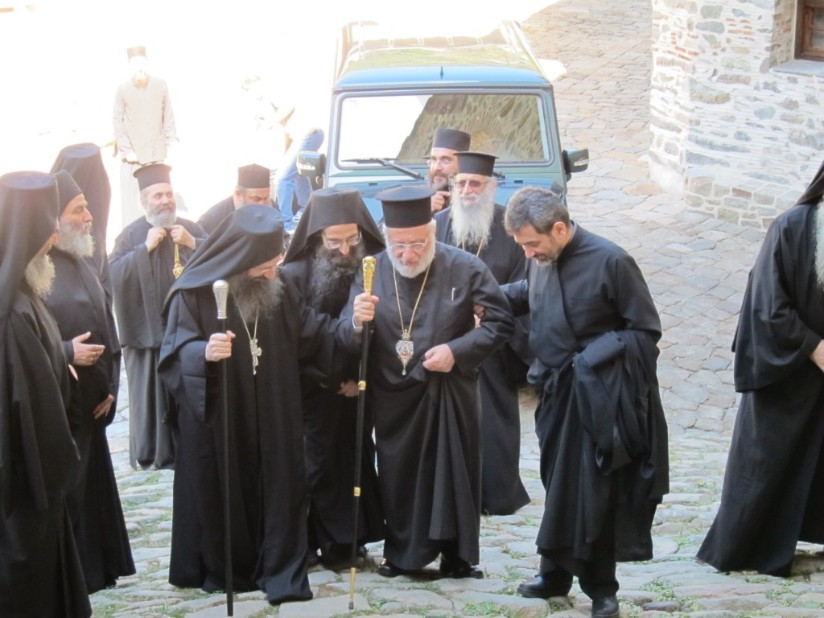
Antiochian Bishops Visit Mount Athos

The Arabic original is from here.


The Historic Visit to Greece and Mt. Athos by Metropolitans Georges, Yuhanna, and Ephrem

From the 21st to the 30th of September 2010

His Eminence Metropolitan Georges (Khodr) of the Archdiocese of Jbeil, Batroun, and their Dependencies undertook a historic visit to Mount Athos, accompanied by Their Eminences Metropolitan Yuhanna (Yazigi) of the Archdiocese of Western Europe and Metropolitan Ephrem of the Archdiocese of Tripoli, al-Koura and their dependencies. They were also accompanied by Fr. Ephrem from Met. Yuhanna’s brotherhood, Deacon Georges Shalhoud, and Br. Parthenios.

From the entrance hall of the Beirut Airport, the Antiochian delegation set out for Athens, then Thessaloniki, on Tuesday, Sept. 21, 2010.

That afternoon, the first place the Antiochian delegation visited was the Monastery of the Transfiguration in the region of Nea Poli where they were greeted by, in addition to the priests and the abbot of the monastery, Metropolitan Barnabas, the local bishop. They greeted “the wise Georgios”, as he was called by Metropolitan Barnabas, who accompanied them to the monastery’s trapeza. They discussed many matters, like the situation in Lebanon and the Middle East, especially the situation of the Church, and the issue of how to attract the youth to the Church today. Metropolitan Barnabas has taken an active role in his diocese with the youth and is counted among the energetic personalities in this field.

On the second day, Wednesday September 22, 2010, the delegation visited the historic metropolitan’s complex in Thessaloniki and was met by the Metropolitan of Thessaloniki Anthimos, who greeted them. They then visited the museum of the metropolitanate, which houses historic icons and they then visited the metropolitan church, which is named for St. Gregory Palamas, bishop of Thessaloniki.

After that, the delegation went to the historic Blatadon Monastery which overlooks the city near its walls. They were met there by the abbot of the monastery, Metropolitan Pandeleimon who has in the past been dean of the Theological Institute at Balamand. It is worth mentioning that he has long known Their Eminences the metropolitans, especially Metropolitans Ephrem and Yuhanna who were his students. It is known that he is a well-versed specialist in Church law.

In honor of the beloved guests, as His Eminence described them, he invited them to the trapeza and gave them a valuable gift, a copy of the hierarchical service book in Greek which he had helped to prepare.

The third day was the chief purpose of the trip to Greece, the visit to the Holy Mountain. It should be mentioned that Metropolitan Georges had been dreaming of visiting the Holy Mountain, and we give thanks to God through the blessing of the Virgin that He granted him the opportunity to undertake this historic visit, as he himself described it, in all ways- spiritually, liturgically, and culturally.

The Antiochian delegation set out from Thessaloniki to the port of Ouranoupoli on the morning of the third day, Thursday September 23, and from there they went to Dafni, the port of the Holy Mountain, where they were met with two cars, to make their transportation on the Holy Mountain easier.

The first stop on the itinerary was at the Monastery of Vatopedi. The delegation visited the basic parts of the monastery, such as the church where the members of the delegation venerated the relics of the saints there, and the monastery’s private museum, in addition to the room where they preserve valuable treasures like church vessels and priests’ vestments. Metropolitan Georges expressed his amazement at everything he saw and he praised the role of monasticism, which is a special world in His Eminence’s expression, in preserving tradition.

The next morning, after participating in morning prayers and breakfast, His Eminence thanked, in the name of the delegation accompanying him, their hosts who granted them such warm hospitality with honor and noticeable piety.

The delegation then went to Karyes, capital of the Holy Mountain. After a warm reception from the head of the administrative council of the Holy Mountain, the members of the delegation exchanged words with their hosts. Metropolitan Georges said, “Orthodoxy is not made by knowledge or theology only, but also liturgy, icons, and worship.” He praised the role of the Holy Mountain as a center radiating out into the whole world, which gathers under its care all regions of the inhabited world, repeating the words of the Apostle Paul, “where there is neither Greek, nor barbarian, but all are one in Christ.”

After taking a commemorative picture on the steps of the administration of the Mountain, the delegation went to the first church of the Mountain, the Protaton, which is the first church built on the Holy Mountain. Inside there is the famous Icon “Axion Estin”. The church is rich with frescos painted by Panselinos. Metropolitan Georges expressed his amazement at its greatness and the tradition which is passed on from generation to generation to our own day.

It is worth mentioning that the metropolitans received a signed letter in the name of the monasteries and sketes of Athos welcoming the Antiochian delegation who demonstrate through their visit to the Holy Mountain the fraternal closeness of the Holy Catholic Apostolic Orthodox Church.

After visiting the capital of the Holy Mountain, the Antiochian delegation went to the Monastery of Iviron on Friday September, 24, accompanied by Monk Nikodemos and Monk Gerasimos from the Monastery of St. Paul on Mount Athos.

This monastery is famous for the icon called the Portaitissa. After being greeted there, there was a meeting in the afternoon with the former abbot of the monastery, the monk Vasilios, who is an illustrious spiritual and theological figure who has written many books. At this meeting between the former abbot of the monastery and the honored guest Metropolitan Georges, the two discussed many theological and spiritual matters, especially St. Isaac the Syrian and his importance in the Orthodox Church. Monk Vasilios said: “Orthodoxy is distinguished by freedom, because without freedom there is no Christianity and no life.” Among the gifts offered by the monastery to the delegation were the complete works of the monk Vasilios, former abbot of the Iviron Monastery. The delegation participated in vespers and the paraklisis for the wonderworking icon.

The next day after matins, the Divine Liturgy, and breakfast, the honored guest Met. Georges and those accompanying him went to the Monastery of St. Paul. There Met. Georges was greeted with celebration and they performed special prayers of thanksgiving to greet His Eminence, where he wore the mantiya and entered the church preceded by those carrying candles, incense, the Holy Gospel, while they chanted “It is truly meet”.

The monastery’s abbot, Archimandrite Parthenios greeted the delegation and Metropolitan Georges then thanked this monastery in particular because it was in this monastery that both Metropolitan Yuhanna and Metropolitan Ephrem were raised and he praised both their roles in Antioch, through the prayers of “the elder of this community”, as Met. Georges termed the monastery’s abbot Parthenios. He asked for his prayers for himself and for the delegation and for the Church of Antioch.

The important event of this visit was the participation of Met. Georges in vespers and the Divine Liturgy on Sunday, September 26, the Feast of the Elevation of the Cross, that is September 13th according to the Eastern Calendar. Met. Georges presided over the Eucharistic service, along with Met. Yuhanna, Met. Ephrem, and Met. Boulos (Yazigi), who was at the monastery with a great Antiochian multitude from Syria and from the cities of Greece who came to participate in this outstanding Antiochian event, along with, naturally, the abbot of the monastery, Archimandrite Parthenios, and a number of priests and deacons. In addition to the monastery’s choir, the choir of Met. Yuhanna’s brotherhood, led by Deacon Romanos al-Hannat served at vespers and at the noon service for Sunday.

After the liturgy, everyone shared at the agape table at the monastery and a picture was taken to memorialize the occasion.

On the afternoon of Sunday, Sept. 26, the Antiochian delegation which was joined by Met. Boulos (Yazigi) and a number of priests, went to the Monastery of Simonopetra whose great warmth and love for the Church of Antioch we have become accustomed to over the years.

After arriving, prayers of thanksgiving were performed and the abbot of the monastery, Elisha greeted Met. Georges and said that since they were little they had been hearing about Georges Khodr and that they had hoped to meet him. They had gotten to know him through his writings and his sermons and they had waited for the day when they would meet him. The time had come and the dream was realized, as he said. Met. Georges responded, saying, “The Spirit blows where He wills and we know that He has blown upon this great Mountain” and that he is nourished by it and that he tries to follow in the footsteps of those saints who shined forth here. He added that, “this Mountain is the spring of Orthodoxy” and likewise affirmed his appreciation for the importance of the work written especially for Great Lent by Fr. Macarios and that he benefits from it, asking the abbot to order him to complete the missing part of it, which is the part about Holy Week. On this celebratory day fell the Feast of the Elevation of the Cross.

The next day, His Eminence and the accompanying delegation participated in the festal vespers for that important day and on Monday morning September 28, His Eminence presided over the festal liturgy for the Feast of the Elevation of the Cross.

After the Divine Liturgy everyone shared in a meal and afterwards the delegation left the Mountain carrying with them unforgettable memories of this historic trip, especially for Met. Georges who has elevated the image of our Church with his understanding, his profundity, his wisdom, and his abundant theology.

After visiting the Holy Mountain, the Antiochian delegation returned to Thessaloniki where they spent the night. The next morning, September 29, they all went by plane to Athens. It should be mentioned that the Ambassador of Lebanon in Athens received the Antiochian delegation. Likewise, the delegation had a number of important visits, like the visit to the Archbishop of Athens, Hieronymos.

Additionally, the Lebanese ambassador in Athens, Mr. Ghabi Soufan, with his family invited the Antiochian delegation to lunch at his home in honor of Met. George and those accompanying him, in the presence of prominent personalities including the Polish ambassador in Athens.

Likewise, the delegation visited Metropolitan Nikolaos Hadjinikolaos.

And they visited the museum of Athens near the Parthenon.

In Athens, they stayed at Pendeli Monastery whose abbot Metropolitan John greeted the delegation and held a dinner in their honor.

On Thursday, September 22, Met. Georges, Met. Ephrem, Dn. Georges Shalhoub, and Br. Parthenios left for Beirut via the Athens airport, where the Lebanese ambassador saw them off. We were overjoyed with his humility and love for the Church.

To conclude, this trip was a historic pilgrimage which had great reverberations in the Greek Church. Metropolitan Georges impressed upon the souls of the people who met him that the Church does not grow old. Whenever a believer advances in age, he increases in blessings, wisdom, and theological profundity, as is the case with His Eminence Metropolitan Georges.


Thursday, October 7, 2010

News Articles on Middle Eastern Christians

Today From Reuters:


Christians in Lebanon fret despite privileged role


In Holy Land, Christians a community in decline


Egypt Christians say intolerance grows, close ranks


Factbox: Christian communities in Middle East


Vatican synod mulls Middle East Christian exodus

12th Century Trilingual Psalter

On the website of the British Library they've posted images of a Psalter dated to 1153 written in parallel Greek, Latin, and Arabic. The Arabic translation of the Psalms is that of Abdallah ibn al-Fadl al-Antaki, the famous 11th century deacon and translator from Antioch. You can turn to all the pages and zoom in. Take a look, it's beautiful.

Here.


In St. Petersburg they've recently published a two-volume facsimile and study of a 17th century illuminated Arabic Psalter based on Abdallah ibn al-Fadl's translation. I'll get around to writing a review of that at some point.....

Tuesday, October 5, 2010

Groundrules on Fair Use

I am a strong believer in the free flow of information. That's the basis of this blog. I link and copy and translate things that are available online and I share them, but to the best of my ability I also try to link back to originals and give my sources. When things I translate spread online, I am grateful for this, but I always ask that the original is linked as I am also grateful when my blog is linked as the source as well.


However, if you are considering using material I translate here in print media, please contact me first. There are a number of reasons for this-- first and foremost, I want to be able to go back over my translation to make sure it is completely accurate and to iron out some of my stylistic idiosyncrasies. When a translation I make is presented as semi-authoritative, this is even more urgent.

Again, I am always pleased when my work here can be helpful for the Church, that's the whole point of this labor of love, but I want to make sure that it is used in as accurate and responsible a way as possible.

Thanks.

--Samn!


For context, compare pages 4 and 5 of this and this to this. I'm glad that they at least read it over to catch my typos, though.

Saturday, October 2, 2010

Fr. Pandeleimon (Farah) on Reading the Bible

This is a sermon that was given by Fr. Pandeleimon, abbot of the Monastery of Hamatoura, on Sunday, October 4, 2009. The original can be found here.


Glory to the Father and to the Son and to the Holy Spirit, now and ever and unto the ages of ages, amen.

Sometimes I feel like I’m repeating myself, but the subject is very important for our lives as Christians. We notice that people neglect reading in general, and more specifically spiritual reading. In this way they lose every connection with Christ and their behavior changes. They do not know the true way that the Lord Jesus wants, what He taught, how we must behave. This is because they do not read the Holy Scriptures and so they do not know the words of the Lord Jesus, even though they are holier than the holy things, because He spoke them himself from His holy mouth when He was on the earth. So we need to grab them and hold on to them as tightly as possible and try to apply them in our life with seriousness and exactitude so that we can behave like Christ and be worthy of being Christians. It is not because of a name or because of society that we are Christians.

There is a great problem in the whole world where people confuse nationality, race, ethnicity, and religion. If you’re Greek, this means that you’re Orthodox, but not all Greeks behave in the same way, with the same love and the same faith! If you’re Lebanese, you must be Maronite. Christ does not know boundaries and gives no weight to tribe or ethnicity. When we go to the countries of the diaspora, if you say that you are an Arab, this means that you are Muslim. They do not understand that you could be from any country and from any race and that you have a different idea because you base your teaching, your life, your behavior on the Gospel, on the Letters of the Saints and on their lives and teachings. People claim that they are Christians, especially in our country, where the basis for everything is lies, deceit, and procrastination. Everything. They say to the priest “your honor” but they do not honor him and they do not love him and they do not value him as he is worth. Not only with regard to his personality as a human, but with regard to his work. In his priestly service he is distinguished in that he brings us into the presence of God and brings down upon us the grace and mercy of the Lord during the Divine Liturgy and in all the circumstances of his life. This is because we do not know Christ’s actions as we should and we do not study it. We need to go back and read them over and over until we have them memorized and absorbed and until we know how to behave. There are brothers who do not love each other and who do not talk to each other or help each other out and so instead they act as enemies with knives at each others' throats, all while being called Christians! How does this happen?! They go to church and take communion while they act as enemies! They behave randomly like pagans in their morality and their life, and then they go church and take communion like they are worthy Christians! This lack is on account of not reading! Reading stimulates the mind makes a person know and grasp things. One who knows bears more responsibility than one who does not know and who is ignorant of how to behave in life. Likewise with regard to spiritual matters, knowledge alone does not suffice but it presses you when you read the Holy Bible to take a blessed attitude as is fitting.

Saint Paul says, “You are a temple of the Living God. ‘I shall dwell in you,’ says the Lord, ‘and shall walk among you and I will be your God and you will be My people.’” You are not a tribe. You are the people of Christ, because you accept the Christ’s dwelling among you and you behave like one for whom this name is fitting. “And so I will bring you out from among them.” Come out from amongst the nations who do not know the Christian life. This exit does not mean isolating oneself far from people. But, while you are in the midst of the city you can life as one believing in and knowing the Lord Jesus, different from others through your actions. So don’t annoy people when you want to listen to the radio or watch television, don’t annoy others like they annoy you. Give your child a peaceful and orderly wedding, without throwing raucous parties. People go into debt in order to throw wedding parties. What foolishness! What great accomplishments! Even more than that, they are negligent and make noise all night and annoy other people, spending their money for no use, without doing anything good with it even for themselves. So instead of waiting for people to give you presents and alms, give to yourself so you can make a fitting household where you will be at rest with your wife without the pride and grandiosity that is an expression of emptiness. How can you start your life when you’re in debt? How can you spend what you don’t have? Christ asks you to be simple, loving, helping. How can you be an enemy to others when the Lord asks you to pray for them, to love them, that means to treat them well. Love is not an abstract feeling, it is a motion from within you from your self towards the other. “Be my sons and daughters,” says the mighty Lord, “and I will accept you and be your Father, because you have not accepted to become unclean but rather you desire to live according to the will of the Lord.” Within this alienation from society which tries to pollute you, to distort the image of Christ within you, to make your efforts to be in vain, you persevere so that you will be worthy to become sons and daughters-- “and I will dwell among you and I will be your Father.” “I will be your Father” means you will be completely under my care and you will not fear the difficulties and hardships and persecution that will come to you. Indeed, they will confirm that you are children of God! Those who want to live in piety will be persecuted, as the Apostle Paul teaches. The devil does not let us rest, he always presses us to return to sin and die. He rejoices when he finds everyone separated from Christ and alienated from him. For this reason the Apostle says in the end: “since we have these promises to be sons” that is, that we will be under His protection, in His mercy, the heirs of His good things, “so let us purify ourselves from every defilement of body and spirit and let us perfect holiness in the fear of God.” So let us live this life fulfilling God’s commandments as is fitting and distancing ourselves from every impurity in thought and in the body, purified from everything the world throws at us.

Every day the Evil One comes to present himself to us, to present his thoughts to us. And every day we must remember the promise we made on the day of our baptism when we said: I accept Christ. I reject the Devil and all his works. Every moment you must pause in the face of temptation and say: I reject you, Satan and I spit upon you and I make you my enemy because I want to be of Christ. This is how we possess the fear of God in our hearts because we feel His presence, we feel His being there with us. Let us distance ourselves from all things that separate us from Him and from everything that defiles our souls and our bodies. What is your virtue if you love those who love you? Or if you help those who help you? Each thing is symmetrical to the other. You did nothing. But the one who is kind and generous is in a state of imbalance since no one can return his generosity and for that reason he is kind and generous and has a pure soul. So lend, that is give, without seeking anything in return. God is the one who provides for you before you give and he will provide for you after you give and He will abundantly increase your harvest. You will not lack anything because you are the sons and daughters of the Most High. You will be in this love and you will keep away every stench, every bit of selfishness and all its delights. In them there is sin because when we care for ourselves and our desires we distance ourselves from Christ. But when we ignore them and we work for the service of others and for the love of them, we love Christ and we put into His hands all our abilities and all our possibilities and He blesses us, increasing them and returning them to us in their proper order.

May the Holy Lord enlighten us, while we are on the threshold of the Nativity Fast, with His great humility. May we try to emulate Him and participate with Him every day by closely reading the Holy Scriptures, from the beginning to the end. Let us not grow tired or impatient with them but rather let us continue until they are preserved upon our hearts. This is not in order for us to petrify it in words that we repeat, but so that we know how to respond to every situation that we encounter in our life and so that we bear the thought of Christ and not our own selfish thought. Mothers and fathers need to read from the Holy Scriptures in front of their children every day, even if it’s just in summary, in order to show them through this motion that they should read too and so that they will learn how to absorb the Christ’s thought and His will and His noble sayings. The priest carries God’s Holy Bible in the church and lifts it above the holy altar before all the people and says: This is the wisdom of God. Let us stand up straight according to this wisdom. This is what it means when he says, “Wisdom, let us stand aright.” It is the book of God’s wisdom. It is Jesus Christ, who is the Wisdom of God, written in this book. Let us stand up straight in accordance with what the Lord says in the Gospel. May the Holy Lord allow us to read and to understand and to act in accordance with this reading, learning to love the Lord more than anything, amen.

Friday, October 1, 2010

Fr. Touma (Bitar): The Great Annihilation

The original can be found here.


The Great Annihilation


In the life of St. Pachomius, founder of coenobitic monasticism, it is said that when he was a soldier and he and his companions were in bad shape, hungry, thirsty, exhausted, while on a military mission, local residents brought them food and drink. Pachomius, who was then a pagan, asked, “How can these people take pity on us when they don’t know us?” He was told that they were Christians, and that they were doing what the God of Heaven taught them to do. So Pachomius decided that if he survived he would become a Christian and serve those in need. By God’s providence he was released from the army and he returned and was baptized and then became a monk and father of coenobiticism and served many who were in need.

The most distinctive mark of the first Christians was their love for each other and for strangers! Over the centuries, this warmth has not lasted. The love of God has gradually faded in our hearts until they have grown cold!

Last week I was reading something about prominent personalities and religious movements in the history of Christianity. The Bogomils in the Balkans and that Cathars in Germany, Italy, and the South of France, were perhaps a copy of the first. They started off and flourished from the eleventh and twelfth centuries. They taught teachings that were strange to the Church and were judged to be heretics. Among what they taught was the Manichaean dualist teaching that the world and the body are from the god of evil and the soul is from the good god. What struck me, though, was their insistence on poverty as a way of life and for them this was connected with caring for the poor! Poverty for them was the path for the “perfect”. I am inclined to think that what attracted people to them, since they lasted for a few centuries, was the emphasis they put on poverty in their life as it was the best confirmation of their sincerity among the people. With regard to their dogma, what remains are details, some of which appear late, and of which the average convert to the heresy did not necessarily realize its full contents and their dangers.

I also read about Peter Waldo of Lyon who lived between the end of the twelfth century and the beginning of the thirteenth century and was a wealthy merchant. He distributed his money to the poor and worked to translate the Gospel from Latin into the local language and then went out preaching the word of salvation with great zeal as one poor before the Lord. Pope Alexander II at first blessed his vow of poverty but he put his preaching under the authority of the clergy, which is natural. The confession of faith which he submitted was at first flawless. However it seems that the shortsightedness of the local clergy, their lack of understanding and hardheartedness alienated Peter and so he left his obedience to the institutional Church and went astray. They embarrassed him and they kicked him out! He gained many followers in the south of France, Spain, Germany, and elsewhere. They were all persecuted violently and handed over to the courts of the Inquisition and to death. But it lasted for centuries and their specific dogmas evolved. Here too I am inclined to think what strongly motivated this group was not a certain belief, but rather the movement’s commitment to poverty and the poor. It seems that the clergy pushed them into heresy because they did not embrace with wisdom, thoughtfulness, and love. The beginnings for many, through history were perhaps often sound and upright but when they do not find the climate favorable to embrace them they deviate as a reaction for self-preservation.

Last week also Pope Benedict XVI made a visit to Britain which caused controversy between those who have faith in Christ and those who follow secularism as a religion. I happened to hear on the BBC a discussion between a believing woman and a secularist man. Among what the secularist said was, “We are a secular, democratic society we do not need religion and its values. During the disaster which struck Pakistan (20 million were affected) Britain, a secular state, was the one who most helped that unfortunate country! There is nothing to indicate that religious countries are better than secular countries in this matter. The need, in any case, is for mercy, and that is common to all people and does not come from religion.”

Naturally these are words, but even if they are in need of revision and clarification they are not, in our opinion, without truth. And so we consider them to be a terrible and painful judgment on account of its accuracy and on account of the picture that it reflects of the Church in the eyes of many who do not believe in Jesus. It is not that the belief of the Christians is false but that they lack mercy, even on a human level. This makes them empty, to a great degree, of the love of God because even if it won out within them, it would frankly overshadow in its exertion the counterfeit (!) love between people, as became clear to St. Pachomius. Naturally, the love of God has not ceased to be active among many Christians here and there, if not then all of us and the whole world would cease to be. But let us confess that legitimate love has altogether lessened among those who are considered to have faith in Jesus. Where once it was considered to be the most dominant and prominent feature among them, it is now an exception! Whatever the case may be, this is a given, even if it raises questions, it requires reflection and re-thinking and a return to ourselves and perhaps… group repentance!

Everything in the Church of Christ comes from and is shaped within one commandment. For this reason the Lord taught: “A new commandment I give unto you, that you love one another. Just as I loved you so too you love each other. In this way all will know that you are my disciples, if you have love for each other” (John 13:34-35). Dogma, canons, liturgy, hierarchy, parishes, organizations, institutions, and everything else, without true Christian love within the Church is a lamp without oil. It does not give light in this dark world and is worthless! Life in divine love is our sole capital or else we are not of the Church and nothing within the sphere of the divine does us any good!

Most of the problems that believers have encountered across history, as compared to non-believers, are on account of the disappearance of divine love among them. Why did Constantinople fall? Because in general the love of God was no longer active among the people. Why do groups of believers rise up against each other and break communion among themselves? Primarily because of a lack of love. Why did the Lord God permit the emergence of Islam? Because the divine love between us and among us had faded and some of us rose up against each other and so Islam was a great chastisement! Why do some Muslims consider the Christians among us to be crusaders and thus their enemies? Because the Crusaders, in the name of Christ, abandoned the love of Jesus and went to war, maiming and destroying. Why did novel teachings and heresies spread here and there? Naturally, because the Devil is at work, but also because at time because of a lack of love in us we do not properly embrace people and guide them, and so they take offence and go into error. The Lord’s last commandment in the Gospel of Matthew was: “Go and make disciples of all nations and baptize them in the name of the Father and the Son and the Holy Spirit…” (Matthew 28:19). Why have the believers, or those who are considered to be believers, not succeeded in making disciples of all nations after two thousand years, when the Holy Spirit was given in the Church to the world, but to the contrary a very large portion of them have abandoned the Faith? Because they left their first love (Revelation 2:4) and to a large extent behaved in the spirit like pharisaical Jews. From where did disbelief and worldliness enter the world? From the hardness of hearts of a great many Christians and their disbelief in the faith of the Gospel. From where comes blasphemy against the name of Jesus? From the Devil who does not have the love of Jesus in him and from his workers among the non-Christians, but especially from his workers among those who are called Christians who no longer have the love of Jesus in them and they bear false witness against Him in the spirit. There is much talk of theology today: books, libraries, institutes, studies, all the media, internet sites…. But there is only a little of the Spirit! Many personalities but little spirituality! Why? Because the love of Jesus has faded in our hearts and they have grown cold. Where there is no love, nothing bears fruit and nothing leavens. Labor, however shining its appearance, however profound and fresh and valuable it may be, where there is not divine love, the Devil makes for himself a place to live! To a people who have come to sanctify knowledge without faith active through love in the Church except formally, I will recall the words of the Apostle Paul: “If I have all knowledge… but I do not have love, then I am nothing” (1 Corinthians 13:2). I will also say that the richest library of knowledge about God in existence is the Devil’s library! There is nothing more expansive than the Devil’s archives! There, there is everything that can be known about God, but without the Spirit of God and without love!

Today where do you find pure and overwhelming Christian love? There is no longer a difference between most Christians and the rest of the people of the world who do not know Christ. Their morals are like other people’s morals and likewise their vices are even greater! When some of them have something of Christ in them, the devil strives to make them apostatize and to make them the worst sinners on earth out of spite for Christ. Without a doubt, you can find the fruit of the Holy Spirit in some shining faces here and there, but Christian groups have to a great degree become hotbeds of selfishness, enmity, hatred, and debauchery. Not only do we not practice the commandment of love, but we don’t even keep the Ten Commandments! Lying, love of money, avarice, theft, licentiousness, fornication and other vices have to a great degree come to be imprinted within Christian milieus.

I do not say this to incite despair in the reader but to give a picture of reality and to awaken the unaware to the negative trends among us and around us and to encourage repentance and struggle with the self for the commandment of Christ, because most of the body has become sick, from the head to the soles of the feet. The healthy time, when we would imbibe piety with our mother’s milk has passed! We now drink up the spirit of the world with our milk! The spirit of sin blows violently in every area of life and he who does not greatly struggle to preserve himself will easily be swept away! Despite this I also say that the Spirit of the Lord also works strongly today because wherever temptation increases grace greatly abounds. The Church is alive and the gates of hell will not overpower her. There are many icons of God among the people. He who years for the truth and searches it will find them, but they are hidden from the eyes of those who only see with the eyes of their senses and they are not generally seen by the media! Sinners are fooled by the deceits of sin. God sends to them the work of delusion so that they will believe the lie (2 Thessalonians 2:10-11)! However, today much of what is done in the Church in God’s name has no relation to the Church of Christ and does not proclaim the Spirit of God, even if the people praise Him and think that it is a revival and reckon it to be the work of God and they glorify and thank God for it. At its root, their glorification is of themselves and their worship is of themselves! Do not look at the buildings and organizations and outward aspects of the Church and think, “How beautiful they are and well-ordered!” because this is what the Jews did before you when they bragged about the temple in Jerusalem. And what did the Lord God say to them? “Do you see this stonework? There will not remain stone upon stone!” What is the use if the inside is empty, or even almost empty, of divine love and grace and blessing? Look after the temple of the body! It is built through repentance, following the commandments, practicing virtue, prayer, fasting, partaking of the divine mysteries, and love. And love. And love…. It is not built with money and cultural programs and organizations and eloquent preaching which is dripping with the spirit of vanity and self-love, with jealousy, conceit, vainglory, pride, love of power and conflict! They think that they are serving God when in practice they are using Him!!!

The mystery of evil now works strongly and love grows cold (Matthew 24:12) and apostasy increases (2 Thessalonians 2:11). It not only increases with atheism, secularism, and agnosticism but especially through the spirit of worldliness. In most people’s consciousness, the Church becomes worldly! What will its fate be? “Be sober and watchful because your adversary the Devil walks about like a roaring lion, seeking whom he will devour. Resist him, steadfast in faith.” (1 Peter 5:8-9) Redeem the time, for the days are evil!


Archimandrite Touma (Bitar)

Abbot of the Monastery of St. Silouan the Athonite, Douma

Sept. 26, 2010