Wednesday, December 17, 2025

Jack Tannous: What is Syriac? Explorations in the History of a Name

 Jack Tannous, "What is Syriac? Explorations in the History of a Name," Hugoye: Journal of Syriac Studies 28.1 (2025), 65-153.


Abstract

This article looks into various aspects of the history of the name “Syriac,” arguing that this glottonym has had different meanings at different points in history. While scholars today use “Syriac” to refer to the Aramaic dialect of Edessa, historically, it has also been a word that referred more generally to the northwest Semitic language that today is commonly called “Aramaic.” This is true for both “Syriac” as an English word and its various cognates and equivalents in other languages. “Syriac” was a language used by pagans, Jews, Manichees, and a variety of different Christian groups and its association with specific Christian confessions in the Middle East is also a historical development. The article ends by
suggesting possible reasons that Edessene Aramaic—as opposed to some other type of Aramaic—became the linguistic vehicle of choice for many Middle Eastern Christian groups.


In addition to being an incredibly useful article about what premodern writers meant when they described someone or something as "Syriac", there is also a lot of information about the much-neglected use of Syriac by Chalcedonian Orthodox communities, such as the following:

"There are more dated Melkite manuscripts from the eleventh, twelfth, and thirteenth centuries, than there are dated manuscripts from the Church of the East."

"Many Christians of Maʻlūlā were of course Chalcedonians and one only need point to the history of this church to further show that liturgical language in a Middle Eastern context does not reflect the language of day-to-day life: in this church, usually regarded as the most Arabophile and Hellenophile and least Syriac of all the Christian communities of Greater Syria and the Fertile Crescent, Syriac was still in use liturgically until the seventeenth century. Indeed, Korolevsky suggested that, apart from international centers like Jerusalem, Alexandria, and the Sinai, places which received a constant-influx of Greek speakers from outside the Middle East, all Chalcedonian liturgical manuscripts from the ninth to seventeenth centuries throughout the region were in fact Syriac ones.72 St. Catherine’s monastery in the Sinai, an institution whose Chalcedonian credentials are impeccable, has one of the most precious collections in existence of Christian Greek manuscripts; it is perhaps less well-known that its collection of Syriac manuscripts is regarded as one of the 'ten most important collections in the language in the world.'"

Download the entire article in open access here. 

Friday, December 12, 2025

Jad Ganem: Politicizing the Faith

 Arabic original here.


 Politicizing the Faith

An interview that Metropolitan Elpidophoros recently gave to a Greek newspaper demonstrates a striking paradox in church discourse when it comes to the relationship between the Church and politics. On the one hand, the metropolitan sharply criticizes the Russian Church, regarding it as employing Orthodoxy in the service of state interests and stating that the churches ties to "non-democratic organizations" harms Christianity in the long term. The paradox arises, however, when the discussion turns to his own role and the relationship between his archdiocese and the Greek government, since he explicitly states that his institutional duty is "serving Greece and national interests."

This discrepancy in standards raises a whole set of essential questions about the concept of "politicizing the faith" and who has the right to define the boundary between what belongs to the Church and what belongs to the nation. If using the faith to serve Russian politics is to be condemned, then how can "serving the national interests of Greece" be an institutional duty? Here lies a critical point: this discourse rejects employing religion for politics when others do it, but it excuses it when it comes from within the Greek-Constantinopolitan system.

The contradiction can be highlighted with three chief observations:

1) The metropolitan describes Russian influence in Syria as a "tutelage" that exploited Orthodoxy as a cover for a Russian nationalist agenda. This is a political characterization par excellence, which assumes that the role of the Church is to be completely apart from the state, even when the state is providing momentary protection. However, in contrast, when he is asked about his own role with regard to the Greek government, he emphasizes that it is his institutional duty to serve Greece "regardless of which government is in power."

2) The metropolitan repeatedly refers to "national interests" by characterizing them as the point of reference for his ecclesiastical activity in the United States. Within this context, he justifies any contact with the White House or interference in bilateral relations as a national duty. This statement shows that in his view, the Church is not only a religious institution, but part of the Greek state apparatus abroad, reproducing exactly what he criticizes when it comes to the Russian Church.

3) When asked about the baptism of children from a same-sex family, the metropolitan talks about "a distortion of the message of the Gospel," by classifying baptisms as "gay" or "straight." This admission gives the impression that the standard is not theological so much as it is tied to the social and political context, raising further questions about the extent to which his pastoral decisions are independent.

The metropolitan also talks about "a network of centers and paracenters" in Greece and America that is working to distort his image, stating that part of the media campaign against him is tied to internal political conflicts in Greece, which once again drives home the point that his ecclesiastical position now strongly intersects with national policies, despite his sharp criticism of such a phenomenon in the Russian context.

On this basis, the picture of a double discourse comes together: from one side, affirmation of the purity of the faith and its separation from authoritarian organizations, while from the other side an obvious integration of the role of the Church into Greek national identity. This problem is not only personal. Rather, it expresses the historical tension within the Patriarchate of Constantinople between its global spiritual identity and its nationalist role within the Greek diaspora. When condemnatory language is deployed against others' political use of Orthodoxy, while at the same time there is a demand for the bishop to serve "Greek national interests," the question naturally becomes: Is the problem a matter of principle, or is it an issue of who is acting on this principle?

This discourse reveals that the greatest challenge for worldwide Orthodoxy today lies not only in the division between ecclesiastical centers, but also in the ability of each center to transcend narrow ecclesiastical nationalism and to distinguish between what is of the Gospel and what is of nationalism. In a world where everyone uses religion to bolster political influence, there is a pressing need for fixed standards that do not change according to which national flag the speaker happens to be waving.

Adrian Pirtea on a Newly-Discovered Maronite Chronicle from 713

Adrian Pirtea, "A Hitherto Unknown Universal History of the Early Eighth Century: Preliminary Notes on the Maronite Chronicle of 713." Medieval Worlds 23 (2025), 155-167.


Abstract

This research note introduces the Maronite Chronicle of 713, a hitherto unknown Christian world chronicle in Arabic, recently identified by the author in the collection of manuscripts at St. Catherine’s Monastery on Mt. Sinai. Extant in a single thirteenth-century manuscript (Sinai Ar. 597), this Arabic chronicle is a translation of a lost Syriac work, originally composed in 712-713 CE, probably in a Syriac Monothelete milieu with close ties to the Monastery of Mar Maron. The chronicle covers the history of the world from Adam to 692-693 CE and exhibits numerous parallels with the so-called »eastern source«, which informed the chronicles of Theophanes, Michael the Syrian, Agapius of Mabbug and the anonymous Syriac Chronicle of 1234. To demonstrate the links between these sources and the new chronicle, the note analyses, as a case study, a passage discussing the main events of the year 633-634 CE. The author argues that the Maronite Chronicle of 713 provides an alternative chronology of events for this year and thus represents an independent source for the early stages of the Arab conquests. A more detailed study and a critical edition and annotated translation of this new chronicle are in preparation.


Read the entire article in open access here. 
Wednesday, December 3, 2025

Joe Glynias: Ibn Buṭlān, a Physician on the Move between the Byzantine and Islamic Worlds


Ibn Buṭlān, a Physician on the Move between the Byzantine and Islamic Worlds
 
Joe Glynias 
 
Medieval Worlds 23 (2025), 115-138.
 
 
Abstract:
 
In this paper, I introduce a novel perspective on the Baghdadi physician Ibn Buṭlān, analyzing how he flexibly deployed his Christian identity, his Baghdadi medical education and connections, and his knowledge of the Greek and Arabic traditions to gain employment and fame as he traveled across both the Byzantine and Islamic worlds. Ibn Buṭlān is known to scholars of medieval Arabic medicine and literature as an exemplary Arabic litterateur of the Islamicate world. However, his actions and career as a Christian Arabic author – including his authorship of a treatise on the Eucharist for the Byzantine patriarch in the midst of East-West schism in Constantinople in 1054 – are much less well understood. In this paper, I show how Ibn Buṭlān marketed his Baghdadi intellectual heritage as he traveled across the Islamic world. Furthermore, I show that he converted to join the Byzantine church and became a Byzantine monk. This enabled him to join other Arabic-speaking Christian scholars active under Byzantine rule in the city of Antioch, and to market his Baghdadi heritage to new Byzantine audiences, both Arabic- and Greek-speaking. I argue that, by composing Arabic texts and instructing students in Antioch, he helped instigate a wider, long-lasting Byzantine interest in the Greco-Arabic medicine of Baghdad. 

Download the article free in open access here.
 

Tuesday, December 2, 2025

Habib Ibrahim: The Correspondence of Mūsā Ṭrābulsī (1732-1787)

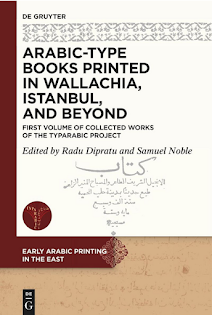
This new book, free to download in open access here, provides an Arabic edition and English translation of letters written in the circle of Orthodox churchmen and intellectuals around the secretary of the Patriarch Sylvester of Antioch. Taken alongside Mihai Țipău's monograph on Sylvester, published last year and available in open access here, we now have a vastly richer understanding of the life of the Patriarchate of Antioch in the immediate aftermath of the Melkite Schism.


The Correspondence of Mūsā Ṭrābulsī (1732-1787)
Critical Edition, English Translation, and Introduction

Habib Ibrahim, Eberhard Karls Universität Tübingen, Germany
 
The correspondence of Mūsā Ṭrābulsī preserved in the unique MS 300 of the Orthodox Syriac Patriarchate in Homs is a collection of 71 letters (+1 repeated) received mainly by Mūsā from various correspondents during his tenure as a secretary of Patriarch Sylvester of Antioch (1724-1766) and his travels in the Patriarch's company. The letters exchanged by Yūsuf Mark and Mūsā Ṭrābulsī illustrate the help that Sylvester received in Moldavia and Wallachia and his efforts to secure the printing of Christian Arabic books there in 1745–1747, and in Beirut in 1750–1753. Other letters connect Ilyās Fakhr and Sophronios of Kilis with this circle of Syrian intellectuals who supported many of Patriarch Sylvester’s projects.

The volume contains the Arabic edition of the letters, an English translation, an introduction presenting the biography of Mūsā Ṭrābulsī and key figures in the letters, a codicological study of the manuscript, and indexes. Through various sources, the editor was able to gather new bibliographical material. Thanks to these findings, we now have a deeper knowledge of the Nawfal family members, Mūsā himself, the books that interested him, and his translation activity. The present edition demonstrates that Mūsā was an exceptional figure in the history of the Antiochian patriarchate during the challenging period following the 1724 division. Although he did not attain higher ecclesiastical ranks, he was held in special esteem by the clergy of the patriarchate.