Showing posts with label Romania. Show all posts

Thursday, December 19, 2024

A New Open-Access Book on the Patriarch Sylvester of Antioch

Sylvester of Antioch:

Life and Achievements of an 18th-Century Christian Orthodox Patriarch

by Mihai Țipău

In 1724, Sylvester, a native of the island of Cyprus, was elected Patriarch of the Greek Orthodox Church of Antioch and All the East. For more than four decades, he endeavored to preserve the legacy of one of the earliest Christian Churches in the Levant. He faced major challenges because of the ever changing balance of power between the Latin Church and its missionaries, the Patriarchate of Constantinople, the French and English interests in the Levant, and the central and local Ottoman authorities. In his efforts to provide church books for the Arab Orthodox Christians, Sylvester was helped by rulers of the Romanian Principalities, Moldavia and Wallachia. He printed a number of books in Jassy and Bucharest and opened an Arabic press in Beirut. Alongside his patriarchal duties, Sylvester was also an accomplished icon painter. His works, in the Post-Byzantine Greek style of the 18th century, are preserved in Syrian and Lebanese churches, as well as elsewhere. Their study reveals just another aspect of his complex activity. The book presents for the first time in English the biography and achievements of Sylvester of Antioch, based on a wide range of contemporary Greek, Arabic and Romanian historical sources.

The book is available free for download here.

Tuesday, November 7, 2023

Ovidiu Olar: The Travels of the Patriarch Macarius of Antioch and the Liturgical Traditions of the Christian East

Ovidiu Olar, "The Travels of the Patriarch Macarius of Antioch and the Liturgical Traditions of the Christian East." Revue Des Études Sud-Est Européennes 53.1-2 (2023), 275-287.

Abstract:

This study proposes to demonstrate the importance of the account of the journey of the Patriarch Macarius of Antioch composed by his son, the Archdeacon Paul of Aleppo, as an eyewitness of the liturgical practices and traditions of the Christian East. The passages where Paul describes the multilingual liturgical celebrations are used to highlight the (principal) reason for the existence of two manuscripts held at the Library of the Romanian Academy: BAR Bucharest ms. roum. 1790 and BAR Cluj ms. roum. 1216.

Download and read it here.

Tuesday, September 26, 2023

Ioana Feodorov: Arabic Printing for the Christians in Ottoman Lands (Open-access Book)

Arabic Printing for the Christians in Ottoman Lands:

The East-European Connection

Arabic printing began in Eastern Europe and the Ottoman Levant through the association of the scholar and printer Antim the Iberian, later a metropolitan of Wallachia, and Athanasios III Dabbās, twice patriarch of Antioch, when the latter, as metropolitan of Aleppo, was sojourning in Bucharest. This partnership resulted in the first Greek and Arabic editions of the Book of the Divine Liturgies (Snagov, 1701) and the Horologion (Bucharest, 1702). With the tools and expertise that he acquired in Wallachia, Dabbās established in Aleppo in 1705 the first Arabic-type press in the Ottoman Empire. After the Church of Antioch divided into separate Greek Orthodox and Greek Catholic Patriarchates in 1724, a new press was opened for Arabic-speaking Greek Catholics by ʻAbdallāh Zāḫir in Ḫinšāra (Ḍūr al-Šuwayr), Lebanon. Likewise, in 1752-1753, a press active at the Church of Saint George in Beirut printed Orthodox books that preserved elements of the Aleppo editions and were reprinted for decades. This book tells the story of the first Arabic-type presses in the Ottoman Empire which provided church books to the Arabic-speaking Christians, irrespective of their confession, through the efforts of ecclesiastical leaders such as the patriarchs Silvester of Antioch and Sofronios II of Constantinople and financial support from East European rulers like prince Constantin Brâncoveanu and hetman Ivan Mazepa.

Download the entire book here. 

Wednesday, April 8, 2020

Ioana Feodorov: The Arabic Book of the Divine Liturgies Printed in 1745 in Iași by Patriarch Sylvester of Antioch

The open access journal Scrinium has just published an article by the Romanian scholar Ioana Feodorov on the Arabic Book of the Divine Liturgies published by the Patriarch Sylvester in Iasi in 1745. It can be read and downloaded in full here.

Abstract:

The following article focuses on a printed text of the Arabic Book of the Divine Liturgies, produced in 1745 in Iași (Jassy), capital of Moldavia, by Sylvester, the Patriarch of the Greek-Orthodox Church of Antioch (1724-1766), which is comprised, together with a section of a Syriac and Arabic manuscript commentary on some Gospel passages, in MS 15 of the library of Dayr Sayyidat al-Balamand (near Tripoli, Lebanon). It is a rare copy of this early Arabic printed book, whose existence was recently established. The study encloses an outline – based on Romanian, Greek and Arabic sources – of Patriarch Sylvester’s printing activity in Iași and Bucharest in 1745-1747, a description of the Book of the Divine Liturgies (Iași, 1745) preserved in the Balamand codex, and comments on the value of this finding for future research on the printing work carried out in the Romanian Principalities, in 1701-1747, for the Arabic-speaking Christians of Ottoman Syria.

Sunday, October 28, 2018

Jad Ganem: The Dangerous Rift

Arabic original here.

The Dangerous Rift

The Romanian Orthodox Church has spoken its word with regard to the recent developments that are sweeping the Orthodox world. In its decision, it emphasized the importance of "preserving unity through co-responsibility and cooperation between the Local Orthodox Churches, by cultivating dialogue and synodality at the pan-Orthodox level, this being a permanent necessity in the life of the Church. The unity of the Church is a holy gift of God, but also a great responsibility of the hierarchs, clergy, and lay believers." At the same time, it repeated its call "for the Ecumenical Patriarchate and the Moscow Patriarchate to arrive at a solution together [to the Ukraine issue], while preserving unity of faith and administrative-pastoral freedom, the latter representing a characteristic feature of Orthodoxy." Anyone who reads this statement cannot but welcome its stressing the importance of conciliarity as the basis for organizing the life of the Church, as a means of resolving internal disputes and preserving the grace of unity. One is however quickly startled by the manifest contradiction between the general principles emphasized in this statement and its approach to solving the Ukrainian issue on the basis of bilateral agreement between the two concerned patriarchates, which abstracts the issue from its risk to the entire Church and is in total contradiction to conciliarity. This statement once again demonstrates the profound ecclesiological crisis from which the Orthodox Church is suffering, as she is experiencing a dangerous rift between her teaching and her practice and for centuries has been incapable of embodying her ecclesiology in the details of her organizational life and her lived reality.

Tuesday, January 30, 2018

The First Gospel Printed in Arabic in the Middle East

This appeared without attribution in the bulletin of the Archdiocese of Mount Lebanon, here.

The First Gospel Printed in Arabic in the Middle East

Patriarch Athanasius Dabbas was born in 1647 in the city of Damascus with the name Boulos, son of the priest Fadlallah. He received his primary education at the Orthodox Patriarchate. Then he learned the trade of weaving and practiced it with his uncle. After this, the young Boulos entered the famous Monastery of Mar Saba near Bethlehem, where he was tonsured a monk with the name Paisios, then a priest with the name Procopius, until he became the abbot of that monastery. There he learned Greek, excelling at it and mastering its grammar, just as he had excelled at Arabic. Dabbas was head of the Patriarchate of Antioch twice, first from 1688 to 1694, then from 1720 to 1724. In the intervening period, Dabbas headed and cared for the affairs of the Archdiocese of Aleppo. Greek sources likewise indicate that he was elected honorary or regent head of the Church of Cyprus from 1705 to 1709.

Dabbas was famous for having, directing and putting into use the first Arabic printing press in the Middle East. At the end of the seventeenth century (1697-1700), Aleppo suffered an economic crisis causing serious hardship for its population on account of drought and a high cost of living. At the beginning of the eighteenth century, Dabbas undertook a journey that led him to Constantinople, then to Moldavia and Wallachia in order to collect material assistance for his diocese and its people. Additionally, this journey to the countries of Eastern Europe was undertaken in order to secure assistance for the Patriarchate of Antioch in order to put a stop to the activity of Western (Protestant and Catholic) missionaries, which was intensive in the seventeenth and eighteenth centuries.

We do not know precisely when the journey began, but we know that Dabbas was in Bucharest in March of 1700. There he was the guest of its ruler, Prince Constantin Brâncoveanu (1688-1714), a saint and martyr who is commemorated in the Church on August 16. There, in May of that year, he blessed the marriage of the prince's daughter. Prince Constantin learned that the Patriarchate of Antioch's books were still in manuscript form, so he ordered that a printing press with Arabic letters be made and gave it to the Patriarchate of Antioch. This is after he himself had financed Romanian and Georgian printing presses.

There in Bucharest Arabic printing was graced with an edition of the Orthodox liturgy, when the Priest's Kontakion and Great Euchologion were printed under the supervision of Dabbas and the monk Anthim the Iberian, who made Arabic letters for the press. This monk knew many languages, including Turkish, which at that time was written in Arabic script and so he was able, with Dabbas' help, to make new letters. After Athanasius mastered the art of printing, he took the press to Aleppo as a gift from the prince and this was the first Arabic printing press in the Middle East. Its first production, in 1707, was the Four Gospels.

In Aleppo, the patriarch oversaw not only the technical aspects of printing, which he had learned during his stay in Romania, but also the texts of the books, their orthography, and the eloquence of their language. He was not content to print the texts of the manuscripts he possessed, but rather he generally revised the texts and corrected weaknesses or errors in them. This is attested in the introduction to the Four Gospels, where the Patriarch Dabbas writes that he printed the book "where I corrected its Arabic word by word."

Patriarch Athanasius Dabbas is regarded as the final figure of a cultural period that lasted over a century, beginning with Patriarch Euthymius III Karma at the beginning of the seventeenth century, brought to its perfection by Patriarch Macarius ibn Za'im, then finally crowned by Dabbas with his bringing printing to the Middle East. 

This effort of his to obtain an Arabic printing press was motivated by pastoral needs. First, because of the importance of liturgical life for the faithful, Patriarch Dabbas unified the texts of all the prayers held in the churches of the Patriarchate of Antioch. Using his printing press, he took them from manuscripts filled with errors to books printed under the supervision and guidance of the Patriarchate. The Patriarchate of Antioch became one in practice on account of these books, which unified the rites and liturgy. 

Second, Dabbas intended to popularize reading of the Gospel and theological books. He helped people to acquire the Gospel and other books through the press, which printed hundreds of copies. The patriarch discussed this effort of his in the introduction to the Four Gospels, which he printed under the title The Book of the Noble, Pure Gospel and the Bright, Illuminating Lamp [Arabic book titles were almost always long and rhyming in this era]. He says in this introduction, "In order to make it easier for you to acquire and possess it, I have endeavored to print it." He believed that owning a copy of the Gospel is "the duty of every believer", as it contains "concepts sufficient for all classes of people", clergy, monks, married people and unmarried people. For Dabbas, acquiring the Gospel first of all means reading it and grasping its meanings, so that it may be in every house like "an invincible weapon and a decisive attack" against strange and heretical teachings.


Friday, December 19, 2014

How Bishop Qais Sadeq Entered The Patriarchate of Antioch

From an interview in this month's Majallat al-Nour. Arabic original in pdf here.

Who is Qais Sadeq?

I was born in Amman, Jordan in 1954. My father is Fuad bin Georges Sadeq who put on the robe of Christ in the baptismal font of the Church of Saints Sergius and Bacchus in Kousba, al-Koura, the village of his fathers and grandfathers. My mother is from Ramlet al-Bayda, Palestine. I received my general Jordanian secondary diploma in literature in 1972 from Taj High School in Amman. On the Feast of the Cross, September 14, 1986 Patriarch Ignatius IV ordained me as a celibate deacon at Holy Cross Cathedral in Damascus and as a priest in the same cathedral on September 14, 1988. I was elevated to the rank of archimandrite by Patriarch Ignatius IV on March 11, 1990 and was appointed as an advisory judge for the spiritual appeals court in Damascus (Patriarchal Decision no. 84/1990). On May 6, 1992, I was appointed pastor of the Church of Saint George in Damascus and pastor of the Romanian Orthodox in Damascus. With the blessing of Patriarch Ignatius IV, I returned to Amman to be a consultant at the Crown Prince's Office for Christian Affairs (1995-1999).

How did you come to the Patriarchate of Antioch?

In June, 1972, I came to Balamand from Jordan for the first time to participate in summer training workshops held by the Orthodox Youth Movement. Among those I met there were the Metropolitan of Mount Lebanon, the engineer Michel (now Metropolitan Ephrem) Kyriakos, Hani (now Patriarch John X) Yazigi, members of the Holy Synod of Antioch and senior members of the Youth Movement.

After two months, with the blessing of Patriarch Elias IV I returned once more to Balamand as a patriarchal student at the Saint John of Damascus Institute of Theology. Among those under whom I studied were Patriarch Ignatius IV of thrice-blessed memory, then Metropolitan of Lattakia and dean of the Institute; His Eminence Metropolitan Elias (Audi), his assistant; Sayyedna Georges Khodr; Nadim (Fr Paul) Tarazi; and Dr Adib Saab. Among my colleagues during my studies then were Metropolitans Elias (Kfoury), Samih (Mansour), Georges (Abu Zakhem) and Paul (Bendaly) of blessed memory. However, God's will was that I leave Balamand before the end of the first term and go to Bucharest in order to receive theological instruction at its theological institute as a student from the Patriarchate of Antioch.

How did you come to Romania?

Through the World Fellowship of Orthodox Youth  Movements (Syndesmos) and with the blessing of Patriarch Justinian of thrice-blessed memory (the patriarch of the Romanian Orthodox Church), I received a scholarship to do theological studies at the Orthodox seminary in Bucharest, Romania. Because of the position of the Orthodox spiritual leadership of Jerusalem toward Arab members of the Church, the bishop of the diocese (Diodoros, later patriarch of Jerusalem) refused to grant me a certificate of his blessing, claiming that the Church of Jerusalem was not in need of theologians and that the priests and servants that it already had were enough for it. Because of Patriarch Justinian's understanding of the pastoral situation in the See of Jerusalem, he regarded me as a member of the Romanian Church and so did away with the need for a recommendation from Jerusalem. With the blessing of Patriarch Elias IV and the encouragement of the dean of the Saint John of Damascus Institute of Theology at the time, Metropolitan Elias (Hazim), the future patriarch, I entered the Orthodox seminary in Bucharest at the end of the first term as a member of the Antiochian and Romanian Churches. This provoked a protest from the Church of Jerusalem, headed by Patriarch Venediktos, his vicar Metropolitan Basilios and the bishop  of Jordan, Diodoros against the Church of Romania. However, the unity of the position of Antioch and Romania resolved the issue.

Thursday, July 11, 2013

Downloadable Articles on Arab Orthodox History

Academia.edu has done a lot to democratize access to academic articles. Linked below are recent articles pertinent to Arab Orthodoxy that can be viewed and downloaded there....


--Un ancien calendrier melkite de Jérusalem (Sinaï syr. M52N)


--La visión inicial del Islam por el Cristianismo oriental. Siglos VII-X


--The Constitution of Christian Communal Boundaries and Spheres in Jordan


--The Arabic Translations of the Lectionary


Liturgical Byzantinization in Jerusalem: Al-Biruni’s Melkite Calendar in Context
 Worship of the Holy City in Captivity: The Liturgical Byzantinization of the Orthodox Patriarchate of Jerusalem After the Arab Conquest (8th-13th c.)


--Quand les « grecs-catholiques » dénonçaient les « grecs-orthodoxes » : la controverse confessionnelle au Proche-Orient arabe après le schisme de 1724


--Bibliography of Syriac and Christian Arabic Studies in Russian, 2010-2012


--The Influence of Latin-Melkite Relations in the Land of Transjordan From the Rebirth of the Latin --Patriarchate to the Foundation of the Archdiocese of Petra and Philadelphia (1866-1930)
--Religious communities and tribal culture in Ottoman Transjordan The overlap of two different cultural horizons
--Transjordan during the 19th century. Reconsidering the relation between Arab tribes and Christian religious communities
--The Modern Image of the Holy Land Through the Manuscripts of Some Christian Missionaries


--Handlist of Manuscripts at the Antiochian Heritage Library, Ligonier PA
--The Concept of God's Unity according to Abdallah ibn al-Fadl al-Antaki
--(with Alexander Treiger) Christian Arabic Theology in Byzantine Antioch 'Abdallāh ibn al-Faḍl al-Anṭākī and his Discourse on the Holy Trinity


--Between umma and dhimma. The Christians of the Middle East under the Umayyads


--The Indigenous Christians of the Arabic Middle East in an Age of Crusaders, Mongols, and Mamlūks (1244-1366)


--Fonti indirette e nuove fonti manoscritte nell'opera teologica di Sulayman al-Ghazzi
--Les versions arabes du Martyre de Saint Aréthas
--UN TRATTATO SUL MICROCOSMO DI SULAYMĀN IBN ḤASAN AL-ĠAZZĪ


--Arabo-Byzantine Traffic of Manuscripts and the Connection between the Greco-Arabic Translation --Movement and the First Byzantine ‘Renaissance’ (9th–10th Centuries)


--La correspondance du patriarche d’Antioche Athanase IV Dabbâs avec la cour russe : à propos de l’imprimerie arabe d’Alep
--Le premier voyage du patriarche d’Antioche Macaire III Ibn al-Zaʽîm à Moscou et dans les Pays roumains : 1652-1659


--Some Aspects of Protestant-Orthodox Relations in Modern Times, a Historical Analysis


--A Unified Bibliography on Christian Arabic (2000-2012)
--‘Abdallāh ibn al-Faḍl al-Anṭākī (11th-century translator and Arab Christian Theologian)

--Ṣāliḥ ibn Sa‘īd al-Masīḥī (Christodoulos) (11th-century Arab Christian author of Marginal Notes)
--Michael al-Sim‘ānī, The Arabic Vita of St. John of Damascus


--Some Historiographical Remarks on Medieval and Early-Modern Scholarship of Biblical Versions in Arabic: A Status Quo

Wednesday, February 13, 2013

Patriarch Daniel of Romania's Message to Patriarch John X

Romanian original here.


Your Beatitude Patriarch John
of Antioch and all the East
Beloved brother in Christ, Master, and Co-celebrant,


The selection of Your Beatitude as Patriarch of Antioch and all the East was received by the hierarchs, clergy, and faithful of the Romanian Orthodox Church with great spiritual joy. Through the work of the grace of the Most Holy Spirit, through Whom all good things are fulfilled, you have been entrusted with shepherding the right-believing people in the entire venerable apostolic Patriarchate of Antioch-- a church blessed with a multitude of holy martyrs, hierarchs, monks, theologians, and missionaries.

We are confident, your beatitude, that the rich experience that you have had in the realm of academic theology at Balamand University as well as on an international level as the shepherd of Arabic-speaking Orthodox believers in Europe will be of great use to you in the context of the difficult trials that Christians in the Middle East are experiencing at this time.

Over the centuries, fraternal relations between our sister Orthodox churches have continuously developed, especially during difficult periods of their history. Good fraternal relations have consolidated common witness, manifest in unity of dogma, canons, and ritual, as well solidarity through practical cooperation, especially in preserving and promoting the spiritual and cultural idenitity of Arabic-speaking Orthodox Christians. It is therefor our duty at the present to continue and to deepen these bonds between our sister Orthodox churches, especially during this period of deep and rapid transformation in contemporary society. Across time, Orthodox Christians in the entire Patriarchate of Antioch have suffered much but they have resisted and have faithfully preserved the faith received from the Holy Apostles Peter and Paul.

We are confident that if we constantly promote " the unity of the Spirit in the bond of peace" (Ephesians 4:3), God will help us to give together a Christian witness of peace and cooperation for the common good.

Therefor we pray to Christ the Lord, "the Good Shepherd" (John 10:11) and the "High Priest of our confession" (Hebrews 3:1), to grant you His help in the service so important and heavy with responsibility as Primate of the Patriarchate of Antioch and all the East and in guiding along the path of salvation the people that you have been entrusted to shepherd.

At this beginning on the way of your beatitude's patriarchal service, we congratulate you and wish you many years and blessings!

With brotherly love in Jesus Christ and choice esteem,

+Daniel
Patriarch of the Romanian Orthodox Church

Wednesday, May 4, 2011

A Meeting of Arab Orthodox Living in Romania

Romanian original here.


Meeting of Arab Orthodox of Romania

Around the great feasts, the community of Arab Orthodox Christians in Romania meets at the Patriarchal Palace. On the occasion of Holy Pascha, representatives of the community were received in the “Christian Europe” hall by patriarchal vicar, His Grace Ciprian Câmpineanul, reports Trinitas TV.

“Every year, with the blessing of Patriarch Daniel, there is a meeting at the patriarchal palace on the occasion of Easter between the bishop of the place or the bishop’s delegate and the community of Arab believers who are also to some degree pastored by an archimandrite, Father Qays, sent by Patriarch Ignatius of Antioch. On Thomas Sunday, with the blessing of Patriarch Daniel, I met with them at the patriarchal palace and gave them a message from the patriarch and from myself. Then we began to discuss various problems. It is something extraordinary, since they try to be together as much in the church as outside of it, which contributes to their maintaining both their national identity and the identity of their faith,” said His Grace Ciprian Câmpineanu.

Recently, the Arab Orthodox community in Bucharest has grown, which has led to the allocation of a designated space for their liturgical activities.

“We should mention that in Bucharest there are very many Christians of different confessions, including Arab Orthodox Christians from many countries, from Syria, Lebanon, Egypt, Jordan, or from Palestine. They have become established in Bucharest for a long time on account of their work or because they have married Romanian Orthodox, they have children whom they educate in the spirit of Christian faith. They study in Romanian schools and participate in services on Sundays and feast days for the most part at the church of St. Dumitru-Poştă, though also in other churches. However, on the two greatest feats, the Nativity of the Lord Jesus Christ and the Resurrection of the Savior, Archimandrite Qays comes specially to perform the services in Arabic, to hear their confessions, and to listen to their problems,” His Grace said.

The Patriarchate of Antioch has delegated an archimandrite who comes to Romania on various occasions and officiates services for the Arab Orthodox.

“They are very happy when they hear the service in their native language, as in the Romanian proverb ‘blood doesn’t become water’ and it is very important for them to be able to pray the liturgy also in their own language. This has been possible through the blessing of the .Patriarch of Romania, who has allowed them to meet at the church of St. Dumitru- Poştă,” pointed out Bishop Ciprian Câmpineanul

“It is something normal for the flock to meet with shepherds and it is a space for meeting and communication with the Church’s hierarchy, that is, between the flock and the shepherds in order to discuss all the challenges that the Arab Orthodox community of Romania faces,” said Archimandrite Qays Sadiq.

The reunion at the Patriarchal palace has become a tradition that seeks to strengthen relations between Arab Orthodox believers.

Tuesday, August 31, 2010

Romania and the Arab Orthodox

The following is from a paper by Romanian scholar Ioana Feodorov, given this year at the 21st International Conference of Historical Sciences in Amsterdam. The full paper, with extensive footnotes is available as a pdf here.


Romanians and Near Eastern Arabs,
Connections through Christian Orthodoxy

Ioana Feodorov, Bucharest


[...]


At a time when Christians all over the Ottoman Empire were brought together by aspirations for freedom of belief, cultural progress and national identity, the Romanians shared with Arab Christians a special responsibility: that of being heirs of the Byzantine legacy, always present in the ritual and spiritual life of the Orthodox'. Near Eastern Churches differ in terms of their cultural features (Greek, Coptic, Syriac, Armenian, and Arab) and their attachment to the resolutions of the Councils of Nikeia (325), Ephesus (431) and Chalcedon (451) as to the nature of Christ. Of all Christian communities of Arabic expression, the Antiochian Orthodox Church, which uses the Byzantine liturgy and dates from apostolic times (alongside the other four that share this glory - Jerusalem, Alexandria, Constantinople and Rome), is the one with which the Romanian Orthodox have had close ties since the 16th century.

Though considered by Muhammad, alike Muslims and Jews, 'People of the Book' (Ahl al-Kitab), Christians were persecuted since the first Islamic century, when the population of Nagran was banished to 'Iraq. After 1516, when the Ottomans conquered the Near East, building churches was repeatedly forbidden, Christians were often forced to live isolated in certain neighbourhoods of the main cities (Damascus, Aleppo, and Mossul) and to take refuge to Mt Lebanon or the Kurdistan, while the tax applied to non-Muslims, gizya, was accompanied by a humiliating status of 'second rank citizens'. Economic difficulties and the repeated vexations from the governors appointed by the High Porte made the Christian Arabs incapable of social and cultural progress, unable to defend their spiritual identity.

In these circumstances the Antiochian patriarchs Makarios III Ibn al-Za'im (1647-1672), Athanasios III Dabbas (1720-1724) and Sylvester of Cyprus (1724-1766) took upon themselves the difficult task of preserving the Christian spirituality in its Arabic expression. The special relationship that certain Eastern Churches had with the Holy See was not encouraging: the authority of the Roman institutions often manifested itself through constraints regarding the attachment to Catholic dogmas. Arabic books printed in Italy required many approvals, lest any "doctrinal error" crept in that would have reflected the creed of a Church other than the Maronite. Biblia arabica had been conceived by Near Eastern scholars based on old local translations, in order to preserve the liturgical traditions proper to Arab Christianity: nevertheless, the Roman theologians ruled for the printing of a new translation of the Vulgata. Liturgical books freely given to the Eastern churches by Catholic missionaries were meant to replace the old Arabic manuscripts that had been used by generations of priests.

The gloomy situation of their communities convinced the hierarchs of the Antiochian Church to look for help in Eastern Europe, where they travelled in search of financial and spiritual help, beginning in the 16th century. The favourable answer that they received from Romanian princes encouraged them to embark on long and perilous journeys. The expectations of these unusual travellers relied on the spiritual solidarity and the benevolence of the Romanian rulers, who had supported the Eastern patriarchates and monasteries since the 14th century." Although kept apart by wide stretches of land and sea, the Romanians and the Antiochian Arabs succeeded in establishing contacts that resulted in important cultural acts. The situation was comparable for the Romanians and the Levantines in many respects, although they were subjected to the Ottoman domination in rather different forms. In the 16th century, acknowledging their Arab identity, Christians of the Antiochian Church (the only Patriarchate were Arabic has been used continuously as official language) aspired to replace the traditional church language-- Greek with the Arabic vernacular". At the same time Romanians were striving to move from the old ritual language Slavonic to their spoken language, Romanian: here too the necessity emerged to spread Liturgical texts through books printed in the people's vernacular.

Moreover, the ties of the Oriental Churches with Eastern Europe helped Christian Arabs assert their role as part of a civilization deeply rooted in spirituality. Unsurprisingly, present-day Lebanon and Syria, lands of many creeds and ethnic groups (with 42% of the population registered as Christian in Lebanon in 1992) were in the front line of the 19th century Arab Renaissance, Al-Nahda, born in Aleppo. Consequently, the French, English and American missionaries found in these provinces the good ground where they set up schools and printing-shops, encouraging the emergence of modern political and cultural movements. The Romanians contributed to these changes readily and fair-mindedly, acting in the spirit of their self-ascribed mission of relief for the Eastern Christian communities.


The first Arab visitor was, presumably, Patriarch Yuwaklrn Ibn Da'wu who crossed the Romanian territory in 1581, heading for Poland, and reported his passage in a poem (unfortunately lost). From 1652 to 1658, Patriarch Makarios III Ibn al-Za'im and his son, Archdeacon Paul ('of Aleppo', Ar. Bulos al-Halabiyy) travelled to the Romanian Principalities, the Cossaks' land and Russia. Athanasius Dabbas, who had temporarily relinquished the Patriarchal see of Antioch to his competitor Cyril Ibn al- Za'rm, visited Wallachia and established durable ties with the local princes and hierarchs. His disciple and successor Sylvester of Cyprus repeatedly sojourned at the princely courts of Bucharest and Iasi, Resuming his forerunners' projects of printing and financial support for the Syrian Christians, he obtained in 1746 from Prince Constantin Mavrocordat the repair and re-consecration of the old church of St. Spyridon in Bucharest, a metochion of the Patriarchate of Antioch.

Following up the research carried out in the 20th century by scholars like Nicolae Iorga, Vasile Radu, Marcu Beza, Dan Simonescu, and Virgil Candea, the considerable crop of literary and historical texts generated by the above-mentioned connections requires further examination. After a long period of neglect, several projects are now promoted by a new generation of Romanian researchers, proficient in Arabic and Greek, aiming to shed more light on the rich information provided by Christian Arabic historical sources.

1. An up-to-date record of the Arabic texts that refer to the Romanians and the Balkan peoples in the 17th-18th centuries.

Considering the eagerness of the Arab hierarchs to bring home spiritually
useful texts, a careful search of Near Eastern libraries and archives (public,
ecclesiastic and private) for surviving copies of journals, letters and literary works will definitely result in interesting finds concerning the circulation of ideas from Europe to the Near East. Catalogues of manuscripts in major libraries of Lebanon have increasingly become available, while recent research focuses on cataloguing and describing documents that reflect the cultural exchanges between Europeans and Levantine Christians. The texts and correspondence that originate in the Arab provinces, dated in the 17th-18th centuries and preserved in Romanian collections, have not been properly investigated yet.

An interesting case is that of Demetrius Cantemir's work The Divan, translated into Arabic by Athanasius Dabbas in 1705, based on the Greek version enclosed in the edition of 1698 (Iasi). Identified in 1969 in Lebanon by the Romanian scholar Virgil Candea as an unknown translation of Cantemir's first printed book, this text has recently been edited and translated into English. Book III of Cantemir's work encloses an entire work written by the Polish Unitarian Andzrej Wiszovaty, Stimuli virtutum, fraena peccatorum, ut et alia eiusdem generis opuscula posthuma (Amsterdam, 1682), a rare example of a Protestant work that reached, via Greek, the Christian Arabic literature.

2. Editions and translations of Arabic works that refer to Romanian history.

During their visits to Eastern Europe Patriarch Makarios III and his son Paul spent nearly four years on Romanian territory. The journal that Paul kept with utmost care and detail survived in several copies of approx. 700 pages each, enclosing unique data on history, politics, society, religious life, personalities, traditions, architecture, etc. This is recognized as an outstanding source of information for the historical research on Romania, as well as Syria, Turkey, Bulgaria, the Ukraine, and Russia. Never edited and translated in its entirety, this text is the object of a research theme conducted at the Institute for South-East European Studies of the Romanian Academy in Bucharest. The end result of this theme will be a complete edition and English translation of the longest and richest manuscript, Ms. Arabe 6016 of BnF-- Paris, in cooperation with Russian researchers (Institutes for Oriental Studies in St. Petersburg and Moscow).


Makarios III also wrote notes and miscellanies that enclose texts on Romanian, Bulgarian, Georgian and Russian historical topics (Magmu' Latif, Magmu' mubarak, a.o.). Two chapters regarding the Romanians were edited and translated by this author, La Chronique de Valachie (J292-1664) and The Arabic Version of the Life of Saint Paraskevi the New. 16 The same collections enclose texts that were adapted from famous works by Paisios Ligarides, Dorotheos of Monembasia, Agapios Landos, Damaskinos Studites, etc., acquired or copied by Patriarch Makarios III durning hiS Journeys.


3. Catalogues of the Oriental manuscripts preserved in Romanian libraries.

After a first step towards a catalogue of the Oriental manuscripts was taken in 1946, the Iranian researcher Mohammad Ali Sowti recorded thirty years later in a catalogue (never published) 721 Oriental manuscripts, including Arabic, preserved in the largest collections in Bucharest and Cluj. The author's hope was that his efforts would be continued: "I have tried to help future research into Turkish and Arabic manuscripts, to the extent that the data I present herewith encloses previously unpublished clarifications and information. In the absence of specialists in Oriental codicology and cataloguing, the record was not brought to completion". The Library of the Romanian Academy is preparing a project concerning the description and online catalogue of its Oriental collections. This requires the cooperation of foreign specialists in codicology, cataloguing and specialized software, alongside support for European funds dedicated to increasing the accessibility of Oriental collections. Completing this record will help both the Romanian research community and the progress of world surveys of Islamic and Christian Arabic manuscripts, which have been under special focus in the last decades.


4. Defining the Romanians' contribution to the beginnings of printing in the Near East.

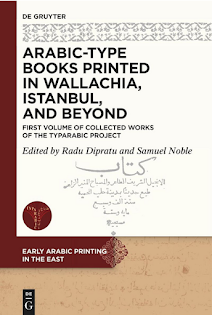
Around 1700, Athanasios Dabbas travelled to Wallachia several times and was hosted by Prince Constantin Brancoveanu (1688-1714). The Romanian ruler helped him print the first church-books in Arabic script, asking the scholar and master engraver Antim Ivireanul ('the Iberian') to carve a set of Arabic types. Two books were printed in Wallachia in Greek and Arabic: a Liturgikon (Al-Qondaq al-falahi, 252 pp.) in 1701 (Snagov), and a Book of Hours Kitab al-Sa 'at, 711 p.) in 1702 (Bucharest). When leaving the Wallachian capital in 1705, Dabbas received from Brancoveanu the Arabic types and printing implements, installing them at the Metropolitan residence of Aleppo. Eleven books were printed there between 1706 and 1711: the first was the Psalter (Kitiib al-Zabiir al-sarifi, showing on the first page Brancoveanu's coat of arms. Then followed the Gospels (Kitab al-Ingil al-Sarif alTahir wa-l-misbdh al-munir al-lahiry, the Book of the Chosen Pearls (Kitab al-durr al-muntahab) enclosing 34 homilies by St. John the Golden Mouth, and in 1708 a second edition of the Gospels, the Book ofProphecies, the Apostle, a.s.o. These books were later edited again and again in the printing-shops of Lebanese Christians.


In 1745-1747 Patriarch Silvester of Antioch addressed the Prince of Moldavia Ioan Mavrocordat for help in printing books for the Christian Arabs: the Liturgikon, the Aleppo Psalter and several polemical works (among them, The Proof of Truth and Transmission of Justice by Patriarch Nectarios of Jerusalem that Sylvester had translated in 1733 as Qadii al-haqq wa-naql al-sidq). In a recent book devoted to the life and works of Patriarch Athanasios III Dabbas, A. C. Dabbas stated that Patriarch Sylvester re-installed in 1747 at the Metropolitan residence of Aleppo the old press brought by his ancestor. A fourth episode, less documented, is the establishment by the Christian Arabs of the first press in Beirut after 1750, transferring the old one from Aleppo. A symposium held in Bucharest last year addressed the issue of the Romanians' contribution to printing in the Balkans and the Near East, including a paper, by this author, about the Arabic books printed in Wallachia and Syria before the middle of the 18th century. Whatever the particulars of these events (still under scrutiny), they resulted in a transfer of printing technology and know-how from Wallachia and Moldavia to Aleppo and neighbouring areas. Thus, European culture, in its Romanian forms, was "imported" in the Near East in order to fulfill the Christian Arabs' needs, similar to those of all the Sultan's subjects.

At the present time, the model of living together that Christian Arabs and Muslims of the Near East have provided for centuries is becoming increasingly interesting. Long before it was promoted by missionaries sent from Rome, the dialogue between Christianity and Islam was lived effectively, on a daily basis, by the multi-confessional Arab communities of the Eastern Mediterranean lands. Nowadays when attitudes towards Near Eastern peoples are constantly reappraised, the progress of this research is encouraged by an increased interest of the scholarly circles for the Christian Arabs, a diverse but neglected community, spread all over the world. By completing the projects that I have mentioned, Romanian researchers have the opportunity to participate in a truthful and more detailed definition of the Christian Arab civilization in its relationship with South-East Europe.