Showing posts with label liturgy. Show all posts

Thursday, August 20, 2026

New Open-Access Book- Books Printed for Arab Christians in the 18th Century: A Descriptive Catalog

Archimandrite Policarp Chiţulescu and Yulia Petrova, Books Printed for Arab Christians in the 18th Century: A Descriptive Catalog (De Gruyter, 2026)

About this book

This catalog provides descriptive records of 54 Arabic books printed in Eastern Europe and the Arabic-speaking communities in the Ottoman East during the 18th century. It offers a thorough overview of the connections established through printing between the Romanian principalities and Arabic-speaking Christians in the eastern Mediterranean during this period. The catalog emphasizes the social progress that the printing culture brought to the Near East, to which Romanians made a significant contribution. The catalog also addresses the historical context of these connections and the printing activities of several prominent political and ecclesiastical figures. The books presented here are pivotal to the cultural history of the Ottoman East. They have been particularly significant in the context of conserving Byzantine-based Christianity in Arabic-speaking provinces in the region. Additionally, these books contributed to the standardization of Arabic liturgical texts and greatly influenced Christian Arabic literature. This catalog will be of interest to historians of the Arabic printed book, researchers of Arab Christian communities under Ottoman rule, as well as librarians and antiquarians because it will enable them to accurately identify and describe the 18th-century Arabic editions in their collections.

Author / Editor information

Policarp Chiţulescu, Romanian Patriarchate, Bucharest, Romania; Yulia Petrova, Krymskyi Institute of Oriental Studies of the National Academy of Sciences of Ukraine


Download for free here. 

Thursday, April 16, 2026

Fr Alexander Treiger: Patriarch Athanasius III of Alexandria's Arabic Encyclical Epistle (ca. 1300 AD)

Alexander Treiger, "Patriarch Athanasius III of Alexandria's Arabic Encyclical Epistle (ca. 1300 AD)," The Historical Reporter 53 (2025), 344-359.

Abstract:

The article presents, for the first time, an Arabic encyclical epistle by the Melkite Orthodox patriarch of Alexandria Athanasius III (sed. ca. 1275--ca. 1315), written during his exile in Constantinople. It is preserved in the unicum 14th century manuscript Sinai ar. 451 and is addressed to Athanasius III's locum tenens archbishop Peter (otherwise unknown). In this epistle, Patriarch Athanasius shares his views on the proper order of church life and seeks to correct certain problematic practices that had become widespread among Orthodox Christians in Egypt. Patriarch Athanasius' recommendations include the following: the liturgy is to be celebrated at the third hour (9am in modern time-reckoning), the antidoron should be handled in a proper fashion, hot water must be added into the chalice towards the end of the liturgy, it is forbidden to rent candles for use at the church or to use oil from the church lamps for worldly purposes, and some others. The epistle sheds light on both day-today life and liturgical practices of the Egyptian Melkites, on the progressive Byzantinization of their church services, and on their struggles under Mamlūk rule; it adds important details to the portrait of this outstanding Alexandrian hierarch. If earlier we knew him only as a church official of the era of Emperors Michael VIII and Andronicus II Palaiologos, as the author of an epistle to the Russian Church, and as a bibliophile, the epistle published herein allows us to see him as a pastor caring for his flock. The article includes a critical edition and English translation of this important treatise. 


Download the article here. 

Monday, November 10, 2025

Venera Kotchlamazashvili on the 17th Century Arabic Translation of the Typikon

 Venera Kotchlamazashvili, "Peculiarities of the 17th c. Arabic Translation of the Typicon of Mar Sabas's Laura and Its Role in the Revival of Christian Arabic Literature," Herald of Oriental Studies 1 (2025), 564-583.

 Abstract:

This paper deals with the development of 17th century Christian Arabic literature and discusses the significance of one of its literary monuments. In the 17th century, both the clergy and the laity of the Patriarchate of Antioch were Arabic-speaking Christians, and the renewal of translation processes contributed to raising the level of education among the clergy in their native language. This study places particular emphasis on the Arabic translation of the Typicon of Mar Sabas, which, as a significant example of ecclesiastical literature, plays an important role in the Greek Orthodox liturgical tradition. This research is based on comparative-philological, historical, and linguistic methodologies, which allow for an analysis of the textual and structural changes in the translations. The paper analyzes the main manuscripts that reflect the linguistic and cultural tendencies of the period. The findings of the study indicate that Christian Arabic literature is not only a component of religious practice but also a significant phenomenon within a broader cultural and linguistic context, reflecting the transformation of Greco-Syriac traditions within the Arabic cultural sphere.

Download the entire article here. 

Sunday, July 13, 2025

Elie Dannaoui on the Transition from Syriac to Arabic in the Orthodox Liturgy


When Scribes Switched Languages: Curious Patterns in Syriac Rūm Orthodox Manuscripts

by Elie Dannaoui

Imagine opening a centuries-old manuscript and finding three different languages woven together on the same page—Syriac prayers in elegant script, Arabic translations squeezed between the lines, and Greek annotations scattered in the margins. This isn't the work of confused scribes, but rather the ingenious solution of a religious community navigating one of history's most significant linguistic transformations.

The Rūm Orthodox Patriarchate of Antioch experienced a major linguistic transformation over its first millennium. What began as a Greek-speaking church that also embraced Syriac gradually transformed as Arabic spread throughout the region following Islamic expansion in the 7th century. By the 19th century, Syriac had virtually vanished from the church's daily life—a language that had once echoed through monastery halls and parish churches was effectively silenced.

But here's where the story gets fascinating. The manuscripts from the 14th to 18th centuries—a period that has received surprisingly little scholarly attention—reveal that this wasn't simply a case of one language bulldozing another. Instead, these documents showcase remarkable creativity: scribes developed sophisticated strategies to preserve ancient traditions while making them accessible to communities whose daily language was shifting to Arabic.

The surviving manuscripts tell a story of adaptation rather than abandonment. Monastic communities emerged as guardians of the Syriac tradition, creating innovative multilingual arrangements and parallel translations. Most intriguingly, they developed a nuanced system where Syriac remained the language of priestly prayers and sacred elements, while Arabic served the growing needs of lay participation.

Read the whole article, with many images of manuscripts, here! 


Friday, June 20, 2025

Veneration of St Gregory Palamas in the Melkite Catholic Church

Because the question of the veneration of St Gregory Palamas by Eastern Catholics comes up from time to time on social media, I thought it might be useful to see how his commemoration was restored in the Melkite Catholic Church in the early 1970s. The debate that this caused was somewhat contentious, but some of the information raised by various participants is also quite useful for the history of liturgy within the Orthodox Church of Antioch. Of particular interest, to me at least, is that, despite the large number of available Arabic and Syriac manuscripts, no one seems to have identified any Greek liturgical manuscripts used in the Patriarchate of Antioch in the 14th-17th centuries. Also, the letter to the Propaganda Fide attributed to Patriarch Athanasius Dabbas is very unlikely to have been written by the patriarch himself, who by 1718 had already decisively turned against the Latin missionaries. It should almost certainly be attributed to his ardently Catholic secretary, Abdallah Zakher, who is known to have written two short anti-Palamite treatises and in other matters (such as the affair of Euthymius Sayfi) is known to have been reprimanded by Dabbas for writing hyper-Latin statements in his name.

The following is translated from the journal Istina 21.1 (1976), 55-65:


On the “Reintroduction” of the Feast of Gregory Palamas in the Melkite Liturgy

A small phrase, slipped without malice into the introduction to issue 3, 1974 of Istina, dedicated to Gregory Palamas, has provoked correspondence that we think is useful to bring to the attention of our readers. The phrase that became a topic of debate was the following: “These facts should incite Catholics who lay claim to the entirety of the patristic tradition to extreme circumspection about the fundamental thesis of Palamism. Otherwise, they risk doing like the Eastern Greek patriarchate which, in its haste to ‘reintroduce’ Palamas into the liturgy, did not realize that, when it was still Orthodox, it had never given him such a place” (p. 259). One will quickly recognize an allusion to the decision of the Holy Synod of the Melkite Church held at Ain Traz in August 1971.

We will first publish a letter by the Rev Fr Olivier Raquez, superior of the Greek College of Rome. It is a private letter addressed to the journal. Following an indiscretion, this letter was published, without any authorization being asked, in Le Lien (1974, no. 6, pp. 47-48), the official bulletin of the Melkite Patriarchate, even before Fr Raquez’s letter reached the journal. Fr Raquez reminds us—something we already knew—that certain liturgical books of the Melkite Patriarchate in the 17th century contained a commemoration of Gregory Palamas on the Second Sunday of Lent.

Putting this letter into the public domain, the editors of Le Lien accompanied it with a brief note by Mgr P. L. Medawar which recounts the circumstances under which the decision of Ain Traz was made in 1971.

The facts evoked by Fr Raquez did not, however, seem convincing to Mgr Nasrallah, exarch of Antioch in Paris. In the article that we publish below, Mgr Nasrallah argues that the decision of 1971 cannot be considered a “reintroduction” of Palamas’ feast into the Melkite liturgy but rather constitutes a real innovation. He is certain that the facts uncovered by Fr Raquez at most prove the existence of a commemoration of Gregory Palamas in the Melkite Church in the 17th and 18th centuries. But at present in the Byzantine liturgy it is a solemn feast with its own office, which is rather different and of altogether different significance.

We sent Mgr Nasrallah’s text to Fr Raquez. We are grateful to him for once again informing us of the result of his research on the place of Palamaas in the liturgy of the Melkite Church of the 17th century.

The differences of opinion that thus appear with regard to this liturgical fact demonstrate, in any case, that it covers an underlying question deserving attention.


I. Letter of Fr Olivier Raquez

October 16, 1974

I read with surprise in no. 3 (1974) of your journal the final phrase of your introduction (p. 259): “they risk doing like the Eastern Greek patriarchate which, in its haste to ‘reintroduce’ Palamas into the liturgy, did not notice that, when it was still Orthodox, it had never given him such a place.”

Your write “in its haste to reintroduce Palamas into its liturgy.”  You might have read Le Lien 1971, no. 5, p. 14, which gives a summary of the Synod of Ain Traz, which dealt with that issue. It states the following: “Re-introduction into the Triodion of the commemoration of the commemoration and Office of Saint Gregory Palamas on the Second Sunday of Lent. It is in response to a question from the Sacred Congregation for the Doctrine of the Faith that His Beatitude the Patriarch submitted the issue to our Holy Synod. The favorable response given by the Holy Synod is the subject of a letter that His Beatitude sent to Cardinal Seper dated August 29, 1971.”

Let me allow myself to point out to you that it is not the Melkites who took the initiative, but the Congregation for the Doctrine of the Faith. Second, the Eastern Catholic patriarchate does not speak directly of reintroducing into its Liturgy but gives its opinion on the re-introduction into the Byzantine liturgy in general, which was Cardinal Seper’s question. In fact, in any case, up to the present the Melkite liturgy in force has not been modified. So there is no haste to reintroduce into the liturgy!

Your introduction continues by stating that said patriarchate did not realize that, when it was still Orthodox, it had never given such a place to Gregory Palamas. I do not know who the informant of your journal is, but this is truly unfortunate, since the Melkites or the Greeks of the Near East did indeed celebrate the memory of Gregory Palamas when they were Orthodox and even during the period when they started the long negotiations that would end in union with Rome by one part of that Church.

In fact, you will know that the first printed Arabic liturgical books are from the beginning of the 18th century. The first printed Horologion is from 1701-1702. It was printed in Wallachia at the request of the Patriarch Athanasius who, at the time, was Catholic (elected patriarch in 1685, having made a Catholic profession of faith, he would be confirmed by Rome in 1687- his position nevertheless remains ambiguous because in 1722 he signed, along with Chysanthos of Jerusalem, an encyclical against the doctrinal divergences of the Catholics). This Horologion contains a mention of the commemoration of Gregory Palamas.

The earlier manuscript tradition gives us the same testimony. I draw to your attention in this regard that Fr Cyrill Korolevsky, in his Histoire des Patriarcats melkites, vol. 3, pp. 100-102, describes manuscript Arabic 172 of the Borgia Arabic collection, held at the Vatican Library. On folios 205v-206r, it has the note “On the Second Sunday of Lent we celebrate the memory of our holy Father Gregory the Wonderworker, archbishop of Thessalonica.” This rubric is followed by the troparia, apolitikon and kontakion corresponding to the traditional Greek texts. This manuscript is dated 1634. It is a translation from the Greek by the bishop of Aleppo, Meletius, who later became patriarch under the name Euthymius Karma (1635-1648). Meletius himself sent this manuscript to Rome, to Pope Urban VIII, at the time when he wanted to unite with him.

The manuscript mentioned by Korolevsky is not unique in its genre. A rapid survey at the Vatican allowed me to find one other in the Sbath collection (no. 24, f. 174). This latter example, contemporary to the first, is amusing since the text that refers to Gregory Palamas was crossed out, probably by some pious hand that saw in it a disturbing theme; but in the margin someone later wrote, “on this day which is the Second Sunday of Lent, we celebrate the entire office of Saint Gregory the Theologian. May the hand whither which dared to erase the memory of this saint, the Advocate of Orthodoxy, who continues until today to perform his miracles for those who invoke him!”

The memory of Palamas was genuinely venerated. We find a witness for this in a request sent around the year 1718 by the Patriarch Athanasius, which we mentioned above. This request is kept in the Archives of the Propaganda in Rome (Scritture riferite 1718, folios 235-236). Athanasius’ request to the Roman congregation is the following: “Can a Catholic prelate tolerate the office of Saint Gregory Palamas, a bishop who died in schism but considered holy by the Greeks, in order to be able to suppress his commemoration after a certain period of time, when we have taken hold of the spirit of the clergy and people who are not yet Catholic; would it be sufficient, while waiting for that, to understand by the this name that of Gregory of Nazianzus or of Nyssa?”

Finally, you will know that the Office of the Holy Relics in usage among the Melkite Catholics is a composition by the Patriarch Maximos Mazloum (1833-1855). No specific office replaced that of Palamas before its composition last century. Consulting a catalogue of the Arabic manuscripts of Deir el-Shir, we found mention of several Arabic manuscripts of the Triodion. Most contain the office of Palamas, even if they were completed with a marginal note making it known that this office had been abrogated by Patriarch Mazloum and replaced with that of the Holy Relics (cf., for example, MS 155, folios 178-194, dated 1724 and MS 156, folio 541, which is older)…

Fr Olivier Raquez


II. Note on the Feast of Saint Gregory Palamas

By Mgr Pierre K. Médawar

In Le Lien no. 4 of 1971, pages 48-53, there is the first part of an article on the Greek Catholic missionaries in China, of which the first was Fr Antoine Cotta, who died in 1957. At the bottom of page 49, there is a note (2) where there is a discussion of an Arabic manuscript of the Triodion, copied by a certain Antoine Cotta in 1839 in Cairo and offered to the Church of Our Lady. Attached is a complementary extract of that note (2).

“On the Second Sunday of Lent there figures the commemoration of Saint Gregory Palamas, with the entire office. Which means that at that time our Church still celebrated said feast. When, several years later (December 1843), Maximos III Mazloum replaced this commemoration with the Feast of the Holy Relics, the pages with the office of Saint Gregory Palamas were crossed out.”

The first edition of our Arabic Triodion, that of Khalil Badaoui, was made in 1903. Up until that time, we used manuscript Triodia (like that of Antoine Cotta) or the Orthodox edition made in 1856 by the Patriarchate of Jerusalem. After the order of Maximos III Mazloum, the pages of this printed Orthodox Triodion were crossed out by us or were simply cut out and destroyed. I have seen books in this condition.

What happened in 1971 is exactly the following:

The Greek editions of the Triodion made by Rome in 1738 and 1879 had omitted inclusion of the commemoration and office of Saint Gregory Palamas on the Second Sunday of Lent. Now, the Sacred Congregation for the Oriental Churches is in the process of editing a Greek Anthologion in four small, elegant and practical volumes. Volumes I and IV have already appeared. Before printing Volume II of this Anthologion, which includes the Tridion, the ad hoc liturgical commission wanted to get the opinion of certain Roman dicastries on the precise question of whether the feast and office of Saint Gregory Palamas should be reestablished for the Second Sunday of Lent. Before giving his response, Cardinal Seper wanted to consult our Patriarch—and probably other church leaders—about the orthodoxy of Palamite doctrine and the possibility of recognizing the sainthood of figures who died outside the Catholic Church (letter of April 3, 1971). Our Patriarch Maximos V Hakim made the following response on April 21, 1971 (later adopted by the Holy Synod in its session of August 1971):

“… As concerns the question of the principle followed by the Catholic Church up to now of not officially recognizing a member of a separated Church as a saint, it seems that this principle needs, in the current ecumenical era, to be reviewed and rectified; all the more since the separation, as it was triggered and experienced, did not in itself imply a personal or even communal rejection of a doctrine defined or taught by tradition…

With regard to the opportunity to reintroduce the commemoration of Gregory Palamas in the second volume of the Anthologion that will be published, in the current situation I do not see anything inconvenient about reintroducing the feast and the office of this saint of the Orthodox Church, taking care to mention that this feast was introduced by the Orthodox Church in the 14th century. In short, we recognize a fact of the Orthodox Church, without approving its legitimacy, just as we now call them Orthodox without insisting on the real meaning of the word.

The importance of the question from the dogmatic and liturgical point of view would, in my opinion, require a synodal response. Our Holy Synod will meet this coming August. We will examine this aspect and we will write to you immediately after the conclusion of the synod…”


III. The Melkite Church and Gregory Palamas

By Mgr Joseph Nasrallah

After our Synod of Ain Traz in August 1971 had admitted the “re-integration” (introduction would have been more accurate and more in line with history) of the feast of Gregory Palamas into the calendar of the Triodion on the Second Sunday of Lent, we undertook a small study to show our disagreement. Urgent activities obliged us to delay its publication until later.

Reading an article in Le Lien (1974, no. 6, pp. 47-48) obliges us to step out of our reserve and to deliver the following reflections.

The Rev Fr Olivier Raquez takes up the defense of our Church against the journal Istina.[1] We thank the Reverend Father superior of the Greek College for his intention. Unfortunately, his arguments are quite weak and made from steel that would benefit from being quenched.

Our response to the Synod included three parts:

1. True sainthood can exist and effectively has existed in the non-Catholic Churches, whether non-Chalcedonian or “Orthodox.” Among the former, we could present the typical case of Isaac of Nineveh, considered by our Melkite authors of the Middle Ages as a saint and whose works, first translated into Greek by the Sabaites Patrikios and Abraham, and then into Arabic by one of the most prolific Melkite authors, Abdallah ibn al-Fadl (11th  century), afterwards held a place among the ascetic collections of our Church. We add these details as a compliment to the wonderful demonstration undertaken by the Re Fr I. Hausherr[2] in which he evokes the figure of someone who is more than just a “heterodox” Father, who lit the way for the monastic life of generations of monks, whether Catholic or not. Let us content ourselves to cite two passages concerning Isaac of Nineveh: “No mystical writer has been praised more magnificently than ‘Saint Isaac the Syrian’. Even among the Latins, although he was confused with the Isaac of which Saint Gregory the Great spoke of in his Dialogues.”[3] For Arseniev, Isaac of Nineveh is “the great Isaac the Syrian”, “perhaps the greatest mystic of the Eastern Church, superior to Symeon the New Theologian, who is only one of the greatest mystics of the Church of the East.”[4]

We could also cite the Monophysite Philoxenus of Mabbug, from whom our Melkite homilaries borrowed several sermons. If we pass to the saints venerated in our Melkite calendar, we could cite the martyrs of Najran, al-Harith and his companions.

2. Setting aside Gregory Palamas’ belonging to the Orthodox Church—which poses no problem—before pronouncing on the “re-introduction” of his feast our Synod should have examined: 1. the rectitude of his doctrine; 2. the holiness of his life. But these two points have hardly been addressed, to our knowledge, and some Orthodox authors themselves do not accept them without restriction.[5] Moreover, the response of His Beatitude Maximos V, dated April 21, 1971, to the consultation that Cardinal Seper requested on April 3, 1971, was much more nuanced than the Synod’s decision: “With regard to the opportunity to reintroduce the commemoration of Gregory Palamas in the second volume of the Anthologion that will be published, in the current situation I do not see anything inconvenient about reintroducing the feast and the office of this saint of the Orthodox Church, taking care to mention that this feast was introduced by the Orthodox Church in the 14th century. In short, we recognize a fact of the Orthodox Church, without approving its legitimacy, just as we now call them Orthodox without insisting on the real meaning of the word.”

3. Our Patriarchate of Antioch was among the great opponents of Palamas. So we can’t blame ourselves for forgetting our own tradition. On the contrary, it is out of fidelity to it that the “re-introduciton” of the feast of Palamas should have been based on a serious study. One should remember the position of our hierarch Ignatius II (before November 1344-1360) who, in a letter to John Calecas, treated Palamas as an innovator who suddenly appeared in the Byzantine church. His courageous opposition caused him to be deposed from his patriarchal see. Have we forgotten that his representative in Constantinople, Arsenius of Tyre, was, along with Matthew of Ephesus, Joseph of Ganos, Theodore Dexios, the young humanist Theodore Atouemis and especially Nicephoros Gregoras, one of the enemies of Palamism, which he refuted in his writings?[6] When a triumphant Palamism was imposed on Antioch by Byzantium and the Melkite patriarchs of the time signed the synodal decision taken in 1368 by the Ecumenical Patriarch Philotheos and his synod to canonize Palamas, Gregory’s feast was nevertheless not introduced into the Antiochian patriarchate. At least we have no trace of it. Manuscript 149 of Bkerké (codex 38 of Khalife’s catalogue), a Triodion copied in 1603, better reflects the liturgical practice of Antioch than the later manuscripts cited by Fr Raquez. And this manuscript has on the Second Sunday of Lent “Sunday of the Prodigal Son”. The copyist thought to add, “The Greeks celebrate (on this day) the akolouthia of Gregory of Thessalonica.” This is one example that we cite. In order to pronounce a definitive judgment, we should, however, examine all the Melkite Triodia copied between the end of the 14th century and the first quarter of the 17th century. Without making the least guarantee, Fr Raquez nevertheless states to Istina, “I do not know who the informant of your journal is, but this is truly unfortunate, since the Melkites or the Greeks of the Near East did indeed celebrate the memory of Gregory Palamas when they were Orthodox and even during the period when they started the long negotiations that would end in union with Rome by one part of that Church.” This is exactly what has to be proved, as does the claim that the Melkite Catholic Church goes back to Cyril Tanas. He gives as evidence for the existence of a feast of Palamas: the Horologion published in 1702 (not in 1701-1702, as he stated—moreover, it is not the first Melkite Horologion to have been printed; that of Fano (1514) predates it by 188 years), a Horologion found in Vat. Borg. arab. 178 (1634 AD), another of the 17th century constituting Sbath 23, and two Triodia of Deir el-Shir: 155 (1724 AD) and 156 (not dated).

We allow ourselves to point out to Fr Raquez that these liturgical codices are merely versions made after 1612 on the basis of Greek books printed in Venice, books belonging to the Great Church. They reflect the practice of the Patriarchate of Constantinople rather than that of Antioch. Their translators did not exercise any criticism, contenting themselves with translating what they had before their eyes without looking any further. The person who made the greatest effort in this field was the bishop of Aleppo, Meletius Karma (1612 to 1634), later patriarch under the name Euthymius II (1/10 May, 1634 – 1/10 January, 1635) (He died on that date and not in 1648 as Fr Olivier wrote). Karma revised the Arabic version of the Liturgikon (1612), the Typikon (1612), the Sticherarion (1633); he translated the Horologion (around 1628) and the Euchologion (1633). In addition, he undertook the translation of the Synaxarion of the Menologion, the 1607 Venice edition. He died before completing that work. It was completed by his brother Thalja who translated the Synaxaria of the Triodion and the Pentekostarion. The translation of the Triodion properly speaking was the work of one of Karma’s disciples, Elias ibn al-hajj Masarra ibn al-hajj Sa’ade, in 1678. The Patriarch Athanasius Dabbas (1685-1724) seems to have produced another one.

Despite his merits, his zeal and the holiness of his life, Karma bears responsibility before history for having completely byzantinized our liturgy and, by spreading his new version, for having allowed many ritual peculiarities that we had preserved, despite the byzantinization of the 11th century, to fall into disuse. The true Melkite tradition of Antioch is to be found in the manuscripts prior to 1612.

We know of a series of patriarchal orders issued by Karma and especially Macarius Za’im (1647-1672). None contains any mention of the adoption of a feast of Palamas. Even the request addressed around the year 1718 by the Patriarch Athanasius Dabbas (1685-1724) to the Propaganda, which Fr Raquez cites, is in conformity with the tortuous character of that patriarch—although it does constitute an attestation of a cult to the archbishop of Thessalonica—though we are in 1718—it denotes an embarrassment and the desire to get rid of an annoying commemoration. We cite Fr Raquez: “Athanasius’ request to the Roman congregation is the following: can a Catholic prelate tolerate the office of Saint Gregory Palamas, a bishop who died in schism but considered holy by the Greeks, in order to be able to suppress his commemoration after a certain period of time, when we have taken hold of the spirit of the clergy and people who are not yet Catholic; would it be sufficient, while waiting for that, to understand by the this name that of Gregory of Nazianzus or of Nyssa?” Dabbas’ proposal seems to have perhaps been put into practice, since we find in two manuscripts of the Triodion (158, 1755 AD) and 161 (before 1770 AD) of the library of Deir el-Shir: “Second Sunday of Lent, we chant the akolouthia of our venerable father among the saints Gregory the Theologian” (ms. 158, p. 161). “We chant this akolouthia of our venerable father among the saints, Gregory the Theologian” (ms. 161, p. 188). The name of “Gregory the Theologian”, al-Thaloghos, is only applied in our liturgy to Gregory of Nazianzus.

“The Melkite Church,” Fr Raquez says in the end, “is striving to renew contacts with the Orthodox sister-church. She should not be discouraged.” We thank the father superior of the Greek College for his concern for our church. But at the same time we note that “every ecumenical effort based on compromises risks having harmful repercussions. The union of the Churches is not made; it is discovered.”[7] History is the best teacher to help us in this discovery of our faith and of our traditions in common with Orthodoxy. Fr Congar, whose contribution to ecumenism no one will dispute, wrote a few months ago, “Ah! If there could exist, for peoples and Churches, a sort of radical psychoanalysis, therapy that would allow them to liquidate the defects and complexes contracted from childhood and consolidated by the years! If there could exist a way to clarify the reasons for so many failures, while an incomparable treasure of substance should be able to establish total communion! A means and a therapy exist: it is history established with the maximum possible amount of honesty and objectivity. It in fact has the result of situating the other and situating ourselves in the truth.”[8] The hasty infatuation of the Latin West with Gregory Palamas and our real desire for rapprochement with Orthodoxy should not make us forget our authentic tradition.


IV. Letter of Fr Olivier Raquez

November 8, 1975

Mgr Nasrallah thinks that my “arguments are quite weak and made from steel that would benefit from being quenched” and that my statements are made “without making the least guarantee.”

We evidently have to come to an agreement about what we want to prove. Mgr Nasrallah does not want one to date the Catholic Patriarchate of Antioch from 1724. For him, “the Patriarchate of Antioch has never officially broken its reelations with Rome…” (cf. correspondence in Le Lien 1974, 2, p. 70). If we accept this thesis, it is obvious that the evidence that I presented in my letter on this subject from the 17th century lose their value since at that time the patriarchate would not have been Orthodox, but rather Catholic. But what are the criteria for judging the Orthodoxy or the Catholicism of a patriarchate? Besides putting myself in line with the date that is still generally recognized, I continue to believe that one can determine belonging to one confession or another by the fact that one is in communion with one or the other. I know very well that in the 17th century the criteria for communio in sacris and, consequently, for full communion were not as precise as they are today, but it nevertheless seems to me that, despite some exceptions and a progressive rapprochement with Catholicism, the Patriarchate of Antioch still remained in communion with the other Orthodox Churches.

Whatever the case may be about the question of the Orthodoxy or Catholicism of the Patriarchate of Antioch in the 17th century, Mgr Nasrallah does not write anything that could contradict the pertinence of the arguments that I presented to prove the existence of a commemoration of Gregory Palamas on the Second Sunday of Lent in the Melkite Church in the 17th and 18th centuries. This commemoration is attested by the liturgical books in Arabic. These books were translated from the Greek: I said so myself in my letter. They date from the 17th century: I also said that and I have said absolutely nothing about an earlier tradition, believing that the testimonies of the 17th century are sufficient to prove that the Melkite Church at that time celebrated that feast and that, as a consequence, it was not necessary to introduce the office of Gregory Palamas ex novo, but rather to “reintroduce” it, as the Melkite Synod of Ain Traz decided in August of 1971.

With regard to the previous liturgical tradition, Mgr Nasrallah cites a liturgical text—only one—found in manuscript 149 of Bkerké, which he attributes to the year 1603 (I have not viewed Kalifé’s catalogue, but I. Armale, cited by Mgr Nasrallah in a note, dates it to 1612). What Mgr Nasrallah does not highlight is that this is a manuscript of the Melkite liturgy in Syriac. This rather archaic liturgy is very interesting. It has been carefully studied by C. Charon (alias Korolevsky or Karalevskij) and also recently by J.M. Sauget. I myself have been interested in it on several occasions and I have had the opportunity at the Vatican to examine several manuscripts earlier than the one cited by Mgr Nasrallah. I even lingered in particular on studying the question of the commemoration of Gregory Palamas. But that Melkite Syriac liturgy raises a number of issues that are impossible to address within the context of a simple letter, all the more so since it does not seem to me to be necessary for our limited purpose here.

Finally, I cannot keep myself from pointing out that the text sent by Mgr Nasrallah does not contribute anything new to the debate when he says that the Patriarch Ignatius (1344-1360) and his representative in Constantinople, Arsenius of Tyre, were among those opposed to Palamas. C. Karalevskij brought this to our attention already, with important details, in his 1920 article “Antioche” (cf. Dictionnaire d’histoire et de géographie ecclésiastiques, III, 629-631). This opposition is well known but it was not exclusive to members of the Church of Antioch: we know that Palamite doctrine provoked notable opposition within the Orthodox Church. This opposition existed in Antioch as elsewhere. Nothing indicates to us that it was the case in the whole of the patriarchate or that it expresses its proper tradition. Several successors of Ignatius, perhaps for various reasons, were clearly Palamitizing: cf. Karalevskij, op. cit., among others the clearly Palamite profession of faith of Nikon (1387-1395)…


[1] In its number 3 of 1974 this journal published a series of articles on Gregory Palamas. The editors preceded them with an introduction that ends with a Parthian arrow: “These facts should incite Catholics who lay claim to the entirety of the patristic tradition to extreme circumspection about the fundamental thesis of Palamism. Otherwise, they risk doing like the Eastern Greek patriarchate which, in its haste to ‘reintroduce’ Palamas into the liturgy, did not realize that, when it was still Orthodox, it had never given him such a place” (p. 259). While we agree with the editors with regard to the “reintroduction” of the commemoration of Palamas, we do not at all agree when they claim that this Eastern Catholic patriarchate—which, to name names, is the Melkite Patriarchate of Antioch—has always been Orthodox. But that is another issue. We shall attempt to focus on that in another article.

[2] “Dogme et spiritualité orientale,” in Etudes de Spiritualité orientale, « Orientalia Christiana Analecta » no. 183, Rome, 1969, pp. 144-179.

[3] Ibid., 154.

[4] Ibid., 178

[6] Cf. our Chronologie des patriarches melchites d’Antioche de 1250 à 1500, Jerusalem, 1968, pp. 13-17.

[7] W. Lossky, Essai sur la théologie mystique de l’Eglise d’Orient, Paris, 1944, p. 30.

[8] Y. Congar, “Présentation” of the book of W. de Vries, Orient et Occident. Les structures ecclésiales vues dans l’histoire des septs premiers conciles oecuméniques, Paris, Le Cerf, 1974, pp. 1-2.

Wednesday, January 17, 2024

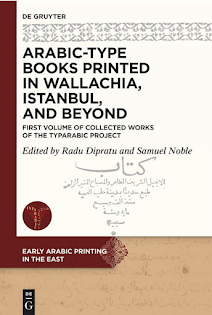
Open-Access Book: Arabic-Type Books Printed in Wallachia, Istanbul, and Beyond

 To see the table of contents and download the entire book for free, go here.

Arabic-Type Books Printed in Wallachia, Istanbul, and Beyond

First Volume of Collected Works of the TYPARABIC Project

Edited by: Radu-Andrei Dipratu and Samuel Noble

Volume 2 in the series Early Arabic Printing in the East
 

This first volume of Collected Works of the ERC Project TYPARABIC focuses on the history of printing during the 18th century in the Ottoman Empire and the Romanian Principalities among diverse linguistic and confessional communities. Although "most roads lead to Istanbul," the many pathways of early modern Ottoman printing also connected authors, readers and printers from Central and South-Eastern Europe, Western Europe and the Levant.

The papers included in this volume are grouped in three sections. The first focuses on the first Turkish-language press in the Ottoman capital, examining the personality and background of its founder, İbrahim Müteferrika, the legal issues it faced, and its context within the multilingual Istanbul printing world. The second section brings together studies of printing and readership in Central and South-East Europe in Romanian, Greek and Arabic. The final section is made up of studies of the Arabic liturgical and biblical texts that were the main focus of Patriarch Athanasios III Dabbās’ efforts in the Romanian Principalities and Aleppo.

This volume will be of interest to scholars of the history of printing, Ottoman social history, Christian Arabic literature and Eastern Orthodox liturgy. 


Tuesday, November 7, 2023

Ovidiu Olar: The Travels of the Patriarch Macarius of Antioch and the Liturgical Traditions of the Christian East

Ovidiu Olar, "The Travels of the Patriarch Macarius of Antioch and the Liturgical Traditions of the Christian East." Revue Des Études Sud-Est Européennes 53.1-2 (2023), 275-287.

Abstract:

This study proposes to demonstrate the importance of the account of the journey of the Patriarch Macarius of Antioch composed by his son, the Archdeacon Paul of Aleppo, as an eyewitness of the liturgical practices and traditions of the Christian East. The passages where Paul describes the multilingual liturgical celebrations are used to highlight the (principal) reason for the existence of two manuscripts held at the Library of the Romanian Academy: BAR Bucharest ms. roum. 1790 and BAR Cluj ms. roum. 1216.

Download and read it here.

Monday, October 3, 2022

Open access: Fr Andrew Wade- Byzantinised or Alexandrianised—Or Both? Vespers in the 13th c. Melkite Alexandrian Arabic Horologion

Andrew Wade, "Byzantinised or Alexandrianised—Or Both? Vespers in the 13th
c. Melkite Alexandrian Arabic Horologion Sinai Arabic 232." Religions 13 (2022).


Abstract:

 This paper presents an annotated English translation of the rite of Vespers contained in
the Melkite Alexandrian Arabic Book of Hours (Horologion) found in the 13th century Christian
Arabic manuscript Sinai Arabic 232. Most of the texts comprising this service have been identified
from the contemporary Greek Horologion, the Constantinople Euchologion and the Coptic Agpeya.
This very unusual combination is discussed. While further research on Sin. Ar. 232 and other Arabic
Horologia is necessary before we may draw more definitive conclusions, enough seems clear at this
point to suggest that the Egyptian Melkites originally used a Hierosolymitan type Horologion and
that this, in due time, was both Alexandrinised and Byzantinised. We can therefore say that Sin. Ar.
232 is an Egyptian redaction of a Middle Byzantine Horologion with archaic Hierosolymitan features.
No other Arabic Horologia have been studied to date, and no earlier Melkite or Coptic Alexandrian
Horologia are known. Considerable further research on Arabic Horologia is needed.


Download the pdf here.

Tuesday, November 30, 2021

Yulia Petrova: The Development of the Orthodox Christian Vocabulary in Arabic


 Yulia Petrova, "The Development of the Orthodox Christian Vocabulary in Arabic"

in Romano-Arabica 20 (2020), 259-271


Abstract:

The beginnings of Christian literature in Arabic and the use of Arabic in a liturgical setting go back
to the early 8th century. During its history, the Arabic Christian vocabulary underwent several stages of
formation. The earliest common Christian vocabulary was much influenced by Aramaic, which co-existed with Arabic in the region for centuries. In addition, different lexical peculiarities developed within the vocabulary specific for each Middle Eastern Christian community (Melkites, Copts, Jacobites, Nestorians, Maronites), reflecting their religious traditions and their cultural history. The Arabic Christian Orthodox vocabulary developed under the strong influence of Byzantine tradition. As the manuscript sources witness, in the 17th - 18th centuries a large number of Church terms (especially from the liturgical domain) were Greek loanwords that circulated widely and were in common use among the Melkites. If compared with the contemporary texts, it can be observed that many original Greek terms became archaisms and were replaced with Arabic equivalents. At the same time, the majority of the terms used since the Ottoman epoch coincide with the contemporary variants. It can be concluded that the bulk of Arabic Christian Orthodox terminology was formed in the 17th century, in the period of the “Melkite Renaissance”. 

A pdf of the article is can be downloaded here or, if that doesn't work, here.

Tuesday, November 9, 2021

Martin Lüstraeten: Arabic Typicon Translations and Byzantinization

 Martin Lüstraeten

The Source Value of Arabic Typikon‑Manuscripts as Testimonials for the Byzantinization of the Melkites

Abstract

With the expansion of Islam, the patriarchates of Antioch, Jerusalem, and Alexandria were divided from the Byzantine Empire. The Orthodox Christians there still defined themselves as Byzantine Orthodox and began to adapt their liturgical customs by adopting Byzantine liturgical books. When Greek was not understood any longer, they began to translate and copy their liturgical books, thereby creating their own branch of tradition, which is marked by multilingualism, reception of their own Bible tradition as well as the exclusion of “neo‑martyrs” from their calendar of saints.

Read the entire article, open-access here.


I think that the evidence Lüstraeten presents, and even his own analysis of it, points to a shift to a stronger identification of the Melkites with Byzantium in the Mamluk period (during which Melkite ecclesiastical institutions suffered a near-fatal decline) than had existed previously, certainly than had existed prior to the Crusades. Likewise, he mentions but does not explore in detail the fact that these Typica may well have been translated from earlier Syriac translations, something that also complicates any account of  Byzantinization as simply a matter of performing a Byzantine cultural identity. A detail in support of this might be the fact that during Byzantine rule in 11th century Antioch, Nikon of the Black Mountain  promoted the Palestinian Sabaite Typikon in Antiochian monasteries rather than the more properly 'Byzantine' Studite one. So the choice of the Typikon that was translated likely was motivated both by the prestige of its association with the most important Palestinian Orthodox institution (especially among the Sinaite monks who promoted the translated Typicon) in addition to any desire to move towards more mainstream Byzantine practice, something that took over entirely with Meletius Karma and the introduction of printing.


Saturday, August 8, 2020

Galadza and van Vogelpoel: Multilingualism in the Divine Liturgy of St. John Chrysostom Among the Melkites

Daniel Galadza and Alex C. J. Neroth van Vogelpoel, “Multilingualism in the Divine Liturgy of St. John Chrysostom Among the Melkites,” ARAM 31:1-2 (2019), 35–50

Abstract

This paper examines elements of multilingualism in the text and celebration of the Divine Liturgy of St. John Chrysostom among the Melkites, from the eighth to thirteenth centuries. The main focus for this investigation is the manuscript Sinai Gr. N.E. X 239, a thirteenth-century bilingual Greek-Syriac manuscript with Arabic marginal notes found among the Sinai New Finds in 1975, which contains the text of the Divine Liturgy of St. John Chrysostom. The fourteen paper folios of the booklet containing the Divine Liturgy include a particular zeon rite during the Communion of the clergy. The texts and rubrics of the liturgical service are often repeated in Greek and Syriac, along with three Arabic marginal notes, which suggest the copyist and those praying from the manuscript were more familiar with Arabic and Syriac than they were with Greek. Nevertheless, Greek was used as a liturgical language. Comparison with other Syriac Melkite liturgical manuscripts, in particular with the thirteenth-century Euchologion Vatican Borg. Syr. 13, brings forward certain peculiarities of Melkite liturgical practice. Many of these Syriac Melkite liturgical texts have been examined by Cyrille Korolevsky, Joseph Nasrallah, and Heinrich Husmann, but their observations remain only preliminary to this day. The study of Syriac Melkite liturgical texts is accompanied by a comparison with Greek and Georgian liturgical texts originating in the Chalcedonian Patriarchates of Antioch and Jerusalem, facilitated by recent research on the Greek and Georgian Euchologion from Jerusalem and Palestine by Heinzgerd Brakmann and Tinatin Chronz. The paper concludes by outlining what elements constitute unique Melkite liturgical practices in the Divine Liturgy, how they were celebrated in the multilingual environment in which Melkite Christians lived and prayed, and how the liturgical practices and rites were related to the liturgy of the Byzantine Rite in Constantinople and elsewhere.

 Read the entire article here.

Wednesday, April 8, 2020

Ioana Feodorov: The Arabic Book of the Divine Liturgies Printed in 1745 in Iași by Patriarch Sylvester of Antioch

The open access journal Scrinium has just published an article by the Romanian scholar Ioana Feodorov on the Arabic Book of the Divine Liturgies published by the Patriarch Sylvester in Iasi in 1745. It can be read and downloaded in full here.

Abstract:

The following article focuses on a printed text of the Arabic Book of the Divine Liturgies, produced in 1745 in Iași (Jassy), capital of Moldavia, by Sylvester, the Patriarch of the Greek-Orthodox Church of Antioch (1724-1766), which is comprised, together with a section of a Syriac and Arabic manuscript commentary on some Gospel passages, in MS 15 of the library of Dayr Sayyidat al-Balamand (near Tripoli, Lebanon). It is a rare copy of this early Arabic printed book, whose existence was recently established. The study encloses an outline – based on Romanian, Greek and Arabic sources – of Patriarch Sylvester’s printing activity in Iași and Bucharest in 1745-1747, a description of the Book of the Divine Liturgies (Iași, 1745) preserved in the Balamand codex, and comments on the value of this finding for future research on the printing work carried out in the Romanian Principalities, in 1701-1747, for the Arabic-speaking Christians of Ottoman Syria.

Friday, June 7, 2019

Paul Bacel: Melkite Catholic Liturgical Innovations in the 18th Century

French original here. The author is, naturally, writing from a Roman Catholic perspective in the early 20th century, but this is still a very valuable account of liturgical practices in the 18th century and the trouble that the Latinizing reformers who spearheaded the movement for union with Rome in Antioch had with Rome's desire for them to remain similar in practice to the Orthodox. Footnotes below the jump.

Liturgical Innovations among the Melkite Greeks in the 18th Century

Towards the end of the 17th century, a man who, by his deep erudition, had acquired considerable influence in Syria thought himself authorized to modify, without informing the Holy See, certain usages and certain practices of the Eastern Church, which Rome is unafraid of qualifying as "praiseworthy and very ancient" (1). This was Euthymios Sayfi, Greek Melkite Archbishop of Tyre and Sidon. He had no other goal in doing so than facilitating the conversion of the Orthodox, who were very numerous in his diocese and who disliked some of these practices.

With the goal of repressing certain heterodox beliefs that had been introduced among the Catholics of his metropolis, Euthymios removed from the Liturgy of Saint John Chrysostom the epiclisis prayer that gives the impression that transubstantiation occurs at that moment, by the invocation of the Holy Spirit over the sacred gifts. He likewise forbade the mixing of zeon (hot water that is poured into the chalice before communion), because the faithful imagined that that the consecrated bread and wine then became the person of the Holy Spirit. He authorized the saying of multiple masses on the same day on the same altar with the same liturgical vessels, while from time immemorial the Greeks required that the altar, the chalice, the chasuble, and the other liturgical trappings all should have fasted, just like the priest. Another practice that was even more ancient and respectable was also abolished. At the hierarchical liturgy, the priests who concelebrated with the bishop commune from his own hand in the manner of deacons. That is to say that they receive the consecrated bread in the palm of the right hand placed over the left hand and then they commune.

In order, we believe, to avoid excessive fatigue, Euthymius Sayfi allowed all the concelebrants to commune themselves, as if they were celebrating the liturgy. He likewise permitted the consumption of fish, which was forbidden during Great Lent and the Advent fast, and he showed himself to be less severe than the Lateran Council of 1215 with regard to impediments of natural kinship.

Rome was alarmed by the news of all these innovations and, on February 6, 1716, it sent the following letter to the Archbishop of Tyre:

The aforementioned rites and customs are praiseworthy rites and customs in practice in the Greek church from time immemorial. Thus it is not fitting to remove from the holy liturgy the prayer of the Greeks employed after the formula of the consecration instituted by Jesus Christ. The Council of Florence gave it an orthodox meaning and the Holy See has never condemned it. So if there is someone who, out of ignorance or bad faith, remains persuaded that transubstantiation takes place by these prayers, it is incumbent on Your Eminence to instruct the ignorant and inculcate them with this truth of our holy faith that transubstantiation takes place through the words of institution and not by this prayer that is authored by man.

Nor does the Holy See approve of your prohibition regarding the mixing of the zeon with the precious blood. In fact, this sacred rite, which signifies the warmth of faith, was authorized by the Holy See for the Greeks of the very city of Rome: it is thus perfectly easy to instruct the faithful about it.

The Holy See makes the same recommendation for you in what concerns the third and fourth Greek rites that Your Eminence has modified. Nihil inovetur! for everything that is new ordinarily brings along with it a great subject of disagreements, scandals, and disagreeable enmities for the faithful.

The Holy See equally disapproves of the consumption of fish authorized by Your Eminence during the days and times when one does not consume it in the Greek church. That Your Eminence had as your goal to attract the Orthodox to the true faith, know nevertheless that only the holiness and truth of our holy faith are capable of attracting them, and by no means the relaxation of the fasts and abstinences of the Church.

Finally, the Holy Apostolic See condemns your perspective with regard to the fourth degree of natural and spiritual kinship which, according to the decision of the Lateran Council, constitutes an impediment to marriage, even for the Greek Catholics of the East. For this conciliar decision was announced to all Christian communities, including the Greeks. Consequently, it is important that Your Eminence submit to it and make sure that this law be observed, that prohibits marriage in the fourth degree of natural or spiritual kinship.

Two years later, on June 1 and 9, 1718, the Sacred Congregation for the Propaganda of the Faith responded to three new questions which, this time, Euthymius Sayfi himself had posed. The archbishop had then come to be in a better mood and only acted after asking Rome's opinion. He asked the Propaganda 1) to authorize the the celebration of several liturgies on the same day on the same altar; 2)  to permit those who had been confirmed by an unapproved priest, whether Catholic or not (2), to receive this sacrament a second time from the hands of the ordinary, at least conditionally; 3) finally, to permit second, third and fourth marriages.

Rome's responses were very categorical. On the first point, he was asked to keep to the decision of February 6, 1716 and to follow the rites and customs practiced in his church. On the second point, he was reminded of the decision of Clement VIII, which requires all who have received confirmation from the hands of an unapproved priest to receive this sacrament again and, if possible, from the hands of the ordinary. Nevertheless, since the sacrament of confirmation is not necessary for salvation, the Propaganda asked the archbishop not to trouble those who had received it in the conditions described above, because it would result in a scandal. Finally, the people should know that second, third and fourth marriages were permitted by the Church, so long as the marriage is performed according to the rules set by the canons.

* * *

There was nevertheless no peace, especially in that vast diocese of Tyre and Sidon, where the discussions of the faithful about religious issues gave their bishop justifiable worries. Euthymios once again resolved to bring the debate to the tribunal of the Propaganda, and twice, in 1722 and 1723, asked an entire series of questions, some of which had been settled previously, on February 6, 1716 and June 9, 1718. Here they are, just as the Rev Fr Charon presented them previously in this journal (3):

1) On Holy Saturday, the Greeks placed a torch below the altar then, after several prayers, the patriarch of bishop entered into the sanctuary carrying the lit torch and showing it to the people, claiming that this was a divine light coming from Christ's Sepulcher. This, as one may see, is nothing but a reenactment of the pseudo-miracle of the holy fire at Jerusalem.

2) On Holy Thursday, the Greeks consecrated a large loaf and then dried it over a stove, reducing it to a fine powder that each priest kept, in a barely decent manner, to use in the viaticum communion of the faithful throughout the year.

3) Moreover, they were persuaded that the sacrament of the Eucharist was celebrated on Holy Thursday in a more worthy manner than any other day of the year.

4) The Greeks believed that it was illicit to celebrate several liturgies on the same altar, inasmuch as the altar, the chalice, the chasuble, and the other trappings broke the fast if they were used a second time.

5) They anathematized those who believe that the consecration was done by the very words of Jesus Christ.

6) The pieces of the host which are taken from the bread when serving at the preparation of the Holy Sacrifice and are offered in honor of the Holy Virgin or the saints become, according to them, the body of the Holy Virgin or of the saints in whose honor they were offered, while only the large piece offered in honor of Jesus Christ became the body of Christ.

7) They likewise believed that the bread and wine became, through the words of consecration, the person of the Father, by those of the epiclesis, the person of the Son, and by the inmixing of the zeon, the person of the Holy Spirit.

8) Finally, they believed that the celebration of the holy mysteries during Lent is illicit except on Saturday and Sunday.

Unfortunately, Rome's response did not arrive until six years after the archbishop's death, when the discussions had doubtlessly already ended, while the patriarch Cyril VI Tanas, Euthymios Sayfi's nephew, had maintained all his uncle's modifications with regard to the rites and practices of the Greek church. The rescript, which is dated to March 15, 1729, contains a very explicit response to all the questions that we just listed.

It first warns the faithful against the alleged miracle of the holy fire, a vulgar deception of the Greeks that merits no attention. With regard to the second and third points, dealing with the Holy Sacrifice offered on Holy Thursday and the practice of conserving the viaticum for the whole year in a barely appropriate receptacle, the Sacred Congregation of the Propaganda of the Faith send a decision of Pope Innocent IV (1243-1254) which states that the holy sacrament confected on Holy Saturday should not be saved for a whole year under the pretext that it would then be given as a viaticum for the sick. It is nevertheless permitted to keep the body of the Savior in order to commune the sick, but only for two weeks, for fear that the holy species might rot. A later decision of Pope Clement VIII, on August 15, 1595, says nothing else when it recommends that the holy sacrament that is reserved for the sick be renewed every week or at least every two weeks. With regard to the bizarre practice described in the question, the Propaganda ordered it to be suppressed immediately: "May this despicable custom of drying the the consecrated bread over a stove, reducing it to powder, and mixing it with holy oils on the day of the Lord's Supper be abolished. Likewise, if there exist other superstitious or blameworthy customs regarding the sacrament of the Eucharist, let them be suppressed, taking care to warn the faithful about the dangers they contain for their faith."

The Propaganda also did not want one to celebrate several liturgies on the same day on the same altar, while still recommending that the belief that the altar and its trappings should have fasted like the priest be eliminated. It asked the patriarch-elect, Cyril VI, to erect several altars in the churches when deemed necessary. As for the epiclisis and the pieces of the holy bread, numbers 5 to 7, the Sacred Congregation refers to its earlier decisions asking that all superstitions be abolished. Finally, it required that during Lent the liturgy only be celebrated on Saturday and Sunday, following the ancient canons (4).

Once people were in the habit of asking Rome questions, they continually renewed them, at the risk of annoying the Sacred Congregation of the Propaganda by overwhelming it with often useless and almost always untimely questions. Thus the question was raised whether, in case of persecution or urgent necessity, it was permitted to celebrate the holy mysteries in private homes, then whether it was permitted for laypeople and monks to eat fish during Great Lent, then whether the Filioque could be added to the Creed, then finally whether it was suitable to give Holy Communion to the newly-baptized.

The Sacred Congregation of the Propaganda invited priests to address themselves on the first point to their legitimate pastors. It rejected the consumption of fish and tolerated giving communion to children, if that practice had already existed previously. As regards the question of the Filioque, it made the distinction that one already finds in the responses of Saint Leo III. The insertion of the Filioque in the Creed is distinct from the procession of the Holy Spirit from the Father and the Son. The Greeks should believe, like all Catholics, in this procession without being required to mention it explicitly when they recite the Creed. It is only in cases where it would otherwise be a scandal that they too should recite the Filioque in the Creed.

* * *

After his elevation to the patriarchal See of Antioch in 1724, Cyril VI had to renew the relations with Rome that his predecessors, even the Catholic ones, had not been able to reestablish. For six years, he did not cease to ask for his conformation from the Holy See.

On August 13, 1729, Benedict XIII asked Fr Dorotheus of the Most Holy Trinity to, a Capuchin, to receive Cyril's profession of faith in the form prescribed for the Greeks by Urban VIII. Additionally, Cyril had to swear and promise not to modify anything in the rites of the Greek church without prior consultation with the Holy See and examining the issue with the Sacred Congregation of the Propaganda. He also had to restore to their original state the rites that had been modified, either by himself or by his uncle Euthymios, the archbishop of Tyre, and to conform to the Propaganda's instructions, which Fr Dorotheus would deliver to him or have a copy delivered to him. Once all these conditions were fulfilled, Fr Dorotheus had the mission of declaring to him that his election was confirmed by His Holiness and to convey to him the pope's congratulations. This encyclical from Benedict XIII was sent following deliberation by the Congregation of the Propaganda and dated March 15, 1729 (5).

Having received the pope's encyclical, Fr Dorotheus went to Dayr el-Mukhallis, where the patriarch was located at the time, and read to him the latest recommendations and requirements from Rome. Cyril VI did all that was asked of him and he immediately swore over the holy Gospels, between the hands of the apostolic delegate, the following oath:

I, Cyril, elected Greek patriarch of Antioch, vow and swear before this venerable assembly and before you my Reverend Father Dorotheus, Capuchin, apostolic delegate from His Holiness Pope Benedict XIII, that if the apostolic Holy See desires me as patriarch and confirms me in this office, I will observe all the rites and customs of the Greek Church and that have been modified by Euthymius, Archbishop of Tyre and Sidon, of blessed memory. I will likewise observe the same fasts, abstincences, quarantines and all customs newly enjoined by the Holy Apostolic See. In addition, I will observe them not only personally, but I will also apply myself to having them observed by the archbishops, bishops, priests, religious and by all the people of my nation. I will not innovate anything. I will not modify anything of the aforementioned things without the explicit authorization of the Holy Apostolic See. I will never permit or suffer that anything be neglected, not even an iota in the aforementioned orders. Finaly, I vow and I swear that I have understood this oath and that to which it obliges me; I will observe it in conformity with the desires of the Sacred Congregation of the Propaganda and the Apostolic Encyclical that was read in our presence. So may God deign to help me and His holy Gospels (6).


After this solemn oath, Father Dorotheus presented to Cyril the Encyclical from Benedict XIII and withdrew. That was in 1730.


Two years had not even passed before the new patriarch showed himself to be unfaithful to his oath. Strengthened by the support of two bishops, his subordonates, he held on his own a Council in the small town of Joun and once more abolished the three fasts of Nativity, the Holy Apostles, and the Holy Virgin. He notified the faithful with the following encyclical:


Glory to God forever,
Cyril, by the mercy of God patriarch of Antioch and All the East.
May divine grace and the heavenly blessing be granted to all our spiritual children, the Christians, our blessed flock in our Patriarchate of Antioch! May the Lord bless them, their children, their women and all their works by the most abundant heavenly blessings! Amen.
We inform you that we and our brothers, the Catholic bishops whom God has established in these times as shepherds of His rational flock and guardians of His people, after the necessary examination and very great research, we have been forced, to save our conscience (7), to abolish what should be abolished and to permit what should be permitted. And that, in what pertains to the three monastic absences, that is: the abstinence of Nativity, of the Apostles, and of the Holy Virgin. Consequently, we decree that the faithful, our flock, eat meat during these three abstinences, except for the last day of each of them, when they should abstain from meat and dairy products and fast absolutely as during Great Lent, in conformity with our ancient right and praiseworthy customs. We nevertheless decree that the abstinence of Wednesday and Friday of each week as well as the fast of Great Lent be observed in all exactitude, in all piety and with great respect. Thus we have authorized and thus we have decreed, instituted and abolished in our holy synod, in the name of the Father, the Son and the Holy Spirit. Amen.
If any priest does not respect our decree, we forbid the faithful from confessing to him, since (in so doing) he will have disregarded our authority. Know this and may the blessing be upon you a second and third time.


Made and written on November 11, 1731.


     +Cyril
     Patriarch of Antioch and All the East

The patriarchal encyclical was then sent to the two bishops who supported the one newly-elected [patriarch] with their infuence: Basil Finan, bishop of Bayas, and Clement of Aleppo, bishop of Saydnaya, a former monk of Dayr al-Mukhallis, ordained by Cyril VI in 1731 and entirely devoted to him. The two prelates were asked to affix their signature with their seal and to then publish it.


There was a strong reaction to this news among the monks of Mar Hanna: they organized an open resistance, castigating Cyril's unfaithfulness and standing up, whether in the flesh or in the confessional, against the patriarch's orders, which were in formal contradiction of those with Rome. The Choueirites even wrote to the Propaganda, which had the sending of the pallium until 1744, twenty years after the patriarchal nomination of Cyril VI. Thanks to the intervention of the consistorial lawyer Fracis Scaramuzzi and of Father John Amioni, a monk and Greek Catholic priest, at the time the patriarch's procurer in Rome, on February 29, 1744, Benedict XIV addressed to Cyril VI the Encyclcal Dum nobiscum animo reputamus as well as the pallium.


This was to be delivered to him by the Latin bishop of Babylon, after which Cyril would have renwed in front of him or his delegate his profession of faith and his oath of loyalty to the Holy See, with the promise to observe the constitution Demandatam, sent to him by the Pope the previous year (8). We just mentioned the constitution Demandatam Coelitus of December 24, 1743, addressed to Cyril VI and the bishops of his patriarchate. In it, Benedict XIV settles issues in dispute with regard to the rites of the Greek Church and their conservation. He declares that it is not permitted for anyone, under any pretext whatsoever, whether patriarch or bishop, to change anything in the Greek rites or to impede their exact observation. Consequently, the changes introduced by Euthymius of Tyre were once again repulsed; the patriarch and bishops should make them disappear as well as all the abuses introduced by the ignorance of the schismatics.


The pope then revokes the dispensation granted by Cyril for the fasts of the Apostles, Nativity and the Holy Virgin and he decrees that everything should be restored to its former state. Nevertheless, taking into consideration the needs of the populations, he gives the patriarch the faculty to dispense each year with fasts in the manner that he deems best, but in a prudent manner, so that the ancient rites do not fall into disuse (9).


I will stop here the analysis of Rome's relations with the Greek Melkite Patriarchate, the other instructions that the Holy See published on this topic were directed more to the Latin missionaries and Maronite propagandists. As such, they are of much less interest to us and, moreover, they have already been very well presented by the Rev Fr Cyrille Charon (10).


Paul Bacel,
priest of the Greek rite


Monday, February 26, 2018

Sergei Brun on the Cathedral of Saint Peter / Church of Cassian in Antioch

This is excerpt, translated by the author, from his book, The Byzantines and the Franks in Antioch, Syria and Cilicia. 2015,  Vol. II. Chapter 1, sec. 5. P.41-55,  and his article  'The Vanished Churches of Antioch‘ in Panorama Iskysstv, 2017. Read the entire article, with notes and bibliography, here. 

Brun also informs us that:

Currently a research project is underway, led by myself and some of the most prominent church architects, to create a computer model and full reconstruction of St. Peter‘s Cathedral. God willing, we will complete our work by June of 2018, before the Feast of Saints Peter and Paul, making an online source and a book available to the public. There one could finally be able to find detailed imagery from various stages of the Cathedral‘s history, of its panoramic views, exteriors and interiors. The project will be known as Lost Shrines of the Church of Antioch©


Antioch's Lost Shrine:
The Cathedral of St. Peter/Church of Al-Kusyan

[...]

The foundation of the Cathedral and the consecration of its first altar was attributed to the Apostle Peter himself. The 10th century Melkite chronicler and Metropolitan – Agapius of Hierapolis (Menbidj), drawing on earlier legends and accounts, claims that the Apostle Peter ―laid the foundations of the church‖ and ―established the altar there. Another Levantine chronicler – the Coptic deacon Abu‘l-Makarim – obviously pulling on similar sources and historic tradition, gives the exact date of the church‘s foundation: according to his narrative, St. Peter established the al-Kusyan Church in the first year of Emperor Claudius‘s reign (A.D. 41). Originally the church was known as 'The Church of Cassian‘ (al-Kusyan). This name derives from a legend, popular among the Levantine Christians. According to this legend, the Apostle Peter raised the son of the local king, named Cassian, from the dead. When the youth was brought back to life, the king allowed Peter to establish a church in the place of the miracle (in another version – in the king‘s palace). This is obviously a later day apocrypha, since there clearly was no 'king‘ in Antioch since the fall of the Seleucid state (64 B.C.). Moreover, there was not a single Seleucid king nor Roman prefect with the name of Cassian. One way or another, this legend was treated as history and dogma by the Christians in the Middle East (both – Chalcedonian and Miaphysite). The legend of Cassian survives in various versions; the better known ones can be found in the 11th century narrative of the Melkite physician Yuhanna ibn Bhutlan, and in the late 12th century account of the aforementioned Coptic author – Abu‘l-Makarim4. One should also note that the church was never known as 'St. Cassian‘, since Cassian – whether it was the legendary king or his resurrected son – was never venerated as a saint. The name of 'Cassian‘ or 'al-Kusyan‘ was given to the shrine because of Peter‘s miracle, not the resurrected boy or king in question.

Despite its antiquity and ties to the Apostle Peter, the Church of Al-Kusyan was not Antioch‘s cathedral church in the Early Byzantine period. From the times of Constantine the Great and up to the Arabic Conquest that honor belonged to the Golden (or Octagonal) Basilica, the Domus Aurea, built by Saint Constantine and his Arian son and successor – Constantius II. Yet the Church of al-Kusyan was held in great veneration by both – the Christians of Antioch and the Roman/Byzantine Emperors. When, in the reign of Emperor Theodosius II, the body of St. Simeon the Stylite (Simeon the Elder) was brought to Antioch, it was placed for several days in the Church of Cassian, before being transferred for the last funeral service to the Domus Aurea and then – returned to Kalaat Samaan. In the 6th century Emperor Justinian I donated his imperial vestments to the shrine, which was hung in the church for display, drawing the attention of the local congregation and the pilgrims.

 After the final abandonment and destruction of the Domus Aurea in the 7th-8th centuries, the Church of Cassian – 'the House of Mar Peter‘ – finally assumed its long-awaited and well-deserved role as the Cathedral Church, the Patriarchal See, the place of enthronement and burial of the Patriarchs of Antioch all the East. The Arabic geographer Al-Masudi, writing in the 10th century, left a detailed account of how the Melkite Christians in Antioch gathered on the Calends of January (the Roman New Year) before the Church of Al-Kusyan, lit candles and lamps, and served a midnight Liturgy. It is noteworthy that Al-Masudi speaks of the gathering taking place before the cathedral; this might in fact indicate that originally the church was in fact not very large, and not sufficient enough to accept all of the faithful.

The year 969 inaugurated a new era for Antioch and its cathedral. The city was taken by the Byzantine army; Syria‘s greatest Christian center – after  three centuries of Arab domination – returned to the Empire. With the Byzantine conquest of the city, the Emperor and the Ecumenical Patriarch were faced with a new challenge – a challenge of re-organizing the Patriarchate of Antioch and its cathedral in accordance with the new aesthetic, liturgical and political ideas, long harbored in Constantinople. The Byzantinization‘ of the Church of Antioch has begun. According to the Melkite chronicler Yahya of Antioch, Emperor John I Tzimisces ordered the newly-instated Patriarch of Antioch – Theodore II – to ―make/fashion the Cathedral of Cassian in the likeness of Hagia Sophia in Constantinople. This simple phrase ―to make/fashion the Cathedral (…) in the likeness of Hagia Sophia‖ has several of meanings. It most definitely applies to liturgical reform, to the liturgical Byzantinization of the Chalcedonian Orthodox Patriarchate of Antioch, as well as to the physical rebuilding and redecorating of the Patriarchal Cathedral itself.

It is more than possible that the early Christian church (even if it underwent some reconstruction in the 6th century or in the later period of Arab rule) did not accord with the Byzantine Imperial ideas on how a grand Patriarchal Cathedral was supposed to look like. After all, even if nothing could ever rival Constantinople‘s Hagia Sophia, the Melkite Patriarchal Seats of Alexandria and Jerusalem were still located in the great shrines of the Roman Empire (the Caesareum in Alexandria, Constantine‘s Church of the Resurrection in Jerusalem – rebuilt by the Byzantine Emperors after its destruction by Al-Hakim in 1009). Antioch was clearly different. We should seriously take note of the fact that in Arabic sources, the Church of Al-Kusyan, while mentioned as one of the highly-venerated Christian shrines, is never listed among the most beautiful or spacious churches of the East. Constantine‘s Church of the Resurrection in Jerusalem, the Basilica of Hagia Sophia in Edessa, the Church of St. George in Lydda, Justinian‘s Round Church of the Theotokos in Antioch were all considered the jewels of Dar-al-Islam. The Church of Al-Kusyan was never mentioned alongside.

We do not have a single description of the original Al-Kusyan shrine and its architecture. The first detailed account of Antioch‘s cathedral only comes down to us from the mid-11th century – the period after the grand rebuilding, initiated by Emperor John I Tzimisces and Patriarch Theodore II. The account was written by the aforementioned Melkite doctor – Yuhanna ibn Butlan, who visited Antioch and its cathedral in 1052. ―In the centre of the city is the church of Al Kusyan (…). It consists of a chapel, the length of which is 100 paces,, and the breadth of it is 80, and over it is a church, supported on columns‖9. This description‘s significance is beyond value. First of all, it gives us the exact measurements of the lower (possibly – Early Christian/Late Antique) church, which Ibn Butlan calls a 'chapel'. Judging by the fact that a medieval pace is usually equal to about 71 cm, the length of the lower church was 71 meters, the width – 56,8 meters, and the overall floor space – 4032,8 square meters. Thus, the lower church of the Patriarchal Cathedral at Antioch was about a quarter smaller than Constantinople‘s Hagia Sophia. Second, Yuhanna ibn Butlan is in fact the first author who speaks of the Cathedral of St. Peter/Church of Al-Kusyan as a two-story structure, consisting of a lower church (again, most probably the Early Byzantine church, founded on the place of the Early Christian site), and the imposing upper cathedral church, built on pillars and beams over the original shrine.
[...]

Now let us turn to the interior decoration and relics of the Antiochian Patriarchal Cathedral. Yuhanna ibn Butlan tells us that all of the churches at Antioch, including the city‘s cathedral, were decorated with ―gold and silver, and colored glass, meaning – mosaics. If we take into account that the Cathedral was rebuilt and refurnished in the reign of John I Tzimisces and his immediate successor Basil II (in the last decades of the 10th century), it would be fair to assume that the closest surviving parallel of monumental Byzantine art would be the mosaics of Hosios Loukas in Phokida (1011). Yet it is also possible that the mosaics at St. Peter‘s reflected an earlier period of Macedonian art, a period that is reflected in a handful of surviving icons and the mosaic depiction of Emperor Leo VI the Wise at the feet of Christ in Hagia Sophia. Ibn Butlan also left us a unique, highly detailed description of the Cathedral‘s décor and altar furnishings. The templon, according to the Melkite doctor, was incrusted with mother-of-pearl. The ciborium stood over the altar table on four marble columns, crowned with a dome of silver. Brocade liturgical veils flowed down from the arches of the ciborium. Before the altar there hung a great silver 'crown‘ (either a great polycandelon or an early choros), suspended on chains. A large silver tray (most likely a large lampadophore) with glass lamps hung on a hemp rope near the altar. Three silver gilt processional crosses, adorned with precious stones (crux gemmata) stood beyond the altar table, on square wood-carved stools.

The major part of the treasures, described by Ibn Butlan, were looted by the Sultan of Rum after he took the city in 1084. Yet in the era of Latin Rule (1098-1268) the Cathedral of St. Peter accumulated new treasures and furnishings. Wilbrand of Oldenburg, who visited Antioch in 1211, remarks that the city‘s main shrine was a ―greatly decorated church‖13. In this last period of its history, the Cathedral was adorned with the works of both – Western (Frankish and Italian) as well as Eastern (Byzantine, Syrian, Georgian) masters. A registry of items from the Patriarchal sacristy, entrusted to the Knights Hospitaller and returned to Patriarch Peter II of Ivrea in 1209, mentions various precious vestments and veils, reliquaries, covers and liturgical objects, made of gold and silver, adorned with gems and ivory. There was a large altar cross and a chalice – both made of gold, covered with pearls and precious stones; there were censers and vessels for myrrh made of pure silver; liturgical books (the Altar Gospel, Apostle, Missal) in silver casings; a brocade antependium; covers for chalices embroidered with silver; three episcopal miters, embroidered with gold; a crosier made of gold and ivory; an icon cast of pure silver; ivory combs; gold rings crowned with topazes; patriarchal seals; numerous liturgical vestments (dalmatics, stoles, maniples, chasubles, a cappa magna, liturgical gloves, mantles, tunics), died into precious purple, embroidered with gold and silver threads and gems14. Again, these items formed only a part of the Patriarchate‘s (and the Cathedral‘s) treasures.
Along with her Roman sister-basilica, the Cathedral at Antioch was one of the two principal shrines of the Christian world, dedicated to Saint Peter, the Rock of the Church, the Prince of the Apostles. Over the gate that let into the atrium of the Cathedral and to the Patriarchate there was a sign in gold lettering: ―Depart from here Iezi, for here stands the Throne of Law and Truth; and the Third part of the Earth is obedient to it‖ (Sit procul hinc Iezi, thronus hic sit iuris et aequi; Tercia pars mundi iure tenetur ei). The Cathedral held three great relics, associated with the Prince of the Apostles: the cathedra or Episcopal Throne of Saint Peter (that very 'Throne of Law and Truth‘ mentioned at the Gate), the chains of Saint Peter and the cage, where the Apostle was said to be held during his stay at Antioch. The Throne of St. Peter was described in detail by Melkite authors of the 11th century (Ibrahim ibn Yuhanna and Yahya of Antioch). It was a throne of palm wood, incrusted and elaborately decorated with silver16. St. Peter‘s Throne, on which the Orthodox (and later – the Latin) Patriarchs would preside on, was seen as the central relic of the Cathedral and of the entire Patriarchate of Antioch and all the East; a relic which symbolically and physically connected the eastern successors of St. Peter with the Prince of the Apostles himself. The Protospapharios Ibrahim ibn Yuhanna in his Life of Christophore, the Patriarch of Antioch, gives us a partial list of the main relics, kept at the Cathedral and the Patriarchal Sacristy. These included ―the staff and throne (…) of the Foremost of the Apostles, the relics and vestments of several Father Patriarchs – including Ignatius, the relics of Mar John the Baptist, the venerable Spear of Our Lord, the staff of John Chrysostom, the belt of Mar Simeon the Stylite of Aleppo, and other sacred objects.

[...]

Read the entire article here.