Showing posts with label history. Show all posts

Thursday, September 10, 2026

New Open-Access Book- Yulia Petrova: Prefaces to 18th-Century Christian Arabic Books


Prefaces to 18th-Century Christian Arabic Books

Yulia Petrova


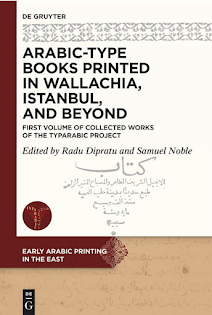
The Arabic-language and Arabic-type presses established in Eastern Europe and the Middle East beginning in the early 18th century produced a number of books for the needs of Arabic-speaking Christians living in the Ottoman provinces. These books included liturgical texts, homilies, didactic treatises, and dogmatic teachings and were often accompanied by complementary prefaces and editor’s final remarks. In some cases, these texts are the main source of information on the circumstances of the beginning of Arabic printing for the Christians of the Middle East.

This volume presents new editions of these Arabic prefaces together with English translations and commentary. The corpus includes Christian Arabic books printed throughout the 18th century in Wallachia (Snagov and Bucharest), Moldavia (Iași), Aleppo, Beirut, and the Monastery of Saint John the Baptist in Khenchara (Dhur al-Shuwayr, Mount Lebanon).

Studying the features of these books makes it possible to trace the process of their editorial activity, the evolution of book design, the influence of European Baroque and also Classical Arabic literature, and the language particularities of the Christian Arabic in the 18th century Greater Syria.


Download the book here. 

Sunday, August 30, 2026

New Open-Access Book: Reconstructing the Disiecta Membra of Köprülü, Mehmed Âsım Bey, 1 bis

 George Kiraz, Sabine Schmidke and Alexander Treiger, Reconstructing the Disiecta Membra of Köprülü, Mehmed Âsım Bey, 1 bis (Gorgias Press, 2026)


A facsimile edition of Ms. Istanbul, Köprülü Library, Mehmed Âsım Bey 1 bis, a composite Christian Arabic manuscript with contents including Arabic New Testament witnesses, a lectionary, and Christian Arabic doctrinal, legal, and canonical texts. Beyond its textual contents, the manuscript provides important evidence for the circulation, fragmentation, and reassembly of Christian Arabic books in the Ottoman period, as well as for the precarious survival of Christian Arabic materials within Islamic library collections.


Download the book for free here.


Thursday, August 20, 2026

New Open-Access Book- Books Printed for Arab Christians in the 18th Century: A Descriptive Catalog

Archimandrite Policarp Chiţulescu and Yulia Petrova, Books Printed for Arab Christians in the 18th Century: A Descriptive Catalog (De Gruyter, 2026)

About this book

This catalog provides descriptive records of 54 Arabic books printed in Eastern Europe and the Arabic-speaking communities in the Ottoman East during the 18th century. It offers a thorough overview of the connections established through printing between the Romanian principalities and Arabic-speaking Christians in the eastern Mediterranean during this period. The catalog emphasizes the social progress that the printing culture brought to the Near East, to which Romanians made a significant contribution. The catalog also addresses the historical context of these connections and the printing activities of several prominent political and ecclesiastical figures. The books presented here are pivotal to the cultural history of the Ottoman East. They have been particularly significant in the context of conserving Byzantine-based Christianity in Arabic-speaking provinces in the region. Additionally, these books contributed to the standardization of Arabic liturgical texts and greatly influenced Christian Arabic literature. This catalog will be of interest to historians of the Arabic printed book, researchers of Arab Christian communities under Ottoman rule, as well as librarians and antiquarians because it will enable them to accurately identify and describe the 18th-century Arabic editions in their collections.

Author / Editor information

Policarp Chiţulescu, Romanian Patriarchate, Bucharest, Romania; Yulia Petrova, Krymskyi Institute of Oriental Studies of the National Academy of Sciences of Ukraine


Download for free here. 

Monday, July 20, 2026

New Book- Philip Stokes, The Linguistic Nature of Early Christian Arabic Literature

Philip Stokes, The Linguistic Nature of Early Christian Arabic Literature (Cambridge: Cambridge UP, 2026).

Abstract

This Element examines the forms of Arabic used by Christians during the early Islamic period in theological treatises and Bible translations. Linguistic analysis of these texts not only clarifies the nature of early Islamic Arabic but also illuminates Christian institutional and intellectual culture. The study challenges common views that Christian authors wrote either flawed Classical Arabic or in substandard
registers. Instead, it demonstrates their Arabic was typical of the early Islamic period. The Element identifies linguistic differences between theological treatises and biblical translations, connecting these to pre-Islamic monastic practices where Greek served theological discourse while Christian Palestinian Aramaic – a local spoken variety written in adapted Syriac script – was used to write texts for lay purposes. After the Muslim conquests, Arabic became the appropriate language for both genres. Christians adapted Arabic, writing deftly and creatively to their literary activities, employing language suited to different audiences and demonstrating sophisticated engagement with emerging Arabic literary registers and traditions.

 This book can be downloaded for free for the next two weeks here. 

Tuesday, July 14, 2026

Fr Sidney Griffith: Memory Eternal!

Fr Sidney Griffith was virtually the founder of the study of Christian Arabic in English, both as a writer, teacher and interlocutor to many. He will be very deeply missed. 

His department has shared the following announcement with the NASCAS mailing list:


I write with a heavy heart to share the news that Fr. Sidney H. Griffith, Professor Emeritus of Semitics at the Catholic University of America, passed away on July 1, 2026 in Maryland. 

Fr. Griffith was born in 1938 in Gaithersburg, Maryland where he attended school until 1952 when he began studies at the John Carroll High School in Washington, DC. He subsequently joined the Missionary Servants of the Most Holy Trinity and attended the congregation’s minor seminary in Alabama and major seminary in Monroe, Virginia. He was ordained as a priest in 1965. 

In 1965, Fr. Griffith began the first of his many years at the Catholic University of America by earning an M.S. in Library Science and a Licentiate in Sacred Theology the following year (1966). Fr. Griffith then began studies in the Department of Semitic and Egyptian Languages and Literatures where he would remain for the rest of his career. He earned his PhD in Semitic and Egyptian Languages and Literatures in 1978. Fr. Griffith joined the faculty of Catholic University in 1977 and was promoted to ordinary professor in 2001. He held this position until his retirement in 2014. 

Fr. Griffith was internationally renowned as a scholar of Syriac and early Arabic Christianity. His numerous scholarly works include studies of the famous Syriac thinker Ephrem the Syrian, early Syriac asceticism, early Arabic Christian theology, and interreligious dialogue and spirituality. Fr. Griffith was the author of over 130 articles and seven books, including the award-winning The Church in the Shadow of the Mosque: Christians and Muslims in the World of Islam (2008); The Bible in Arabic (2013); Yahyā ibn ʿAdī, The Reformation of Morals: A Parallel English-Arabic Text Translated and Introduced (1992); and A Treatise on the Veneration of the Holy Icons Written in Arabic by Theodore Abû Qurrah, Bishop of Harrān (c. 755–c. 830 A. D.) (1997). His Marquette Lecture of 1997 was published as Faith Adoring the Mystery: Reading the Bible with St. Ephraem the Syrian.

Numerous institutions have recognized Fr. Griffith for his work. He was awarded fellowships from Dumbarton Oaks, the Hebrew University of Jerusalem, and the Institute for Advanced Studies. From 1986 to 1988 he was President of the North American Patristics Society; he also served as president of the Byzantine Studies Conference (1990–1991) and of the American Oriental Society (2007–2008). In 2009, he received a Rumi Peace Award for his work in interfaith dialogue. For over a decade he was a member of the Eastern Orthodox-Roman Catholic Dialogue and was a frequent participant in various forms of Christian-Muslim dialogue.

Fr. Griffith was a pillar of the Catholic University of America community, having served as chair of the Department of Semitic and Egyptian Languages and Literatures for three terms, as director of the Center for the Study of Early Christianity from 1984–1999, and as secretary of the Institute of Christian Oriental Research for decades. He trained numerous graduate students in the languages and literatures of the Christian Near East, many of whom went on to become notable scholars in the field.

Colleagues, students, and friends remember Fr. Griffith for his engaging conversations and his scholarly generosity. Fr. Griffith was always eager to work through a text with students or colleagues, sharing their curiosity and offering insights from his immense learning. His generosity, knowledge, and humility will be missed by all who had the privilege of knowing him. 


Wednesday, June 17, 2026

Ecumenism in 18th Century Egypt: Mas'ad Nashw and the Copts


The descendent of an old Coptic family who at some point had settled in Damascus and converted to Chalcedonian Orthodoxy, the priest Masʿad Nashw first came to prominence in the circle of Arabic-speaking intellectuals in the entourage of the Patriarch Sylvester of Antioch. In 1744, he arrived in Egypt where he became oikonomos of the Patriarchate of Alexandria, managing the small church's day-to-day affairs during the frequent absences of the patriarch.
 
The Orthodox of Egypt were subject to the same intense pressures from Latin missionaries as their brethren in Syria, so in order to protect his flock, Masʿad wrote a large number of apologetic treatises and addressed pastoral issues caused by the missionaries in his impressive homiletic corpus. He also worked closely with the Greek theologian Eustratios Argenti, translating some of his works into Arabic, which Sylvester then printed in Wallachia.
 
In contrast to his strident opposition to the missionaries, who posed an acute existential threat to his flock, Mas'ad takes a very nuanced but sympathetic attitude toward the Copts. This is expressed in detail in a letter he wrote to one of his parishioners who asked him to explain the difference between the two communities, which, as he says, "on the one hand isn't anything at all, but on the other hand is very great..."
 
This article presents Mas'ad's previously-unpublished letter for the first time in an English translation.
Read it here. 

Tuesday, June 9, 2026

New Open-Access Book: The Role of Italian Presses in Early Arabic Printing


The Role of Italian Presses in Early Arabic Printing:

Third Volume of Collected Works of the TYPARABIC Project
 
Edited by Octavian Negoiță and Ioana Feodorov

About this book:

This volume contains the proceedings of the fourth TYPARABIC Conference, held in Venice between May 27–29, 2025, together with a selection of additional studies on the religious and intellectual history of Arabic-speaking communities in the Ottoman Levant, that resulted from earlier team conferences. It documents a significant moment of scholarly exchange while offering a varied contribution to the study of Arabic print culture and Church history.

The conference papers concentrate on the Italian connection in the development of Arabic printing in 18th-century Europe and the Near East. They analyze the technical, commercial, and ecclesiastical networks that linked Italian printing centers – above all Venice – with Levantine and Eastern European presses, emphasizing the circulation of type, texts, and craftsmen. The additional contributions expand the thematic scope of the volume by addressing theological debates and cultural interactions within Arabic-speaking Christianity. Through focused case studies, they place Eastern Christians within the wider Ottoman and Mediterranean contexts, highlighting patterns of exchange, adaptation, and intellectual continuity. Taken together, the essays provide a coherent and methodologically rigorous account of the dialogue between print, theology, and cross-cultural connections in the 18th-century Ottoman Levant.
 
 
The book can be downloaded for free here. 


Tuesday, May 26, 2026

Antioch's First Encounter with Latin Missionaries: The Response of Anastasius ibn Mujalla

 Antioch's First Encounter with Latin Missionaries: The Response of Anastasius ibn Mujalla

In the early 1580s, Jesuits initially sent to the Levant to reform the Maronite Church attempted to exploit divisions in the Patriarchate of Antioch to their own advantage. This resulted in a series of exchanges where Latin missionaries attempted to convince the Orthodox to accept the Council of Florence and the Gregorian calendar, while the Orthodox were forced, for the first time in a century and a half, to define their faith and identity in relation to Rome and the wider world.
 
After returning from a journey to Russia, the Patriarch Joachim Daw tasked his disciple, the Metropolitan of Tripoli Anastasius ibn Mujalla with writing a detailed response. While Ibn Mujalla’s response relies heavily on earlier Byzantine and Christian Arabic apologetic literature, he places his community, which he calls “the Melkite Rum,” within a globe-spanning communion made up of “Rum, Russians, Georgians, Wallachians, Serbs, Moldavians, Turks [i.e., the Turkish-speaking Orthodox of Anatolia], Arabs and others in various places,” who, “despite the remoteness of their countries from each other and the differences in their language” are united in dogma, ritual and practice. Moreover, Anastasius places great emphasis on Antioch’s Petrine and Apostolic foundation to demonstrate that Rome cannot claim apostolic or Petrine support for any innovations.
 
Read the entire text in my translation here. 
 

Friday, May 15, 2026

Germanos Farhat on Euthymius Sayfi

 One of the most remarkable Arab Christian men of letters of the 18th century was the Maronite bishop of Aleppo Germanos (before his consecration, Gabriel) Farhat (d. 1732). Author of an extremely popular collection of poetry, he also wrote a number of works on grammar, rhetoric and theology and closely collaborated with the Orthodox Patriarch of Antioch Athanasius Dabbas in his translation and publishing activities to improve their level of literary Arabic. One of his most unusual books, however, is the Register of Heresies (Dīwān al-Bidaʿ), a list of every heretic he knew of, organized by century. Strongly influenced by Counterreformation heresiography,  the cast of characters is remarkably wide: not only Arius, Macedonius and Sebellius, Nestorius and Dioscorus, but also Luther, Melanchthon, Henry VIII and Elizabeth I. Even Raymond Llull (today considered a 'blessed' by Rome) makes an appearance. Unsurprisingly, there are quite a few Orthodox and Byzantine figures. St Mark of Ephesus, Hesychasm, and St Gregory Palamas all receive detailed treatments, but so does Barlaam of Calabria.  The most historically valuable information, however, is found in the entries for three of Germanos' contemporaries: the metropolitan of Sidon and father of the Melkite Catholic Church Euthymius Sayfi, Patriarch Athanasius Dabbas, and the Patriarch of Jerusalem Chrysanthos Notaras.

Below is a translation of the entry for Euthymius Sayfi, made from ms Beirut, Bibliothèque Orientale 32, ff. 197r-200v.

The origins of this Euthymius are in Baalbek. He was raised in Damascus in the Roman faith with the Jesuits. His name was Michael, then he was ordained bishop for the city of Sidon and took the name Euthymius. He was of upright faith and zealous to spread the Roman faith among the sect [milla] of the schismatic Rum, especially among his flock, and he returned many to knowledge of the Roman faith. He had an eloquent tongue, was much-read, and had studied histories, however he was impudent and had a boldness that outran his tongue, because it was his nature to be very proud and to seek advancement and praise, to be hypocritical in front of people, and to be famous. Such a one as this will not escape blame and reproach. For this reason, he was embroiled in many conflicts, both within his own denomination and outside it, and he came to be hated by everyone, especially since he wanted to win over the schismatic Rum of his denomination and bring them to the Roman faith by means that are not permitted, with which the holy Roman Church would not be pleased. That is, he started to change the customs, rituals and rites of the Rum in a manner that he was not legally allowed to do.

First of all, he permitted the Rum to eat fish during fasts when the eating of fish is not permitted. Second, he allowed the monks of the Rum to eat meat, something that is forbidden to Eastern monks as a mortal sin. Third, he toyed with the abstinences—that is, he shortened the abstinence of the Apostles, the abstinence of Our Lady, and the abstinence of Nativity. Fourth, he removed cheesefare week which is before the Great Fast and permitted meat to be eaten during it. Fifth, he removed zeon from the liturgy—that is, the hot water that the priest mixes with the Blood before communing. Sixth, he removed the invocation of the Holy Spirit [i.e., the Epiclesis] from the liturgy. Seventh, he shortened the Entrance and removed some prayers from the liturgy, disturbing the rite and rituals of the Rum from top to bottom.

He said that all these things are the idol of the Rum which prevents them from accepting the Roman faith. Here I must smash this idol and this is pure error on his part. First, because these things are ancient, received from the holy fathers. Second, the Roman Church does not permit the ancient rites and customs to be changed, but rather rejects novelty.

On account of this, a great schism and indescribable disturbance was created among the Rum of Sidon, Damascus and the villages and countries dependent on them. The majority were inclined toward the extensive change, especially the peasants, and they called Euthymius their prophet. The Rum were divided in many places into parties, some with him and some against him, some following the customs of the Latins and some following others’ customs, especially the Rum of Damascus, who went their different ways.  

Truly, had this bishop called people to the Roman faith without changing rites and customs, he would have done a lot of good, been of more benefit, and returned to the holy Church many of his Rum community, for whom customs and rituals are at the level of religion.

When word the changes and substitutions that Euthymius had made in the rites and customs of the Rum reached the Holy Congregation [i.e., the Propaganda Fide] through the missionaries, it was not at all pleased. Indeed, it wrote him two or three times or more to restore what he had changed, but Euthymius refused and he did not obey the Apostolic See in what it commanded him. Instead, he said, “We obey the Apostolic See in matters of faith alone. As for matters of customs and rituals, we are not obliged to obey the Romans.” He erred in this to the point of heresy. He missed what the Apostles James said, “He who keeps the whole law but stumbles in one thing is guilty of the whole” [cf. James 2:10], for God wants obedience from us, not sacrifice [cf. 1 Samuel 15:22]. The error of the schismatics is none other than this: their lack of obedience to the Apostolic See. For this reason, Euthymius hated the missionaries very much, especially the Jesuits, because they rebuked him over this and disputed with him. As we see it, Euthymius brought the Rum out of schism by one route and returned them to it by another.

Nevertheless, when his death approached while he was in Damascus, he asked the missionaries to confess him, but none of them accepted his confession. Then he called a second time for the Jesuits, whom he hated on account of the truth. The zealous father Claudius Girine [? كلوديوس جيرين] went to him saying—as this missionary told me personally—“I have not accepted your confession because you oppose the command of the Apostolic See. If you obey, I will confess you.” That is, “Give me confirmation that if you live now, you will return the rites and customs of the Rum to how they had been at first, as the Apostolic See commanded you.” At that point, he declared his obedience to the command of the Roman Church and that honorable missionary father confessed him.

Then the holy reverend father, the Jesuit priest François-Louis Pousset [? فرنسيس لودويكوس بوسسي] also came and took his affirmation of the holy Roman faith a second time and communed him the body of our Lord Jesus Christ as a viaticum. He died as a true believer in 1723.


Wednesday, May 13, 2026

Phillip Stokes: A Multipolar Approach to Early Christian Arabic

Phillip W. Stokes, A Multipolar Approach to Early Christian Arabic: Vatican Arabic Ms 13 in the Linguistic Landscape of Early Islam (Cambridge: Faculty of Asian and Middle-Eastern Studies, 2026).

This volume offers the most comprehensive linguistic analysis to date of Vatican Arabic MS 13, a late 9th/early 10th-century Arabic Gospel manuscript. Combining meticulous quantitative study with wide-ranging comparative evidence, this book provides an in-depth examination of the manuscript's orthography, phonology, morphology, morpho-syntax, and syntax. Through extensive charts, tables, and multiple interpretive frameworks, the author illuminates how linguistic features pattern across every dimension relevant to accurate analysis.

Crucially, the study does not treat MS 13 in isolation. Its features are systematically compared with those of other Christian Arabic manuscripts, Quranic traditions, medieval Arabic registers, early poetry, and modern dialects. This contextualised approach situates the manuscript within the rich linguistic diversity of medieval Arabic and challenges long-standing assumptions about 'Middle Arabic' and 'Classical Arabic'. By demonstrating that many features of MS 13 align with broader scribal and linguistic practices of the period, the book makes a compelling case against the notion that scribes worked towards a single, unified register or variety. Rather, they drew creatively and pragmatically from a diverse repertoire of features and linguistic traditions, revealing a far more dynamic and multifaceted approach to written composition than previously recognised.

An outstanding and field-shaping contribution, this volume provides an essential model for future work on Christian Arabic, medieval Arabic varieties, and the history of Arabic more broadly.

Download this book in open-access here.

Monday, April 27, 2026

Radu Dipratu: The ʿarżuḥāls of Sylvester, Patriarch of Antioch

Radu Dipratu, "The ʿarżuḥāls of Sylvester, Patriarch of Antioch: Negotiating church affairs with the sublime porte in the first half of the 18th Century."


Abstract

While persecutions endured by non-Muslims under the “Turkish yoke” still represent a common trope both in the public perception and in certain academic circles in Orthodox-majority countries today, recent scholarly work has offered more nuanced approaches to the history of the Orthodox Churches under Ottoman rule. Making use of the rich information provided by Ottoman archival sources, this paper examines several unpublished documents from the Ottoman Archives in Istanbul, representing petitions (ʿarżuḥāl ) submitted by Sylvester, the Orthodox Patriarch of Antioch (1724–1766). It is no surprise that an important theme of these petitions concerned the conflict between the Orthodox and Catholic factions in Greater Syria, the latter being recently energised by the election of a separate patriarch in 1724, in the person of Cyril VI, and the establishment of an independent Melkite Greek Catholic Patriarchate. While previous studies have highlighted the crucial help that Sylvester received from the other Orthodox Patriarchs in Istanbul and Jerusalem in having his seat recognised by Ottoman authorities, the ʿarżuḥāls examined in this paper showcase Sylvester’s own agency in negotiating Church affairs with the Porte. Either demanding imperial commands to reinforce his election as patriarch or to prevent Orthodox Christians from converting to Catholicism and imprisoning his rivals, Sylvester made full use of his position in the Ottoman administrative apparatus by using state-sanctioned practices to solve inter-confessional struggles. The paper argues that the Ottoman Empire provided a legal and administrative framework in which Orthodox Churches were not merely compelled to function under duress, but one which they found advantageous and from which they sought legitimisation for their own factional struggles.

Read the entire article here.

Thursday, April 16, 2026

Fr Alexander Treiger: Patriarch Athanasius III of Alexandria's Arabic Encyclical Epistle (ca. 1300 AD)

Alexander Treiger, "Patriarch Athanasius III of Alexandria's Arabic Encyclical Epistle (ca. 1300 AD)," The Historical Reporter 53 (2025), 344-359.

Abstract:

The article presents, for the first time, an Arabic encyclical epistle by the Melkite Orthodox patriarch of Alexandria Athanasius III (sed. ca. 1275--ca. 1315), written during his exile in Constantinople. It is preserved in the unicum 14th century manuscript Sinai ar. 451 and is addressed to Athanasius III's locum tenens archbishop Peter (otherwise unknown). In this epistle, Patriarch Athanasius shares his views on the proper order of church life and seeks to correct certain problematic practices that had become widespread among Orthodox Christians in Egypt. Patriarch Athanasius' recommendations include the following: the liturgy is to be celebrated at the third hour (9am in modern time-reckoning), the antidoron should be handled in a proper fashion, hot water must be added into the chalice towards the end of the liturgy, it is forbidden to rent candles for use at the church or to use oil from the church lamps for worldly purposes, and some others. The epistle sheds light on both day-today life and liturgical practices of the Egyptian Melkites, on the progressive Byzantinization of their church services, and on their struggles under Mamlūk rule; it adds important details to the portrait of this outstanding Alexandrian hierarch. If earlier we knew him only as a church official of the era of Emperors Michael VIII and Andronicus II Palaiologos, as the author of an epistle to the Russian Church, and as a bibliophile, the epistle published herein allows us to see him as a pastor caring for his flock. The article includes a critical edition and English translation of this important treatise. 


Download the article here. 

Thursday, February 26, 2026

Monastic Literature in Early Islamic Palestine and Sinai: Manuscripts, Scribes, Translators, Authors, and Later Readers

 The journal Comparative Oriental Manuscript Studies Bulletin has just released in open-access a special issue entitled Monastic Literature in Early Islamic Palestine and Sinai: Manuscripts, Scribes, Translators, Authors, and Later Readers with several articles of interest about early Orthodox literature in Arabic. The table of contents is as follows:


Monastic Literature in Early Islamic Palestine and Sinai: Manuscripts, Scribes, Translators, Authors, and Later Readers
ed. Adrian C. Pirtea

  • pp. 7-14: Monastic Literature in Early Islamic Palestine and Sinai: Studies on Manuscripts, Scribes, Translators, Authors, and Later Readers. An Introduction (Adrian C. Pirtea)
    DOI: 10.25592/uhhfdm.18346
  • pp. 15-57: Building a Christian Arabic Library at Mount Sinai: The Scribe Thomas of Fusṭāṭ and the Manuscripts of His Workshop (Peter Tarras)
    DOI:  10.25592/uhhfdm.18348
  • pp. 59-89: Scribes, Owners, and their Multilingual Annotations in the Byzantine Euchologia of Saint Catherine’s Monastery (Giulia Rossetto)
    DOI:  10.25592/uhhfdm.18350
  • pp. 91-115: ‘Inhabiting the Word of the Other’: Linguistic Hospitality, Early Christian Arabic Psalters, and the Functions of Bilingual Manuscripts (Miriam L. Hjälm)
    DOI: 10.25592/uhhfdm.18352
  • pp. 117-139: From Greek into Arabic through a Syriac Intermediary: New Evidence from Palestinian Hagiography (André Binggeli)
    DOI: 10.25592/uhhfdm.18354
  • pp. 141-171: St Macarius the Great at Mar Saba: Melkite Syriac, Arabic and Georgian Translations of the Corpus Macarianum in Early Islamic Palestine and Sinai (Adrian C. Pirtea)
    DOI: 10.25592/uhhfdm.18356
  • pp. 173-208: A Ninth-Century Arabic Christian Refutation of the ‘Eternalists’: David of Damascus’ Homily on Palm Sunday (Alexander Treiger)
    DOI: 10.25592/uhhfdm.18358

 Download and read the articles here.

Monday, February 23, 2026

Ahmad al-Jallad: Echoes of Deuteronomy 6:5 in two Pre-Islamic Arabic inscriptions

 Ahmad al-Jallad, "Echoes of Deuteronomy 6:5 in two Pre-Islamic Arabic inscriptions (Paleo-Arabic) from Northwest Arabia"


This contribution proposes that two Paleo-Arabic inscriptions from Northwest Arabia contain a rough rendering of Deuteronomy 6:5 (via Matthew 22:37/Luke 10:27), providing evidence for contact with Christianity in Arabia Deserta in the first century BH (before the Hiǧrah), awareness of the Bible, and indeed an effort to translate it idiomatically into the vernacular.


Read the entire article in pre-print here. This Arabic rendering of the "greatest commandment" seems to give some small hint of how Arabs were being evangelized in their own language immediately before Islam..


Thursday, January 1, 2026

Paul Ulishney: New Evidence for Conversion to Islam in Anastasius of Sinai’s Hodegos

Paul Ulishney, "New Evidence for Conversion to Islam in Anastasius of Sinai’s Hodegos," Dumbarton Oaks Papers 78 (2024), 29-48.


Abstract:

Contrary to the judgment of earlier scholars, who suggested that all that could be found concerning early Islam in the writings of Anastasius of Sinai had already been discovered, this article unearths new evidence for conversion to Islam in Anastasius’s Hodegos: a list of aporiai raised by those “who now apostatize from Christianity.” I argue that these apostates should be understood as Christian converts to Islam, and that the aporiai themselves shed new light on the nature and content of the earliest Christian–Muslim disputations. In the context of other evidence for early Islamic belief in other seventh-century Christian authors, Anastasius’s aporiai distinguish themselves by offering evidence for the actual intellectual content of Christian–Muslim disputation, rather than words put into the mouths of fictional Muslim interlocutors. The unique nature of this evidence also parochializes traditional conceptions of Christian–Muslim disputation in the Middle Ages, i.e., that of the “monk in the emir’s majlis.” Instead, they offer us a likelier portrait of what Christian–Muslim disputations may have looked like in the earliest days: Greek-speaking converts to Islam engaging in aporetic questioning on the subject of the Greek Christian scriptures with members of their old faith.

Read the full article here.


Wednesday, December 17, 2025

Jack Tannous: What is Syriac? Explorations in the History of a Name

 Jack Tannous, "What is Syriac? Explorations in the History of a Name," Hugoye: Journal of Syriac Studies 28.1 (2025), 65-153.


Abstract

This article looks into various aspects of the history of the name “Syriac,” arguing that this glottonym has had different meanings at different points in history. While scholars today use “Syriac” to refer to the Aramaic dialect of Edessa, historically, it has also been a word that referred more generally to the northwest Semitic language that today is commonly called “Aramaic.” This is true for both “Syriac” as an English word and its various cognates and equivalents in other languages. “Syriac” was a language used by pagans, Jews, Manichees, and a variety of different Christian groups and its association with specific Christian confessions in the Middle East is also a historical development. The article ends by
suggesting possible reasons that Edessene Aramaic—as opposed to some other type of Aramaic—became the linguistic vehicle of choice for many Middle Eastern Christian groups.


In addition to being an incredibly useful article about what premodern writers meant when they described someone or something as "Syriac", there is also a lot of information about the much-neglected use of Syriac by Chalcedonian Orthodox communities, such as the following:

"There are more dated Melkite manuscripts from the eleventh, twelfth, and thirteenth centuries, than there are dated manuscripts from the Church of the East."

"Many Christians of Maʻlūlā were of course Chalcedonians and one only need point to the history of this church to further show that liturgical language in a Middle Eastern context does not reflect the language of day-to-day life: in this church, usually regarded as the most Arabophile and Hellenophile and least Syriac of all the Christian communities of Greater Syria and the Fertile Crescent, Syriac was still in use liturgically until the seventeenth century. Indeed, Korolevsky suggested that, apart from international centers like Jerusalem, Alexandria, and the Sinai, places which received a constant-influx of Greek speakers from outside the Middle East, all Chalcedonian liturgical manuscripts from the ninth to seventeenth centuries throughout the region were in fact Syriac ones.72 St. Catherine’s monastery in the Sinai, an institution whose Chalcedonian credentials are impeccable, has one of the most precious collections in existence of Christian Greek manuscripts; it is perhaps less well-known that its collection of Syriac manuscripts is regarded as one of the 'ten most important collections in the language in the world.'"

Download the entire article in open access here. 

Friday, December 12, 2025

Adrian Pirtea on a Newly-Discovered Maronite Chronicle from 713

Adrian Pirtea, "A Hitherto Unknown Universal History of the Early Eighth Century: Preliminary Notes on the Maronite Chronicle of 713." Medieval Worlds 23 (2025), 155-167.


Abstract

This research note introduces the Maronite Chronicle of 713, a hitherto unknown Christian world chronicle in Arabic, recently identified by the author in the collection of manuscripts at St. Catherine’s Monastery on Mt. Sinai. Extant in a single thirteenth-century manuscript (Sinai Ar. 597), this Arabic chronicle is a translation of a lost Syriac work, originally composed in 712-713 CE, probably in a Syriac Monothelete milieu with close ties to the Monastery of Mar Maron. The chronicle covers the history of the world from Adam to 692-693 CE and exhibits numerous parallels with the so-called »eastern source«, which informed the chronicles of Theophanes, Michael the Syrian, Agapius of Mabbug and the anonymous Syriac Chronicle of 1234. To demonstrate the links between these sources and the new chronicle, the note analyses, as a case study, a passage discussing the main events of the year 633-634 CE. The author argues that the Maronite Chronicle of 713 provides an alternative chronology of events for this year and thus represents an independent source for the early stages of the Arab conquests. A more detailed study and a critical edition and annotated translation of this new chronicle are in preparation.


Read the entire article in open access here. 

Wednesday, December 3, 2025

Joe Glynias: Ibn Buṭlān, a Physician on the Move between the Byzantine and Islamic Worlds


Ibn Buṭlān, a Physician on the Move between the Byzantine and Islamic Worlds
 
Joe Glynias 
 
Medieval Worlds 23 (2025), 115-138.
 
 
Abstract:
 
In this paper, I introduce a novel perspective on the Baghdadi physician Ibn Buṭlān, analyzing how he flexibly deployed his Christian identity, his Baghdadi medical education and connections, and his knowledge of the Greek and Arabic traditions to gain employment and fame as he traveled across both the Byzantine and Islamic worlds. Ibn Buṭlān is known to scholars of medieval Arabic medicine and literature as an exemplary Arabic litterateur of the Islamicate world. However, his actions and career as a Christian Arabic author – including his authorship of a treatise on the Eucharist for the Byzantine patriarch in the midst of East-West schism in Constantinople in 1054 – are much less well understood. In this paper, I show how Ibn Buṭlān marketed his Baghdadi intellectual heritage as he traveled across the Islamic world. Furthermore, I show that he converted to join the Byzantine church and became a Byzantine monk. This enabled him to join other Arabic-speaking Christian scholars active under Byzantine rule in the city of Antioch, and to market his Baghdadi heritage to new Byzantine audiences, both Arabic- and Greek-speaking. I argue that, by composing Arabic texts and instructing students in Antioch, he helped instigate a wider, long-lasting Byzantine interest in the Greco-Arabic medicine of Baghdad. 

Download the article free in open access here.
 

Tuesday, December 2, 2025

Habib Ibrahim: The Correspondence of Mūsā Ṭrābulsī (1732-1787)

This new book, free to download in open access here, provides an Arabic edition and English translation of letters written in the circle of Orthodox churchmen and intellectuals around the secretary of the Patriarch Sylvester of Antioch. Taken alongside Mihai Țipău's monograph on Sylvester, published last year and available in open access here, we now have a vastly richer understanding of the life of the Patriarchate of Antioch in the immediate aftermath of the Melkite Schism.


The Correspondence of Mūsā Ṭrābulsī (1732-1787)
Critical Edition, English Translation, and Introduction

Habib Ibrahim, Eberhard Karls Universität Tübingen, Germany
 
The correspondence of Mūsā Ṭrābulsī preserved in the unique MS 300 of the Orthodox Syriac Patriarchate in Homs is a collection of 71 letters (+1 repeated) received mainly by Mūsā from various correspondents during his tenure as a secretary of Patriarch Sylvester of Antioch (1724-1766) and his travels in the Patriarch's company. The letters exchanged by Yūsuf Mark and Mūsā Ṭrābulsī illustrate the help that Sylvester received in Moldavia and Wallachia and his efforts to secure the printing of Christian Arabic books there in 1745–1747, and in Beirut in 1750–1753. Other letters connect Ilyās Fakhr and Sophronios of Kilis with this circle of Syrian intellectuals who supported many of Patriarch Sylvester’s projects.

The volume contains the Arabic edition of the letters, an English translation, an introduction presenting the biography of Mūsā Ṭrābulsī and key figures in the letters, a codicological study of the manuscript, and indexes. Through various sources, the editor was able to gather new bibliographical material. Thanks to these findings, we now have a deeper knowledge of the Nawfal family members, Mūsā himself, the books that interested him, and his translation activity. The present edition demonstrates that Mūsā was an exceptional figure in the history of the Antiochian patriarchate during the challenging period following the 1724 division. Although he did not attain higher ecclesiastical ranks, he was held in special esteem by the clergy of the patriarchate.