Sunday, September 12, 2010

Fr. Touma (Bitar) on Auxiliary Bishops

The Arabic original can be found here.


The Holy Synod’s Statement about Auxiliary Bishops

During the Forty-Sixth regular session of the Holy Synod of Antioch which took place from the 17th to the 20th of August 2010, it appears that the fathers of the Synod worked hard in dealing with many sensitive questions that occupy the Church at the present time, such as the responsibility for religious education and the auxiliary bishops. They succeeded in creating an atmosphere of peace and contentment in their deliberations. This was at least the impression among most of the members of the Synod whose comments we have heard or whose impressions have reached us. We thank God and we hope for success, because matters need further clarification and more complete definition to resolve the debate!

However, when we read the Synod’s report, we felt that ambiguity clouded the text, especially concerning the auxiliary bishops. The feeling one gets after having read the text is that those who wrote the report perhaps ran into obstacles which were subject to debate and that they looked for a way of compromising between various opinions and wound up with unclear words which are open to interpretation and raise more questions about the issue under discussion than they provide answers!

In this article I will limit myself to discussing the paragraph dedicated to “auxiliary bishops” in order to highlight some expressions with the aim of better understanding the text, or the necessity for clarification!

This paragraph mentions the study prepared by Metropolitan Basil (Mansour) about the historical status of the bishop in the Orthodox Church. It gives the impression that in light of the study “lengthy and detailed discussions” were held on the topic, which led to regarding the bishops of the Archdiocese of North America—and this was, as it seems, the original reason for the question—“auxiliary bishops assigned to dioceses and entrusted by the Metropolitan of the Archdiocese to dioceses. They are subordinate to their spiritual point of reference, the metropolitan of the Archdiocese, who has general authority over the whole Archdiocese.”

The words about the auxiliary bishops being “assigned to dioceses”, “entrusted by the Metropolitan of the Archdiocese to dioceses” and “subordinate to their spiritual point of reference, the metropolitan of the Archdiocese” pile on elements that appear to be disparate. The description of the “auxiliary bishops” as being assigned, entrusted, and subordinate makes one think of things that do not easily fit together. The statement that they were “assigned to dioceses [muqamun 3ala abrashiyyat]” gives the impression that when they were assigned, they were assigned by God and tied to the land and people of these dioceses and that they were named for them. Putting the assignment in the passive voice, “assigned” gives the impression that the mechanism for their assignment is that the metropolitan is the one who proposes their assignment to this or that diocese and the Holy Synod agrees to the proposal. This is effectively what happened, as Metropolitan Basil showed in his study. The matter remains like this, as it is assumed that the assignment of bishops to specific dioceses will in the future be in general subject to the proposal of the metropolitan of the archdiocese with the agreement of the Holy Synod. But if the matter became dependent on the metropolitan of the archdiocese alone, as the current statement seems to say in the communiqué, that they are entrusted by the metropolitan of the archdiocese to dioceses and there is no need, or there is no longer a need, for the agreement of the synod to the metropolitan’s assignment or withdrawal, then the first statement that the bishops are “assigned to dioceses” is no longer useful and the second statement is sufficient and expresses everything. In any case, the matter is in need of clarification, as is the relationship of the auxiliary bishops in North America to the Holy Synod of Antioch! To have two statements each with their own content and their own ambiguity is something that causes unease and makes the text the source of controversy.

From a different angle, the use of the expression “assigned [muqam]” and the expression “entrusted” following each other creates two incompatible images that go in opposite directions. If you say that they are “assigned” then you give the impression that the relationship between the bishops and the metropolitan is within the framework of a local synod, presumably governed by specific and explicit basic internal canons which govern the relationship between the metropolitan and the bishops in pasturing the people of God as well as the relationship between the local synod and the Holy Synod of Antioch. If this is what was originally in mind, then the description of the “bishops” as “auxiliary” creates an equivalency between their being called “auxiliary” and their being named for the land and people to which they were assigned. So then there is no need to characterize them as “auxiliary” but rather to name them the Bishop of Canada, Bishop of Los Angeles and its dependences, Bishop of Witchita and its dependencies, etc… But if you say that they are entrusted by the metropolitan of the archdiocese, then in that case you tie them to the person of the metropolitan. In this case, the permanent relationship of these bishops to a specific land and a specific people and there is no need, or even no justification, for the existence of a local synod in the true meaning of the word. There is only an advisory role for the bishops to help the metropolitan administer the affairs of the archdiocese. He delegates them as he pleases and moves them in the direction he desires. The auxiliary bishops, in this case, are “auxiliary” in terms of their role but necessarily titular bishops in terms of their bishophood since where there is no land and no people you cannot assign a bishop, according to the practice of the Church, except for obsolete bishoprics! And bishops who are assigned to obsolete bishoprics are necessarily titular bishops, even if you don’t call them that, and even if they perform the role of auxiliaries for the metropolitan. The name “auxiliary bishop” is ambiguous and not sound in any case, from the Orthodox ecclesiological perspective because we do not have administrative bishops or bureaucratic bishops. If you did not name them to obsolete bishoprics, then you would have to do this to keep them harmonized with the theology of your church! As for the invention of the rank of “auxiliary bishops”, in different services without a connection, even nominally, to an obsolete bishopric, this would require the decision of an ecumenical council, not local councils, because there is a universal theological aspect to the issue that a local council cannot ignore. There is no doubt that it is a very strange thing to assign bishops in the New World, in North America, where there is a land and there is a people, who in terms of their episcopacy are bishops of obsolete bishoprics whose names are borrowed from the history of the Patriarchate of Antioch, and in terms of their service are auxiliary bishops for the metropolitan for this or that matter! There is no doubt that this is serious regression! The office of the titular bishop, which the Holy Synod cancelled thirty years ago as a sign of backwardness has left the door of the mother church only to re-enter, in practice, through the window of the diaspora in the Archdiocese of North America!

Also, if the emphasis is on the bishops’ being subordinate to their spiritual point of reference, the metropolitan of the archdiocese, “who has general authority over the whole Archdiocese”, then the Holy Synod has brought upon itself a very disturbing precedent which will cause difficulties for the other archdioceses now and in the future. The titular bishops, in the practice of the Patriarchate of Antioch and All the East, were for a very long time subordinate to the patriarch, and his beatitude the patriarch would designate them to assist this or that metropolitan according to his request or to fill a vacancy that that he could not fill. But now you are confronted with a situation that makes the bishops directly subordinate to the metropolitan! Why this exception for the Archdiocese of North America? Perhaps you will say that currently in North America there is internal independence! But was the internal independence there not connected to the creation of territorial dioceses [usqufiyyat 3ala al-ard] and a local synod and local canons? But if you in effect get rid of the local synod and replace bishops over a land and a people with titular bishops over obsolete bishoprics, then what remains of the internal independence? Every metropolitan in his archdiocese has in any case internal independence understood by the canons of the church and a relationship to the Holy Synod of Antioch. In this situation, what distinguishes the metropolitan of North America from the other metropolitans? He is still part of the Holy Synod and subject to the canons within it! So the internal independence of the Archdiocese of North America has been effectively eliminated even if it remains in theory! The auxiliary bishops, now and in the future, become subordinate to the metropolitan instead of the patriarch in every place.

Again and again the question is repeated: If the metropolitan of North America has the right to have a certain number of titular auxiliary bishops, because his archdiocese is sprawling, then why is it not right for the Archdiocese of Australia and New Zealand, for example, to have the exact same privilege? His archdiocese is also expansive and sprawling! Among us, the Archdiocese of Mount Lebanon is in practical need of one or more auxiliary bishops as well! Likewise the metropolitan of Akkar! Then the metropolitan of Baghdad and the Gulf needs an auxiliary, though for another reason. The bishops, if they are considered auxiliaries, then it is assumed that they will assist the metropolitans if they are found to be unable to take up the burdens of their tasks appropriately and in good order, for one reason or another, and this is not unique to North America! This requires re-opening the file on metropolitans and titular auxiliary bishops once more! The question, if we are to understand it along these lines, becomes complicated and we do not see, in the near future, a solution! There is an increasingly thick fog that surrounds the topic and which leaves the field wide open for debate. The text is ambiguous and everyone can interpret it according to his whim, in this direction or that!

To close, I will quote what Metropolitan Basil (Mansour) expressed in his study about the crisis of the subject of auxiliary or titular bishops or those who have territories, call them what you like. He said, “For thirty years the fathers of the Holy Synod of Antioch have affirmed the unacceptability of raising someone to the rank of titular bishop. They believe that it is more appropriate – even necessary – to create a geographic region for a bishop to head, even if he is authorized to perform other tasks. This conforms to the understanding of role of the bishop in Orthodox ecclesiology. We hope that the Fathers of the Holy Synod of Antioch will reach a permanent, conclusive, and appropriate solution to the subject of bishops. If this is done, they will not remain vulnerable to intellectual conflicts or material and temperamental fickleness on various issues by those in ecclesiastical authority. Then, as is the case with heads of archdioceses, a clear and complete canon dealing with bishops will have been codified, defining their relationship with their flocks, their finances, their retirement, and their relationships with the heads of their archdioceses .”

With all love and respect

Archimandrite Touma (Bitar)

Abbot of the Monastery of St. Silouan

September 12, 2010

Thursday, September 9, 2010

The Repose of Bishop Dimitri Hosni


On Tuesday, September 7th Bishop Dimitri Hosni of Rio de Janeiro fell asleep in the Lord after a long illness. Born in Homs in 1946, he served as a priest in Mexico from 1986 and in 2000 was elected bishop of Rio de Janeiro. In 2004 he returned to Damascus on account of illness. May his memory be eternal!

ليكن ذكره مؤبداً

More photos of his funeral can be seen on the website of the Patriarchate of Antioch here.

Sunday, September 5, 2010

The Martyr Abdallah of Lattakia (d. 1844)


The Arabic original, by Fr. Touma Bitar, can be found here, along with the complete poem.
The Martyr Abdallah of Lattakia
In Lattakia, Syria some people, especially the aged, still recite lines from a poem in the local dialect, among them:
Allahu akbar, hayya ‘ala al-salat, hayya ‘ala al-falah
I was a priest, performing liturgy in the morning
I bore the body of my Lord and warned the people
When the army of the Tempter entered my head, I transgressed your words, my Lord
Allahu akbar, hayya ‘ala al-salat, hayya ‘ala al-falah
O my soul, be sorrowful, and weep for your failings
And regret, my soul, my excuses, until I die
O my soul, be sorrowful, and lament as one dejected
Allahu akbar, hayya ‘ala al-salat, hayya ‘ala al-falah
O my soul, be wicked, the worst of the people
Bury yourself among the unclean
Your home is there, having traded the jewel of faiths for the hell of flames
The passing of time has erased the details of who wrote this poem and what caused him to reach such a state. However,  Archimandrite Arsenios Hanouk has investigated what is left in the memory of many, and has found information that gives us an image of the priest mentioned in the above poem and he gave this information to me, Archimandrite Touma Bitar in July 1990 and here we publish it for the benefit of the faithful.
The names of those who knew something about the story of the priest Abdallah are many, all of them from the Orthodox community of Lattakia and in addition to what remains in the memory of some of the faithful, we have what is recounted in the book “Athar al-Hiqab fi Ladhiqiyya al-arab” by Elias Salih, on the basis of manuscript 438 at the Patriarchate of Antioch, along with a manuscript of the entire poem that the Martyr Abdallah recited. This was taken from a manuscript found at the Patriarchal Monastery of Seidnayya. The poem as it was sung in Lattakia, given above, is taken directly from the manuscript of Seidnayya. This was composed according to the letters of the alphabet and has 58 lines.
After gathering the information available to us and putting the pieces back together, an approximate image emerges of the Martyr Abdallah, as follows:
It happened when Artemios was bishop of Lattakia, in 1844, that the priest Abdallah, one of the Rum Orthodox priests in Lattakia, announced that he had converted to Islam. The reason for this was that in Lattakia there was an agent for the Greek consul named Demitri. He was married in his home country, and came to Lattakia and claimed that his wife had died and sought to marry one of the local girls named Katrine, the daughter of the priest Mikhail al-Nahhal. Metropolitan Artemios did not give his permission for this. He told him to bring a paper from the metropolitan of his city attesting to the fact that his wife had died. It happened that the metropolitan was absent from the city for a time, and so Demitri could only convince the priest Abdallah to perform the ceremony of marriage with Katrine. We do not know how the priest was convinced to take this action without the permission of his metropolitan. Whatever the case may be, the crowning took place and Demitri took Katrine to his home. Only a few days later, Demitri’s son from his first wife came and was surprised that his father had married because his mother was still living. When the metropolitan returned from his journey and learned this, he excommunicated Demitri, Katrine, the priest Abdallah, and anyone among the faithful who associated with them, spoke to them, or received them in their home. The priest went around to everyone, great and small, asking them to intercede for him with the metropolitan. He only found disappointment, because everyone turned their faces away from him and refused to speak to him. He remained like this for days, until it became too much for him and he could no longer bear it. He went to the Muslim authorities and announced to them that he had converted to Islam. They received him with open arms and threw a celebration for him. Then, a few days after his conversion to Islam, they paraded him around the city on a Sunday in a large crowd, on account of his circumcision, paying musical instruments, beating drums, and firing muskets.
Here the information ends about the Priest Abdallah in the book “Athar al-Hiqab….” What remains in the memories of some, after that, is that the priest, after having become a Muslim returned and regretted it and tried to go back to his previous faith, but did not find a way to. Every day he stood in front of the Cathedral of St. George and said, “O Church of the Lord, your love is in my heart.” Because of the intensity of his feelings, he composed a poem and started singing it, as he had a beautiful voice. The Muslims heard him reciting it while the evening call to prayer was being made in the central mosque, and they threw him from the top of the mosque and he died. The Christians took him and buried him in the Church of St. Sabba. There, some relate that a light was seen over his grave. The healing of many sick people is attributed to him, like the ending of fever and seizures. It is to be noted that the Church of St. Sabba no longer exists in Lattakia because an Orthodox high school was built on the site, and the graves were moved to the cemetery of al-Faros.

Wednesday, September 1, 2010

Met. Basil's Presentation on the Episcopate

Here is Met. Basil of Akkar's presentation to the Holy Synod of Antioch about the role of the bishop (meaning primarily bishops who are not metropolitans) in the Patriarchate of Antioch. Below is my translation, graciously edited and revised by someone more competent ecclesial Arabic than I am. This document is very important, because it provides the basis for the reasoning behind the Patriarchate's recent decisions about the status of the North American bishops. The Arabic original can be downloaded as a pdf here.

The Office of Bishop in the Patriarchate of Antioch during the Modern Era

Speaking theologically about the office of bishop, it can be said that that anyone who receives canonical consecration to the episcopate is a “bishop.” Differences of rank among bishops are not a matter of priestly order or of dogmatic significance, but depend on the relative authority associated with a particular position. Such positions include the rank of auxiliary bishop (usquf musa3id), a bishop in charge of an archdiocese (sa7ib abrashiyya), a metropolitan (mutran),[1] an archbishop, and a patriarch (or head of an autocephalous church).

There has been no uniform arrangement of episcopal titles by their respective responsibilities in world-wide Orthodoxy to the present day. For example, in Russia, a metropolitan has wider administrative responsibilities and greater authority than an archbishop. In Greece, however, the archbishop is the head of all the Orthodox bishops of the Greek Republic. Likewise, the archbishops of Poland and the Czech Republic bear both the rank of metropolitan and the title of archbishop as heads of autocephalous churches.

The office of bishop developed within the Patriarchate of Antioch and as such it spread everywhere the Gospel reached. The ancient Christian document known as The Didache’ (The Teaching of the Twelve Apostles), affirms that the Apostles installed a bishop in every place where they won souls for the Lord. There was no differentiation in this earliest period between various forms of episcopacy within the Patriarchate of Antioch.

In time, the Church found it necessary to appoint bishops for rural areas (chorepiscopoi) to support the faithful in the face of spiritual challenges. Furthermore, the metropolitan system developed concurrently with the evolution of the Roman administrative system. This gave the bishop of the capital of a broad region with multiple bishops authority over all the bishops of his region, and subordinated them to him as their metropolitan. Thus the institution of the synod arose, a gathering of regional bishops headed by the metropolitan or by the bishop of the capital.

The metropolitan of Antioch was the first bishop to be called “patriarch” in a fully Orthodox sense. This ought not be confused with the way the Donatists used the title, or the way the term appears in the letters of St. Basil. The latter concerns certain monastic leaders who inappropriately claimed the ecclesiastical description properly given to heads of monastic groups.

The office of bishop in the Church of Antioch passed through two stages. The first stage stretched over approximately ten centuries, up to the time when the rank of rural bishops was practically abolished. The second stage lasted through the twentieth century, including the years between 1900 and 2010. We presented the historical and canonical information that we were able to gather about rural bishops and others in our previous study.

In these last hundred years, however, the situation has been different because the Fathers of the See of Antioch did not mention rural bishops at all in the synods of this period. Rather, they used the title of “bishops” to refer to auxiliary bishops and those who were consecrated to obsolete dioceses[2] (titular bishops). The first study along these lines appeared in canon 24 of the year 1906. It gave the patriarch the right to nominate three names, one of which would be chosen by the metropolitans as a titular bishop. The canon of the year 1929 stated that the agreement of the Synod was required if the patriarch wanted to appoint another titular bishop. The first titular bishop was called the patriarchal vicar, and the second, the head of the divan (ra’is al-diwan, perhaps ‘head-chancellor?’).

Here we must stop to look at history: “It was stated in the Travels of the Patriarch Makarios ibn Zaim that during his absence from the lands of the Christians, he made the Metropolitan of Homs, Athanasius ibn Ofeish, his vicar. Likewise the Patriarch Sylvester asked the Metropolitan of Hama, Neophytos, to be his vicar until he returned from the Holy Mountain. Thus the patriarchal vicar was not at that time the metropolitan of Damascus; the status of patriarchal vicar was given gratuitously. Damascus was the diocese of the patriarch and the use of a (auxiliary) bishop as patriarchal vicar existed in Antioch but had not been long-standing.”

Despite the fact that the canons of the Patriarchate of Antioch are not often concerned with ordering the affairs of (titular and auxiliary) bishops, they do reveal their existence. They also show their status and the status of those nominated for the metropolitanate to be equivalent.

In the countries of the Diaspora, the office of bishop has played a beneficial role in cementing relations between the people, their traditional homelands, and their new nations. Thus the office developed along with the growth of the Antiochian emigration.

Around 1860 groups of the faithful began arriving in the countries of the New World—North and South America, Australia, and finally Europe. The immigrants were concerned from the outset with their spiritual affairs, and thus requested priests from their homeland to perform weddings, baptisms, and services for the souls of their dead. They established churches, charitable organizations, and youth groups to teach the faith. Many of these immigrants created a prominent, visible, and deeply rooted presence in their respective countries of the New World. The first bishop of the immigration was Bishop Raphael Hawaweeny, recently glorified among the saints, who worked as an auxiliary bishop to the Russian metropolitan[3] in America ministering to the spiritual needs of Arabic speaking Orthodox Christians.

News of the emigrants and their successes in the New World eventually reached the ears of the Holy Synod of Antioch. The Holy Synod decided to care for the emigrants who were eager to communicate with their homeland regarding their spiritual affairs. They sent both bishops and metropolitans to them. The latter were dispatched to Brazil, Buenos Aires, Argentina, and Santiago, Chile. They also sent bishops as patriarchal representatives to the Arab Orthodox Christians that hailed from territories outside the boundaries of the old country archdioceses. The jurisdictions that were formally created in such places were directly under the authority of the Patriarch. Patriarchal representatives were placed in Chile, Mexico, Australia, and in Rio de Janeiro (according to some, the center of the Archdiocese of Brazil). After the death of Metropolitan Meletios Soueiti, patriarchal representative Kyrillos Doumat of blessed memory was placed in Argentina.

It appears that the Holy Synod of Antioch established representations and chose bishops for them in its regular sessions without creating provisions for their rights and responsibilities, retirement, travel funds, or other needs. Representative bishops, abbots of monasteries, patriarchal assistants, and titular bishops, where they existed, were all considered to be subject to the patriarch. They were personally under his direction as to where he needed them and subject to his wishes. Even Bishop Ghufrail al-Salibi, assistant to the Metropolitan of Beirut, Iliya al-Salibi, was a patriarchal bishop according to the canon that subordinates all (titular and auxiliary) bishops to the patriarch. The same was true of Bishop Elias Najim, auxiliary to the Metropolitan of Mount Lebanon, Iliya Karam – may God have mercy on them.

The status of the dioceses (usqufiyyat) of Tartous and of Pyrgou (Homs), was the same as the rest of the obsolete dioceses whose names were given at the consecration of titular bishops. Both Bishop Basil of Tartous and Bishop Yuhanna of Pyrgou were patriarchal representative bishops to help the metropolitan of Akkar in the two sections of his archdiocese situated within Syrian territory.

The majority of patriarchal dependencies were turned into metropolitanates by decision of the 1996 meeting of the Holy Synod at the Monastery of St. Elias in Shwayya. The last one to be so designated was the dependency of Australia. Similarly, both the dioceses of Tartous and Pyrgou were left vacant after the election of the bishop of Tartous as metropolitan of Akkar (succeeding Boulos Bandaly of blessed memory) and the bishop of Pyrgou as metropolitan of Western Europe (succeeding Ghufrail Salibi of blessed memory). Furthermore, the diocese of New York and All North America was considered to be a diocese dependent on the Patriarchate of Antioch. (Canon of the Greek Orthodox Patriarchate of Antioch of the year 1949). We do not know if this canon was put into effect or not.

The first auxiliary to a metropolitan in the overseas archdioceses of the Patriarchate of Antioch was Bishop Antoun al-Khoury, auxiliary to the metropolitan of North America. Later, the metropolitan of the North American Archdiocese acquired two more auxiliary bishops, Joseph Zehlawi and Basil Essey. Until the decision of the Holy Synod granting self-rule to the North American Archdiocese, these three bishops were patriarchal bishops assisting the metropolitan of North America. After the aforementioned decision, three other bishops were consecrated and assigned to American dioceses agreed upon by the Synod. They were all considered to be members of the synod of the Archdiocese of North America under the leadership of Metropolitan Philip Saliba.[4]

In spite of these developments, nothing was changed in the constitution of the Patriarchate of Antioch. It remained as it was regarding the subordination of all (non-metropolitan) bishops to the patriarch. The canon law of Antioch did not provide for auxiliary bishops dependent on a metropolitan until the Synodal decision of February 24, 2009. On that occasion, an explicit text was released distinguishing between patriarchal bishops and bishops assisting a metropolitan. It stated the latter are responsible to the metropolitan in the diocesan council, and the metropolitan is responsible for them within the metropolitan council.

(Non-metropolitan) bishops[5] do not exist today in the Patriarchate of Antioch other than the bishops of North America and three patriarchal bishops. Even the representation of Rio de Janeiro is not currently led by a bishop because of the illness of its last bishop, Demitri Hosny. The male patriarchal monasteries are led by hieromonks with the rank of archimandrite.

For thirty years the fathers of the Holy Synod of Antioch have affirmed the unacceptability of raising someone to the rank of titular bishop. They believe that it is more appropriate – even necessary – to create a geographic region for a bishop to head, even if he is authorized to perform other tasks. This conforms to the understanding of role of the bishop in Orthodox ecclesiology. We hope that the Fathers of the Holy Synod of Antioch will reach a permanent, conclusive, and appropriate solution to the subject of bishops. If this is done, they will not remain vulnerable to intellectual conflicts or material and temperamental fickleness on various issues by those in ecclesiastical authority. Then, as is the case with heads of archdioceses, a clear and complete canon dealing with bishops (as7ab abrashiyyat) will have been codified, defining their relationship with their flocks, their finances, their retirement, and their relationships with the heads of their archdioceses (as7ab abrashiyyatihim).

At this point, we will propose a few suggestions on the basis of what is stated regarding rural bishops in the ecumenical and local councils and what has appeared in the constitutions of the Patriarchate of Antioch since 1900. Some of these appeared in our historical and canonical study of the rank of auxiliary bishop, and are also based on my experience in the Archdiocese of Akkar as an auxiliary bishop of Metropolitan Boulos Bandaly of blessed memory.

First of all, I see the following necessities:

1. Of identifying the archdioceses which need auxiliary bishops.

2. To define the number of dioceses [usqufiyyat] in each archdiocese in a carefully studied manner.

3. To define the functions which require bishops so that they can be listed.

4. To define the conditions in which auxiliary bishops may be placed in archdioceses which have no dioceses.

After defining matters in the above list, we could proceed to research the right to declare dioceses in archdioceses. Is it the right of the metropolitan synod or is it by its proposal to the Holy Synod of Antioch after a complete study?

A second question may be proposed regarding the promotion of clergy within the archdioceses of the Patriarchate of Antioch: Does this depend on the recommendation of the metropolitan of the archdiocese? Would he present it to a committee of clergy in his See for consent to his recommendation for promotion? Or has the bishop been given the power to do so individually?

As for the bishops, I propose the following:

1. The auxiliary bishop is elected from among the celibate clergy whose names are registered in the list of those eligible for the episcopate.

2. The people of the vacant diocese elect three eligible members of the clergy known for their piety and their pastoral life with the agreement of the metropolitan and the metropolitan council, if such exists. The metropolitan in turn submits the agreed-upon names so that an auxiliary bishop is elected from the names for the designated diocese [usqufiyya].

3. The auxiliary bishops attend the Holy Synod as advisors but they will have full membership in the metropolitan’s archdiocesan synod [abrashiyya].

4. The bishops commemorate the leadership of the metropolitan in the divine services. When he is present with them they commemorate his name, then the priests commemorate the bishop of the diocese [usqufiyya].

5. In cases where the bishop is serving by himself within his diocese, the priests commemorate his name alone, but in the rest of the parishes the name of the metropolitan is commemorated, followed by that of the bishop (for our father and metropolitan ….. and of our bishop… let us pray to the Lord).

6. The diocese annually offers a sum of money to the general fund of the archdiocese to help the metropolitan with his duties.

7. The bishops participate in the election of the metropolitan for their archdioceses [abrashiyyat], if the metropolitan see [markaz al-abrashiyya] for any reason becomes vacant. They likewise participate in the election of diocesan bishops [asaqifa usqufiyya] if there is more than one diocese [markaz usqufiyya] in the archdiocese.

8. The bishops head all organizations within their dioceses and periodically inform the metropolitan on how things are going either personally or in the diocesan council, if one exists.

9. He (the bishop) performs all the episcopal educational and liturgical duties within his diocese.

10. The metropolitan of the archdiocese convenes and presides over the spiritual court. He can also assign one of the auxiliary bishops as his representative.

11. In matters pertaining to the clergy, the bishop does not undertake any action except after the agreement of the metropolitan.

12. In administrative matters, he has freedom in directing existing departments (idarat), but the metropolitan must first agree to the creation of new ones.

13. If it is determined that the bishop is incapable of administering church properties, and that he will endanger them by his behavior, then the metropolitan may forbid him to administer them and form a committee to oversee church properties. This committee is composed of five members, two from the clergy and three from the laity who have expertise in this field.

14. The bishop cannot punish a clergyman in his diocese for more than three months.

15. The metropolitan cannot belong to secret societies or political parties; this also applies to the bishop because the name of Christ is the sufficient and most sure guarantee for our life, our dignity, and our salvation.

16. In case of a bishop’s disability, his diocese has the responsibility to support him until his last breath. The diocese will cooperate with the metropolitan in such matters as placing him in one of the monasteries of the archdiocese or in a care center for the elderly.

17. The canons of the Church and the decisions of both the Synod of Antioch and the Archdiocesan Council apply to everything pertaining to local matters in accordance with the laws of the Church.

18. The bishops have the right to be nominated to fill vacant metropolitan sees.

19. After a specified number of years have passed in honorable service as a bishop, it is possible that he be given the title of titular metropolitan in cases where he is not transferred to lead a metropolitan see.

20. He (the bishop) does not have the right to accept clergy from other dioceses or archdioceses permanently or for a long period of time unless he receives written permission from the metropolitan.


[1] Translator’s note: this could also be rendered ‘diocesan bishop, mutran- metropolitan’. However, throughout the translation I have translated ‘abrashiyya’ as ‘archdiocese’ and ‘usqufiyya’ as ‘diocese’ which seems to be a distinction that the author consistently makes. It is unclear if ‘mutran-metropolitan’ is an appositive for ‘sa7ib abrashiyya’.

[2] Despite the fact that the Holy Synod of Antioch in many of its sessions and constitutions has only mentioned the matter of bishops in a very cursory way, it has mentioned them in passing with much interest. For example in the canons of the Greek Orthodox Church of Antioch that was decided in the session of the Holy Synod of Antioch that was held at the Patriarch’s complex in Damascus on April 2, 1952 it says the following: “What is said in paragraphs four and five of this canon regarding the election of the bishop and his rights and responsibilities, including the assistant bishop (usquf mu’awin) to the patriarch, his nomination is that patriarch’s” The assistant bishop is called the patriarchal vicar, as decided by the basic canon of the Greek Orthodox Patriarchate of Antioch, which was decided by the general Orthodox congress meeting on the November 18-19, 1955. In this same canon it says for the first time that the fullness of the dioceses [kuliyyiat al-usqufiyyat] “is in all the dioceses and the connected agencies”. Here is the question, what are these dioceses? It appears that greater concern and regard for the matter of the bishops is in the internal order of the See of Antioch published on April 7, 1983 which dedicates to the bishop articles 75 to 81, with the content of 81 with the broad parallels it makes between the metropolitan and the bishop in numerous matters.

[3] Translator’s note: This information is erroneous. The Russian bishop at this time did not carry the title metropolitan.

[4] The archdiocesan or metropolitan synod includes the bishops of dioceses with the metropolitan of the capital of the region and meets under his leadership.

[5] Translator’s note: this sentence does not have an explicit subject in the original. Presumably the sense requires the subject to be ‘bishops (usquf)’ in the sense of ‘bishops who are not metropolitans’.

Tuesday, August 31, 2010

Romania and the Arab Orthodox

The following is from a paper by Romanian scholar Ioana Feodorov, given this year at the 21st International Conference of Historical Sciences in Amsterdam. The full paper, with extensive footnotes is available as a pdf here.


Romanians and Near Eastern Arabs,
Connections through Christian Orthodoxy

Ioana Feodorov, Bucharest


[...]


At a time when Christians all over the Ottoman Empire were brought together by aspirations for freedom of belief, cultural progress and national identity, the Romanians shared with Arab Christians a special responsibility: that of being heirs of the Byzantine legacy, always present in the ritual and spiritual life of the Orthodox'. Near Eastern Churches differ in terms of their cultural features (Greek, Coptic, Syriac, Armenian, and Arab) and their attachment to the resolutions of the Councils of Nikeia (325), Ephesus (431) and Chalcedon (451) as to the nature of Christ. Of all Christian communities of Arabic expression, the Antiochian Orthodox Church, which uses the Byzantine liturgy and dates from apostolic times (alongside the other four that share this glory - Jerusalem, Alexandria, Constantinople and Rome), is the one with which the Romanian Orthodox have had close ties since the 16th century.

Though considered by Muhammad, alike Muslims and Jews, 'People of the Book' (Ahl al-Kitab), Christians were persecuted since the first Islamic century, when the population of Nagran was banished to 'Iraq. After 1516, when the Ottomans conquered the Near East, building churches was repeatedly forbidden, Christians were often forced to live isolated in certain neighbourhoods of the main cities (Damascus, Aleppo, and Mossul) and to take refuge to Mt Lebanon or the Kurdistan, while the tax applied to non-Muslims, gizya, was accompanied by a humiliating status of 'second rank citizens'. Economic difficulties and the repeated vexations from the governors appointed by the High Porte made the Christian Arabs incapable of social and cultural progress, unable to defend their spiritual identity.

In these circumstances the Antiochian patriarchs Makarios III Ibn al-Za'im (1647-1672), Athanasios III Dabbas (1720-1724) and Sylvester of Cyprus (1724-1766) took upon themselves the difficult task of preserving the Christian spirituality in its Arabic expression. The special relationship that certain Eastern Churches had with the Holy See was not encouraging: the authority of the Roman institutions often manifested itself through constraints regarding the attachment to Catholic dogmas. Arabic books printed in Italy required many approvals, lest any "doctrinal error" crept in that would have reflected the creed of a Church other than the Maronite. Biblia arabica had been conceived by Near Eastern scholars based on old local translations, in order to preserve the liturgical traditions proper to Arab Christianity: nevertheless, the Roman theologians ruled for the printing of a new translation of the Vulgata. Liturgical books freely given to the Eastern churches by Catholic missionaries were meant to replace the old Arabic manuscripts that had been used by generations of priests.

The gloomy situation of their communities convinced the hierarchs of the Antiochian Church to look for help in Eastern Europe, where they travelled in search of financial and spiritual help, beginning in the 16th century. The favourable answer that they received from Romanian princes encouraged them to embark on long and perilous journeys. The expectations of these unusual travellers relied on the spiritual solidarity and the benevolence of the Romanian rulers, who had supported the Eastern patriarchates and monasteries since the 14th century." Although kept apart by wide stretches of land and sea, the Romanians and the Antiochian Arabs succeeded in establishing contacts that resulted in important cultural acts. The situation was comparable for the Romanians and the Levantines in many respects, although they were subjected to the Ottoman domination in rather different forms. In the 16th century, acknowledging their Arab identity, Christians of the Antiochian Church (the only Patriarchate were Arabic has been used continuously as official language) aspired to replace the traditional church language-- Greek with the Arabic vernacular". At the same time Romanians were striving to move from the old ritual language Slavonic to their spoken language, Romanian: here too the necessity emerged to spread Liturgical texts through books printed in the people's vernacular.

Moreover, the ties of the Oriental Churches with Eastern Europe helped Christian Arabs assert their role as part of a civilization deeply rooted in spirituality. Unsurprisingly, present-day Lebanon and Syria, lands of many creeds and ethnic groups (with 42% of the population registered as Christian in Lebanon in 1992) were in the front line of the 19th century Arab Renaissance, Al-Nahda, born in Aleppo. Consequently, the French, English and American missionaries found in these provinces the good ground where they set up schools and printing-shops, encouraging the emergence of modern political and cultural movements. The Romanians contributed to these changes readily and fair-mindedly, acting in the spirit of their self-ascribed mission of relief for the Eastern Christian communities.


The first Arab visitor was, presumably, Patriarch Yuwaklrn Ibn Da'wu who crossed the Romanian territory in 1581, heading for Poland, and reported his passage in a poem (unfortunately lost). From 1652 to 1658, Patriarch Makarios III Ibn al-Za'im and his son, Archdeacon Paul ('of Aleppo', Ar. Bulos al-Halabiyy) travelled to the Romanian Principalities, the Cossaks' land and Russia. Athanasius Dabbas, who had temporarily relinquished the Patriarchal see of Antioch to his competitor Cyril Ibn al- Za'rm, visited Wallachia and established durable ties with the local princes and hierarchs. His disciple and successor Sylvester of Cyprus repeatedly sojourned at the princely courts of Bucharest and Iasi, Resuming his forerunners' projects of printing and financial support for the Syrian Christians, he obtained in 1746 from Prince Constantin Mavrocordat the repair and re-consecration of the old church of St. Spyridon in Bucharest, a metochion of the Patriarchate of Antioch.

Following up the research carried out in the 20th century by scholars like Nicolae Iorga, Vasile Radu, Marcu Beza, Dan Simonescu, and Virgil Candea, the considerable crop of literary and historical texts generated by the above-mentioned connections requires further examination. After a long period of neglect, several projects are now promoted by a new generation of Romanian researchers, proficient in Arabic and Greek, aiming to shed more light on the rich information provided by Christian Arabic historical sources.

1. An up-to-date record of the Arabic texts that refer to the Romanians and the Balkan peoples in the 17th-18th centuries.

Considering the eagerness of the Arab hierarchs to bring home spiritually
useful texts, a careful search of Near Eastern libraries and archives (public,
ecclesiastic and private) for surviving copies of journals, letters and literary works will definitely result in interesting finds concerning the circulation of ideas from Europe to the Near East. Catalogues of manuscripts in major libraries of Lebanon have increasingly become available, while recent research focuses on cataloguing and describing documents that reflect the cultural exchanges between Europeans and Levantine Christians. The texts and correspondence that originate in the Arab provinces, dated in the 17th-18th centuries and preserved in Romanian collections, have not been properly investigated yet.

An interesting case is that of Demetrius Cantemir's work The Divan, translated into Arabic by Athanasius Dabbas in 1705, based on the Greek version enclosed in the edition of 1698 (Iasi). Identified in 1969 in Lebanon by the Romanian scholar Virgil Candea as an unknown translation of Cantemir's first printed book, this text has recently been edited and translated into English. Book III of Cantemir's work encloses an entire work written by the Polish Unitarian Andzrej Wiszovaty, Stimuli virtutum, fraena peccatorum, ut et alia eiusdem generis opuscula posthuma (Amsterdam, 1682), a rare example of a Protestant work that reached, via Greek, the Christian Arabic literature.

2. Editions and translations of Arabic works that refer to Romanian history.

During their visits to Eastern Europe Patriarch Makarios III and his son Paul spent nearly four years on Romanian territory. The journal that Paul kept with utmost care and detail survived in several copies of approx. 700 pages each, enclosing unique data on history, politics, society, religious life, personalities, traditions, architecture, etc. This is recognized as an outstanding source of information for the historical research on Romania, as well as Syria, Turkey, Bulgaria, the Ukraine, and Russia. Never edited and translated in its entirety, this text is the object of a research theme conducted at the Institute for South-East European Studies of the Romanian Academy in Bucharest. The end result of this theme will be a complete edition and English translation of the longest and richest manuscript, Ms. Arabe 6016 of BnF-- Paris, in cooperation with Russian researchers (Institutes for Oriental Studies in St. Petersburg and Moscow).


Makarios III also wrote notes and miscellanies that enclose texts on Romanian, Bulgarian, Georgian and Russian historical topics (Magmu' Latif, Magmu' mubarak, a.o.). Two chapters regarding the Romanians were edited and translated by this author, La Chronique de Valachie (J292-1664) and The Arabic Version of the Life of Saint Paraskevi the New. 16 The same collections enclose texts that were adapted from famous works by Paisios Ligarides, Dorotheos of Monembasia, Agapios Landos, Damaskinos Studites, etc., acquired or copied by Patriarch Makarios III durning hiS Journeys.


3. Catalogues of the Oriental manuscripts preserved in Romanian libraries.

After a first step towards a catalogue of the Oriental manuscripts was taken in 1946, the Iranian researcher Mohammad Ali Sowti recorded thirty years later in a catalogue (never published) 721 Oriental manuscripts, including Arabic, preserved in the largest collections in Bucharest and Cluj. The author's hope was that his efforts would be continued: "I have tried to help future research into Turkish and Arabic manuscripts, to the extent that the data I present herewith encloses previously unpublished clarifications and information. In the absence of specialists in Oriental codicology and cataloguing, the record was not brought to completion". The Library of the Romanian Academy is preparing a project concerning the description and online catalogue of its Oriental collections. This requires the cooperation of foreign specialists in codicology, cataloguing and specialized software, alongside support for European funds dedicated to increasing the accessibility of Oriental collections. Completing this record will help both the Romanian research community and the progress of world surveys of Islamic and Christian Arabic manuscripts, which have been under special focus in the last decades.


4. Defining the Romanians' contribution to the beginnings of printing in the Near East.

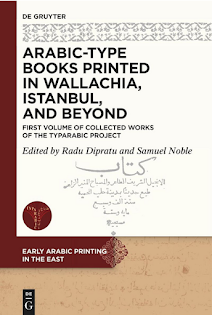
Around 1700, Athanasios Dabbas travelled to Wallachia several times and was hosted by Prince Constantin Brancoveanu (1688-1714). The Romanian ruler helped him print the first church-books in Arabic script, asking the scholar and master engraver Antim Ivireanul ('the Iberian') to carve a set of Arabic types. Two books were printed in Wallachia in Greek and Arabic: a Liturgikon (Al-Qondaq al-falahi, 252 pp.) in 1701 (Snagov), and a Book of Hours Kitab al-Sa 'at, 711 p.) in 1702 (Bucharest). When leaving the Wallachian capital in 1705, Dabbas received from Brancoveanu the Arabic types and printing implements, installing them at the Metropolitan residence of Aleppo. Eleven books were printed there between 1706 and 1711: the first was the Psalter (Kitiib al-Zabiir al-sarifi, showing on the first page Brancoveanu's coat of arms. Then followed the Gospels (Kitab al-Ingil al-Sarif alTahir wa-l-misbdh al-munir al-lahiry, the Book of the Chosen Pearls (Kitab al-durr al-muntahab) enclosing 34 homilies by St. John the Golden Mouth, and in 1708 a second edition of the Gospels, the Book ofProphecies, the Apostle, a.s.o. These books were later edited again and again in the printing-shops of Lebanese Christians.


In 1745-1747 Patriarch Silvester of Antioch addressed the Prince of Moldavia Ioan Mavrocordat for help in printing books for the Christian Arabs: the Liturgikon, the Aleppo Psalter and several polemical works (among them, The Proof of Truth and Transmission of Justice by Patriarch Nectarios of Jerusalem that Sylvester had translated in 1733 as Qadii al-haqq wa-naql al-sidq). In a recent book devoted to the life and works of Patriarch Athanasios III Dabbas, A. C. Dabbas stated that Patriarch Sylvester re-installed in 1747 at the Metropolitan residence of Aleppo the old press brought by his ancestor. A fourth episode, less documented, is the establishment by the Christian Arabs of the first press in Beirut after 1750, transferring the old one from Aleppo. A symposium held in Bucharest last year addressed the issue of the Romanians' contribution to printing in the Balkans and the Near East, including a paper, by this author, about the Arabic books printed in Wallachia and Syria before the middle of the 18th century. Whatever the particulars of these events (still under scrutiny), they resulted in a transfer of printing technology and know-how from Wallachia and Moldavia to Aleppo and neighbouring areas. Thus, European culture, in its Romanian forms, was "imported" in the Near East in order to fulfill the Christian Arabs' needs, similar to those of all the Sultan's subjects.

At the present time, the model of living together that Christian Arabs and Muslims of the Near East have provided for centuries is becoming increasingly interesting. Long before it was promoted by missionaries sent from Rome, the dialogue between Christianity and Islam was lived effectively, on a daily basis, by the multi-confessional Arab communities of the Eastern Mediterranean lands. Nowadays when attitudes towards Near Eastern peoples are constantly reappraised, the progress of this research is encouraged by an increased interest of the scholarly circles for the Christian Arabs, a diverse but neglected community, spread all over the world. By completing the projects that I have mentioned, Romanian researchers have the opportunity to participate in a truthful and more detailed definition of the Christian Arab civilization in its relationship with South-East Europe.

Tuesday, August 24, 2010

Our Lady of the Wind


The Arabic original, by Jirji Sassine can be found here.


Our Lady of the Wind

Patron of the Church of Our Lady of the Wind, Enfeh al-Koura

The nuns of Our Lady of Kaftoun painted this icon in December 2001, at the request of the parish of Enfeh, and after having shown preliminary designs to fathers and theologians who gave their blessing. It is an offering from Michel Faiz Touma, for his parents the reposed Faiz and Nejmeh. It measures 90cm by 60cm and it was consecrated by Fr. Zakhour Nimeh, the parish priest of blessed memory. The feast of Our Lady of the Wind is the Feast of the Annunciation, where it takes the place of the icon of the Annunciation, and below it most of the image is the sea and fish (the Feast of the Annunciation is connected to permission to eat fish despite the fast).

An explanation of the icon “O Virgin, calm the tumult of our passions and quiet the storm of our sins…” (from the Paraklisis to the Theotokos).

This is the message of the icon of the Theotokos, Our Lady of the Wind and what is written underneath it. She is lifting up the prayers of the faithful who are drowning in the sea of sorrows and the tempest of temptations to the Lord Jesus who is always present and watching from heaven, which is represented by the sky-blue circles amidst the golden background. He blesses with both His hands in response to the intercession of His mother the sailors who struggle amidst the waves that toss about the fishing boat (and the boat is a symbol of the Church). He leads them to the shore, the place “below the wind” north of Ras Qal’at Enfeh where the church of Our Lady stands. They seek refuge under her serene protection, far from the storms and whirlwinds coming from the sea (a symbol of death and the world of darkness where the dragon plays (the psalm of vespers). The whirlpool which appears along our coasts in the winter is still called “the dragon” by local fishermen and this is reflected in the icon by depicting the storm in this form), from the southwest across from the cliff, but the Theotokos Our Lady of the Wind is standing next to her church, lifting up her left hand in supplication to her divine Son to preserve her children, while with her right hand she repels from them the storm coming from afar.

The icon goes from nature to the site of the church of Our Lady where the bay “below the wind”, which during most of the days of the year is protected from the southwesterly winds which cause storms and batter the cliff. The icon goes from the calm bay which forms a natural harbor for fishermen to the spiritual reality where Our Lady takes those who seek her intercession under her protection.

In the details, the waves appear as a spiral of the colors of the sea and the sky, and this is in imitation of the style of the extant mural icons in the church of Our Lady of the Wind, which probably go back to the twelfth century. They reflect the ambiance of the local sea and among them are fish, so often mentioned in the tradition of the Church.

Likewise palm trees, which decorate the coastline since Phoenician times, are mystically connected to the Virgin (in the Song of Songs and the Akathist) surround the church.

She is the Virgin Lady, the Theotokos who is honored by the faithful in the village and the surrounding region. And here are the ancient churches forming a ring around her church: from the right St. Simeon, St. Michael, and St. Katrina and from the left St. George and the Monastery of St. John the Baptist. Likewise she is surrounded by her monasteries: Deir al-Nouriyyeh drawn at the top of the cliff in the background along with the site of the ancient monastery in the middle of the mountain where Abd al-Masih al-Enfawi practiced asceticism and from which the light of the Virgin shined forth, according to the tradition of the monastery’s name. At the end of the peak is the church of St. Simeon the Stylite. As for the monasteries and shrines to Our Lady in the region for which there was not room to draw in the icon, they are present in a hidden way, and to complete the list they are: Our Lady of the Seas in Batroun, the Horshiyyeh Cave in Hamat, the shrine of al-Rihaniyyeh in Hari, al-Za’tariyyeh in Shaka, al-Zurou’ in Kfarhazim, Sayyidat Fi’, Our Lady of the Spring (al-Na’oura), Sayyidat al-Bazizat (the Nursing), Sayyidat al-Qutrubiyyeh in Enfeh, Sayyidat al-Khazaib in al-Harisha, the Monastery of Our Lady of Balamand, and Deir Sayyidat Natour, where the perspective of one looking at the icon stands.

She is the Virgin who herself saves through her intercessions all those sailing through the storms and waves on the sea of life.

She is the Lady of all places—land, sea, and air and is constantly present and protecting all who honor her. Through her intercessions, O Lord, have mercy on us and save us, amen.

Monday, August 23, 2010

Final Report from the Holy Synod


The Arabic original can be found here. As always, this translation is my own and is not official. An unofficial French translation has also been released here.


Final report of the 46th Regular Session of the Holy Synod of Antioch, taking place in the Monastery of St. Christopher, between the 17th and the 20th of August 2010 under the leadership of His Beatitude Ignatius IV.

On Tuesday August 17, 2010 the regular session of the Holy Synod of Antioch was held, lasting until Friday August 20, 2010, under the leadership of His Beatitude Ignatius IV (Hazim) and in the presence of the Fathers of the Synod of Antioch, the metropolitans of the nation and the emmigration. They studied an agenda related to pastoral and ecclesial matters and adopted appropriate decisions related to them.

First, the Synod listened to a detailed presentation by Dr. Elie Salem, president of Balamand University. During it, he explained how the university is developing on the academic and administrative levels. At the end of the presentation, the Fathers thanked Dr. Salem for what he undertakes with the working team at the university and they affirmed the necessity that the university continue fulfilling its role showing the Church's mission of service to all the children of the nation.

This was followed by a presentation by Dr. Georges Nahas, dean of the St. John of Damascus Theological Institute, which covered academic, spiritual, and administrative aspects, especially the new education program and modern and accepted methodologies. He likewise indicated the development of the master's program and the bachelor's in religious studies, and the fathers affirmed the necessity of connecting theological knowledge with pastoral experience so that the priest can bear the image of Christ the Good Shepherd into the world. They also formed a synodal committee to assist the patriarch in overseeing the affairs of the institute.

Pastoral care was a significant concern at this session, and on the second day the Fathers approved of a text prepared by Metropolitan Georges (Khodr) for a pastoral guide for priests to rely on in carrying out their pastoral, apostolic, and sacramental service. The guide contains texts reflecting the pastoral reality that priests live today. This guide, which covers a variety of topics in a simple style, treats in detail situations every priest faces. The guide pays close attention to the steadfastness of Antiochian tradition and reflects modernity. It calls for reliance on the principles of performing the sacraments in the Church while it pays close attention to the circumstances of pastoral practice in all other matters.

After that, the Fathers considered the status of youth work in the See of Antioch, and agreed to clarify the role of the clergy and laity in receiving all the gifts of the Holy Spirit for the sake of unity and peace in the Church. This relationship is based on the fatherhood of the bishop and his assistants and on the sonship of the faithful within the one Church.

With this goal in mind, His Beatitude commissioned the Holy Synod to form a committee under his leadership for the organization of pastoral and educational work on the level of the entire patriarchate.

The Holy Synod hopes that God will inspire all with the purposes of the Lord in the cooperation of all His children, so that love and respect will prevail in the establishment of normal relations between all the members of the Holy Church. The Synod is confident of a renewal of spiritual life for all and it remains clear that the responsibility of Christian education for everyone is the responsibility of the bishop and his leadership, along with the participation of those who have competencies for helping him in this.

The Fathers then listened to a report by Metropolitan Philip (Saliba), Metropolitan of the Archdiocese of North America about the status of the Archdiocese and aspects of apostolic and pastoral work there, indicating the development of the Archdiocese in all fields.

On the third day, in light of a study prepared by Metropolitan Basil (Mansour) about the historical status of the bishop in the Orthodox Church, and after long and detailed discussions, the Fathers affirmed that the bishops of the Archdiocese of North America are auxiliary bishops (asaqifa musa3idun) assigned to dioceses and entrusted by the Metropolitan of the Archdiocese to dioceses. They are subordinate to their spiritual point of reference, the metropolitan of the Archdiocese, who has general authority over the whole Archdiocese.

The Holy Synod then listened to reports about pastoral work in the Archdioceses of Central and Western Europe, Mexico, and Argentina. They praised the work being undertaken there and asked the bishops of these archdioceses to continue their work for the Good of the Church and her development. On the basis of the widening of the work of the Archdiocese of Central and Western Europe into the countries of Scandinavia, the decided to change the name of the archdiocese to "the Archdiocese of Europe".

On the fourth day, the Fathers listened to reports about the preparatory meeting for the general Orthodox council which took place in Chambesy- Geneva and also to reports about the meetings of the Orthodox Churches which took place in the countries of the diaspora and especially in North, Central, and South America. They raised up prayers that the mutual Orthodox work might bear fruits to the glory of Jesus Christ and the good of the Church.

After that, they went on to study the topic of Orthodox-Catholic dialogue and the stages it has reached. They affirmed the desire and effort of the Church of Antioch for the realization of the greatest possible closeness between the two churches, especially on the levels of daily witness and service to the weak. They formed a new Antiochian committee to pursue this dialogue.

Finally, they listened to a report from His Eminence Boulos (Yaziji) about the status of plans for Orthodox media and they asked His Eminence to continue work on the next stage.

The session did not end without the Fathers affirming that the the pastors of the Church are from beginning to end shepherds of the People of God, who suffers the difficulties of life and hard circumstances, and that they continue to be watchful in bearing these children of who thirst for the Word of God in the first of their paternal priorities, supplicating God to bless this good flock and its worship, and to increase upon it grace and blessings.


After the end of the meeting, His Beatitude sent a letter to the President of the Republic, Dr. Bashar al-Asad, the text of which follows:

Honorable Dr. Bashar Hafez al-Asad, President of the Syrian Arab Republic

After the best prayers for your preservation,
We lift up greetings and prayers for your honorable position on the occasion of the session of the Holy Synod of Antioch in Seidnayya. Their Eminences, the members of the Synod join me in doing this.

I express my great gratitude to you for this meeting which expresses your love for our Church and your regard for it as the national church par excellence. This makes us even more confident of our deeply-rooted existence in this country so dear to our hearts, Syria.

We repeat our prayer to God, may He be exalted, for your continual health and success.

Ignatius IV, Patriarch of Antioch and all the East